
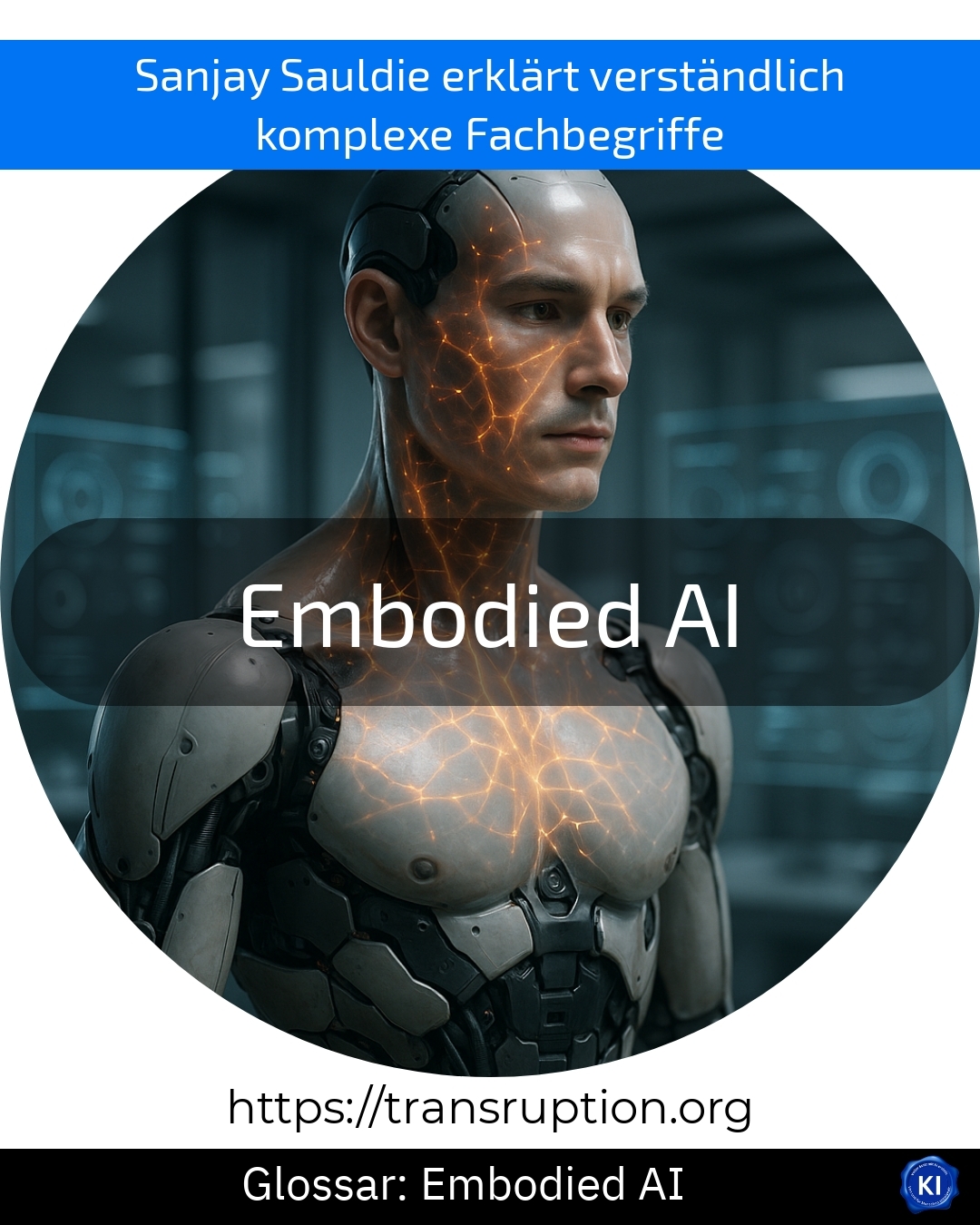
Embodied AI is primarily at home in the fields of artificial intelligence, robotics, and industry and Industry 4.0. The special characteristic of Embodied AI lies in the fact that artificial intelligence not only thinks but also „acts“ in a physical body. This means that an AI interacts with the real world via a robot or other machines, for example, by grasping, driving, or navigating.
Unlike traditional software AI, which merely analyses data or gathers experience from digital environments, Embodied AI learns directly from real experiences in physical space. A common example is a robot in a factory that, using Embodied AI, independently recognises how it needs to grasp, turn, and pass on a product – similar to a human. This allows it to adapt to new products or changing workflows without needing to be reprogrammed each time.
Embodied AI offers greater flexibility and efficiency in automation processes. It relieves people of monotonous, but also dangerous tasks, and allows machines to „think along“ and „feel along“ – a big step for the smart industry of the future.











 Deutsch
  English (UK)