
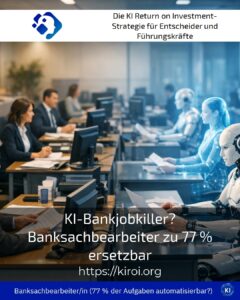
Could your professional activity in the procurement and management of goods and services soon be taken over by intelligent systems? This question is currently occupying numerous professionals in administrative positions. Purchasing clerk AI is fundamentally changing the world of work. Intelligent algorithms and automated processes are finding their way into offices and departments. They take over routine tasks and make independent decisions. This development affects millions of employees in Germany.
Insights on this topic come, amongst others, from the Job Futuromat of the Institute for Employment Research [1]. This innovative tool analyses the automation potential of various job profiles. The results clearly show how strongly technological systems are pushing into administrative areas. If you work in this field yourself, there is a solution. Attend the AIROI seminars to future-proof yourself [2]. You can find the dates on Sanjay Sauldie's aforementioned website. There you will receive valuable insights and practical strategies for dealing with this transformation.
The digital revolution in administrative procurement
The transformation in the world of work is taking place faster than many experts expected. Intelligent systems can now automatically trigger orders and independently process supplier enquiries. They compare quotes in a fraction of a second and identify the most favourable terms. Furthermore, these technologies monitor inventory levels and forecast future demand. The purchasing clerk AI achieves an impressive level of accuracy.
Let us first consider the specific fields of application in daily practice. In the area of quotation entry, algorithms scan incoming documents and extract relevant data. Invoice audits are carried out automatically by comparing them with orders and delivery notes. Deadline monitoring and dunning processes run without human intervention. In addition, chatbots handle communication with suppliers for standard enquiries. These examples illustrate the extent of technological penetration.
Master data management represents a further area of application. Systems update supplier information autonomously and correct errors in databases. They identify duplicates and clean up address data without human intervention. In the area of goods receipt recording, scanners and algorithms work hand in hand. Order quantities are reconciled with actual deliveries and discrepancies are reported automatically.
Best practice with a AIROI customer
A medium-sized retail company was faced with the challenge of modernising its procurement processes. The department handled hundreds of inquiries and orders every day. Employees spent the majority of their time on repetitive tasks such as data entry and document verification. As part of the AIROI accompanying programme, we jointly developed a strategy for intelligent process optimisation. First, we analysed all workflows and identified automation potentials. We then accompanied the gradual introduction of intelligent assistance systems. The specialists were not replaced, but rather given new, more demanding tasks. From then on, they concentrated on strategic supplier relationships and contract negotiations. Within a few months, employee satisfaction rose significantly. The error rate for orders fell by more than half. At the same time, processing speed increased considerably. This example shows how transruptions coaching acts as guidance for such projects. The solution did not lie in displacing people, but in further developing them.
What tasks are intelligent systems already taking on today?
Automation is encompassing various core areas of administrative procurement work. Standardised processes with clear rules and recurring patterns are particularly affected. Order placement at defined minimum stock levels has long been carried out without human intervention. The same applies to the recording of product categories and item master data.
In the field of supplier correspondence, intelligent systems are increasingly taking over tasks. Enquiries regarding delivery dates are automatically generated and sent. Order confirmations undergo automated checks for compliance. Complaint letters are created on the basis of predefined templates and situational analyses. The purchasing clerk AI continuously learns from past communication histories.
Payment approvals and budget monitoring also fall within the scope of automation. Systems check invoices for compliance with contractual agreements. They identify price discrepancies and escalate them to the relevant departments. Furthermore, they generate automated reports on expenditure trends across various product groups. These analyses frequently support strategic planning.
Concrete process examples from everyday procurement
Imagine a typical working day in a purchasing department. Office supplies are ordered via a system that analyses consumption and triggers reorders. Contracts are managed digitally and renewal deadlines are monitored automatically. Supplier evaluations are generated through the analysis of quality metrics and adherence to delivery dates.
Another example concerns the preparation of tenders for regular procurement. Intelligent algorithms create bills of quantities based on historical data. They identify potential suppliers and send out requests. The incoming bids are recorded in a structured manner and evaluated according to defined criteria. Humans then make the final decision based on processed information.
Similar developments are evident in the procurement of production materials. Bills of materials are evaluated automatically and requirements are calculated. Safety stocks adjust dynamically to production fluctuations. Bottlenecks are identified early and alternative sources of supply are suggested.
The AIROI strategy for future-proof procurement skills
Given these developments, many employees are wondering how they can strengthen their position. The answer lies in the targeted development of skills that machines cannot replace. Strategic thinking, negotiation skills and relationship management remain human domains. The AIROI seminars provide impetus on how you can systematically develop these skills.
Transruptions coaching supports you in your personal transformation. It is about shaping collaboration with intelligent systems. Clients frequently report initial uncertainty caused by technological changes. During the coaching process, however, they develop new perspectives and courses of action. They recognise opportunities that arise from the automation of routine tasks.
A central element of the strategy concerns the role as a human-machine interface. Professionals must learn to critically evaluate the results of intelligent systems. They take responsibility for complex decisions that involve ethical or strategic aspects. In addition, they actively help shape the further development of automated processes.
Best practice with a AIROI customer
A procurement professional turned to us with specific concerns about her job security. Management had announced plans to rely more heavily on automation. As part of the AIROI support, we first analysed her individual skills profile. Together, we identified strengths in supplier communication and problem-solving. These abilities formed the basis for a repositioning within the company. The individual increasingly took on tasks in the area of strategic supplier management. She conducted contract negotiations and expanded relationships with key suppliers. At the same time, she helped implement new procurement systems. Her wealth of experience fed into the design of automated processes. The result was a significant upgrade to her professional position. The initial fear of job loss gave way to a constructive shaping role. This example illustrates how AIROI impulses can support people during professional transformation.
View procurement AI as a partner rather than a competitor
The perspective on intelligent systems significantly determines the success of collaboration. Those who perceive technology as a threat close themselves off to the possibilities. Those who view it as a tool can harness its strengths for themselves. The purchasing clerk AI frees one from monotonous tasks and creates space for value-adding work.
Let us consider an example from the practice of strategic procurement. A system takes over the analysis of market price trends and creates forecasts. The specialist uses this information to develop negotiation strategies. They conduct personal discussions with suppliers and conclude advantageous agreements. The result of this cooperation exceeds what human or machine could achieve alone.
Similar synergies are evident in the area of supplier development. Algorithms identify quality issues by evaluating complaint data. Humans interpret this information and develop action plans. They hold discussions with suppliers and agree on improvement steps. Progress monitoring is, in turn, partially automated.
Future scenarios for administrative procurement activities
Technological development will continue to advance rapidly in the coming years. Voice-based systems will fundamentally change interaction with procurement platforms. Complex analyses will be carried out through simple verbal requests and answered immediately. Forecasting models will become increasingly precise, enabling proactive procurement strategies.
At the same time, completely new fields of activity are emerging in the procurement sector. The management of automated systems requires specific competencies. The development of algorithms for procurement decisions requires expert knowledge. Ethical questions regarding automated supplier selections must be evaluated by humans. Ensuring compliance requirements remains a human task.
In the field of sustainability, additional areas of action are opening up. The evaluation of supply chains based on environmental and social criteria is gaining in importance. Systems can collect and analyse data, but the strategic direction is set by people. Communicating sustainability goals to suppliers requires emotional intelligence.
My AIROI Analysis
The transformation of administrative procurement activities through intelligent systems is no longer a distant vision of the future. It is already taking place today in numerous companies and will continue to accelerate. The automation potentials mentioned clearly show which task areas are particularly affected. At the same time, new opportunities are arising for people who actively adapt to these changes.
The AIROI strategy provides a structured framework for this personal and professional development. It helps professionals identify and build upon their unique human strengths. It is not about competing with machines, but rather about optimising collaboration. People who actively help shape this transition will emerge from it stronger.
The seminars, lectures and workshops of the AIROI series provide practical momentum for the procurement sector. They demonstrate ways in which administrative professionals can redefine their role. The focus is on strategic skills, relationship management and critical thinking. These abilities will remain indispensable even in an increasingly automated world. Those who act now are securing their professional future sustainably.
Further links from the text above:
[1] Job-Futuromat of the Institute for Employment Research
[2] AIROI seminars – live events with Sanjay Sauldie
For more information and if you have any questions, please contact Contact us or read more blog posts on the topic Artificial intelligence here.







 Deutsch
 English (UK)