
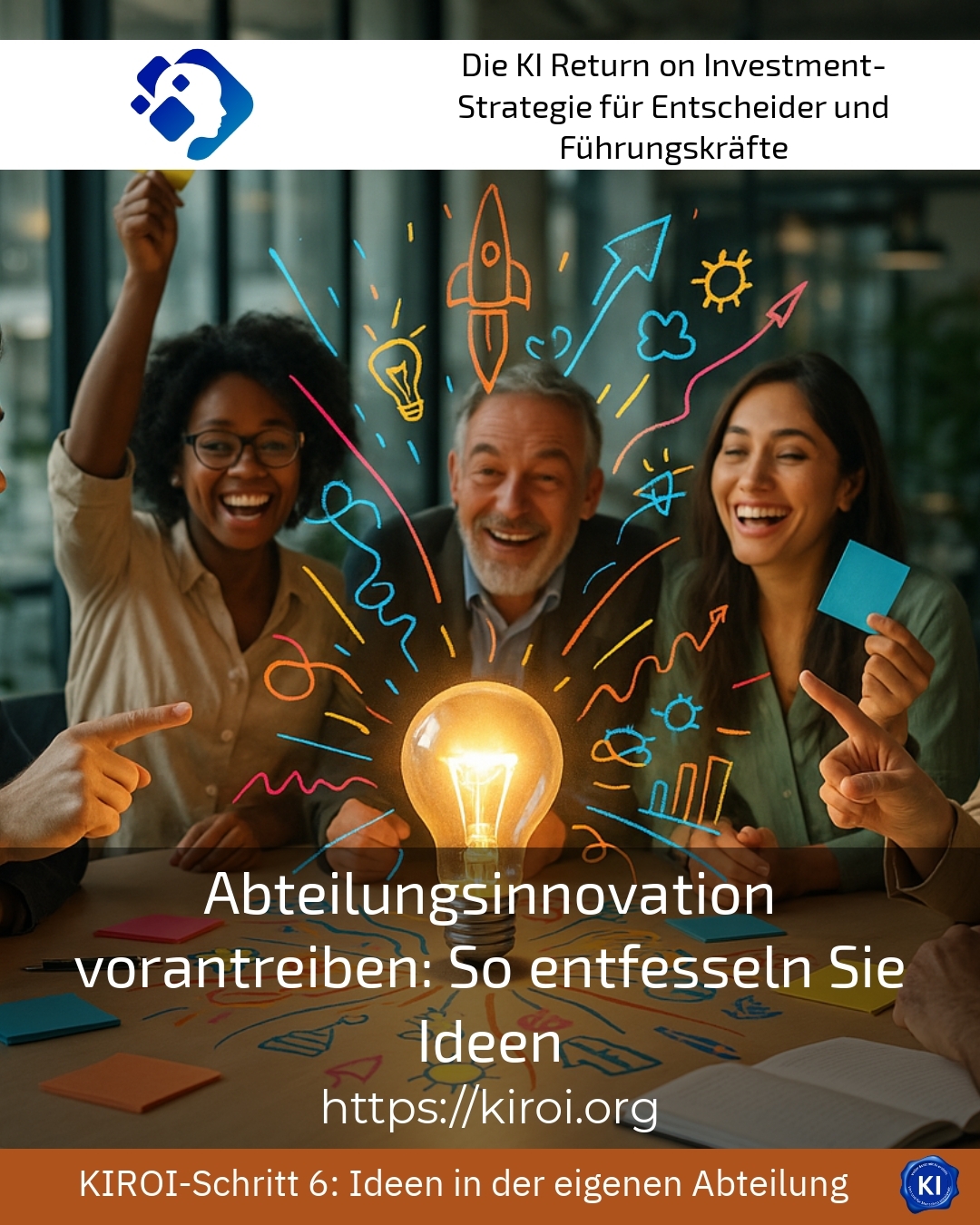
Imagine your department transforming into a living organism that generates new solutions every day while overcoming boundaries that other teams have long accepted. The potential for Driving departmental innovation slumbers in every organisation, yet few understand how to systematically awaken this potential and utilise it sustainably. In an era where change is the only constant, the ability to achieve continuous renewal determines the success or failure of entire business divisions. This article shows you concrete ways to unleash creative energy while proceeding in a structured manner.
Discovering the hidden power of collective creativity
Teams frequently underestimate their own creative ability. They remain stuck in ingrained patterns and overlook valuable opportunities in the process. For example, a medium-sized family-run business in mechanical engineering realised that its service technicians received customer feedback every day that was never systematically evaluated. Following the introduction of a simple digital recording method, three new product improvements emerged within a few months [1]. The situation was similar at a logistics service provider, whose warehouse workers suggested a change to the order-picking sequence. This change reduced turnaround times by a remarkable fifteen percent.
The challenge lies in translating these everyday observations into structured improvement processes. Many leaders come to coaching with precisely this concern. They report brilliant individual ideas that get lost in day-to-day business. They describe frustration among dedicated employees whose suggestions fall on deaf ears. They are looking for methods to channel creative impulses without suffocating them.
Transruption coaching accompanies companies through such projects with a holistic approach. It is not about presenting ready-made solutions. Rather, the support helps them to recognise their own strengths and develop them systematically. Through this form of collaboration, a pharmaceutical company discovered that its research department possessed informal networks that were more valuable than any formal project structure.
Best practice with a AIROI customer
An international technology company approached us because its development department was no longer producing ground-breaking innovations despite having highly qualified specialists. Analysis revealed that rigid hierarchies and a pronounced blamestorming culture were stifling creative approaches in the bud. Together, we developed an experimental space where teams could test new concepts without the pressure of having to justify themselves. Within six months, twelve prototypes were created, three of which were adopted into product development. Particularly noteworthy was the changed atmosphere in team meetings, which were now characterised by curiosity rather than defensive thinking. Managers learned to ask questions instead of giving instructions. Employees reported increased motivation and a new sense of appreciation for their ideas. As a result, the company established a permanent innovation lab, which continues to operate successfully to this day and regularly delivers market-ready concepts.
Driving departmental innovation through psychological safety
Creativity requires a safe space where mistakes are regarded as learning opportunities. Research shows that teams with high psychological safety generate significantly more viable ideas [2]. This finding contradicts the widespread belief that pressure and competition produce the best results. An insurance company discovered that its claims department was able to significantly increase processing quality after introducing a fear-free feedback system. Staff now dared to address ambiguities rather than sweep them under the rug.
The creation of such spaces requires conscious management decisions and consistent action. An automotive supplier implemented weekly experimentation times in which production employees could implement their own ideas for improvement. The results exceeded all expectations. Within a year, the teams submitted over sixty viable optimisations. A retail company took a similar path and enabled its store managers to independently test local range adjustments.
Clients frequently report that they were initially sceptical about such spaces for autonomy. They feared a loss of control or inefficient resource utilisation. transruptions coaching provides impetus on how structured freedom can be combined with entrepreneurial responsibility. It guides leaders in reflecting on their own mindset and changing it authentically.
Establish methods for idea generation within departments
Structured creativity processes form the backbone of sustainable renewal. Design Thinking, Lean Startup and agile methods provide proven frameworks [3]. A telecommunications provider combined various approaches to create an in-house innovation system. This system enabled every department to develop and evaluate improvement projects according to uniform standards. An energy supplier used similar structures to revolutionise its grid planning.
Implementing such methods is best achieved through practical experience. Theoretical training alone rarely brings about lasting behavioural changes. A chemical company therefore started with pilot projects that addressed specific departmental problems. The teams got to know the new tools using real challenges. A financial services provider chose a comparable approach and had its customer advisors actively participate in the development of new advisory formats.
The art lies in choosing the appropriate methods for the respective context. Not every tool is suitable for every situation or corporate culture. transruptions coaching supports this selection and helps to deploy existing resources optimally.
Driving digital tools as catalysts for departmental innovation
Technology can significantly accelerate and democratise creative processes. Idea management platforms enable the structured capture and evaluation of suggestions for improvement [4]. A retail group used such a platform, which recorded over three thousand submissions from all areas of the company within a year. A manufacturing company used Artificial intelligence, to group incoming suggestions by theme and identify duplicates.
Collaboration tools foster communication across departmental boundaries. A media company discovered that its best ideas emerged at the interfaces between editorial, technology and sales. Through the use of appropriate digital tools, this effect was significantly amplified. A healthcare provider connected nursing staff, doctors and administrative personnel via a shared platform. The quality of patient care measurably improved as a result of this enhanced collaboration.
Data analytics supports informed decisions regarding innovation projects. A construction company systematically evaluated which project types generated the most improvement ideas. These insights were incorporated into the strategic direction of the company. A food manufacturer used customer feedback data to direct its product development more purposefully.
Best practice with a AIROI customer
A medium-sized corporate group in the building services sector sought support with the digital transformation of its innovation processes. The individual business units were working in isolation and, in some cases, developing redundant solutions for similar challenges. Together, we designed a company-wide platform that made ideas transparent and enabled cross-departmental collaboration. The key to success lay not in the technology itself, but in the accompanying cultural change. Managers learned to actively look for synergies and promote cooperation. Employees developed trust in the new process and began to share their thoughts openly. After one year, the company recorded a threefold increase in implemented suggestions for improvement while simultaneously reducing development costs by around twenty percent. The executive board emphasised that external support was crucial in overcoming resistance and bringing everyone along.
Leaders as enablers of creative development
The role of leadership changes fundamentally when creative development becomes a strategic goal. Managers become enablers instead of controllers. A software company trained its team leaders in coaching conversational techniques. Employee satisfaction increased, as did the quality of the solutions developed. An industrial group established a reverse mentoring programme in which younger specialists trained executives in new technologies.
Role modelling plays a crucial role in cultural change. A board member of a service company began to communicate their own poor decisions openly. This transparency encouraged employees at all levels to take risks and learn from failures. A retail company introduced regular Failure Fridays, during which failed projects were analysed without allocating blame.
Transruption coaching supports leaders in this personal development. It provides impulses for new behaviours and helps to break old patterns. Many report that this guidance helped them to lead more authentically and strengthen their teams.
Ensuring the sustainability of creative processes
One-off initiatives quickly fizzle out if they are not systematically anchored. A consumer goods company integrated creative objectives into its regular performance appraisals [5]. A technology corporation tied bonus payments partly to the quality of submitted improvement suggestions. A logistics company established an annual award for the best departmental improvement.
Regular reflection cycles help to embed learning effects. A consultancy introduced monthly retrospectives in which teams analysed their work processes. A manufacturing company used quarterly reviews to celebrate implemented improvements and identify new potentials. A financial institution implemented a continuous improvement system based on the Japanese model.
Long-term embedding requires patience and perseverance. Cultural changes do not happen overnight. Transruption coaching helps companies to develop realistic expectations and build staying power.
My AIROI Analysis
The systematic nurturing of creative potential in departments is proving to be one of the most effective levers for sustainable corporate success. My analysis of numerous support projects shows that success depends less on spectacular individual measures than on the consistent implementation of fundamental principles. Psychological safety forms the foundation upon which all further measures can build. Without it, even the best methods remain ineffective because employees hold back their thoughts.
Digital transformation offers enormous opportunities to accelerate and scale creative processes. At the same time, practice shows that technology alone does not bring about a cultural shift. It requires people who use new tools with conviction and set an example. Leaders play a key role in this that cannot be delegated.
Particularly successful are companies that treat creative development as a strategic priority and provide corresponding resources. They understand that short-term efficiency optimisation and long-term capacity for renewal are in tension with one another. The art lies in balancing both goals and prioritising them according to the situation. Transruption coaching can offer valuable support here by encouraging leaders to reflect and opening up new perspectives. The journey to becoming a creative organisation is not a sprint, but a marathon. It requires stamina, courage and the willingness to leave familiar paths behind.
Further links from the text above:
[1] Harvard Business Review – Innovation Management
[2] Google re:Work – Team Effectiveness
[3] Design Council – Framework for Innovation
[4] McKinsey – Eight Essentials of Innovation
[5] MIT Sloan – Building a Culture of Innovation
For more information and if you have any questions, please contact Contact us or read more blog posts on the topic Artificial intelligence here.









 Deutsch
 English (UK)