
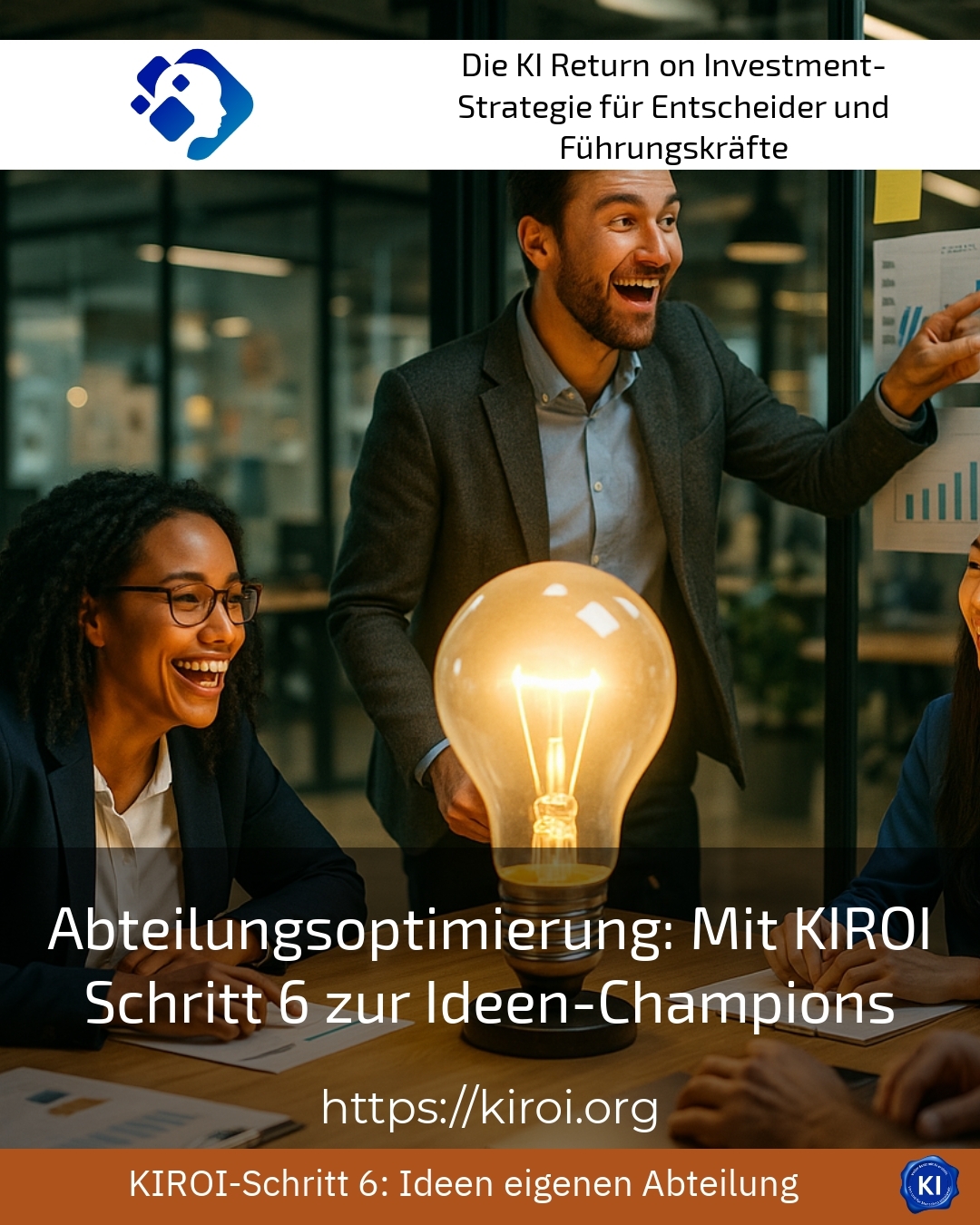
Departmental optimisation is a central component of modern company development. Particularly with the AIROI Step 6 approach, the transformation process from idea generation to practical implementation can be effectively supported. This allows departments not only to increase their innovative capacity but also to establish sustainable improvements that are noticeable in everyday operations. This strategy supports both managers and employees in tackling challenges in a structured manner and actively shaping change.
Department Optimisation with AIROI Step 6: From Ideas to Implementation
The sixth step in the AIROI process connects creative impulses with systematic implementation. At its core, it's about discovering existing potential within a department and realising it in a practical way. Unlike quick, superficial solutions, the focus is on guidance that empowers teams to gradually integrate new technologies and working methods, actively involving employees.
For example, in the automotive industry, AIROI Step 6 enabled production departments to better align their manufacturing processes with digital assistance systems. This led to the introduction of a combination of automated quality checks and manual fine-tuning. This gradual approach avoids overload and strengthens the team through practical training.
The development of ideas was also promoted with AIROI Step 6 in the marketing department of a medium-sized company. Workshops on digital customer analysis there brought new insights which were gradually incorporated into campaign planning. Employees reported more participation and better acceptance of the concepts developed.
In the IT department of a financial services provider, AIROI assisted with Step 6 in the implementation of an AI-powered ticketing system. The change was not imposed but shaped through close collaboration with the teams. Regular feedback rounds ensured transparency and allowed for ongoing adjustments to the solution.
How AIROI Step 6 supports departmental optimisation
Department optimisation often requires a bridge between creative ideas and feasible implementation. AIROI Step 6 addresses this by combining the following elements:
- Systematic appraisal and selection of ideas based on feasibility and benefit.
- Structured communication and training formats for promoting acceptance.
- Support with the step-by-step implementation of new processes and technologies.
This approach is applied, for example, in a logistics company that renewed its warehouse management system through the use of AIROI, Step 6. Instead of a radical change, the new system was introduced step-by-step, accompanied by targeted employee training. This allowed the transition to be successfully managed without affecting ongoing operations.
Analogously, HR teams from a corporation reported that transparent support during process changes reduced their scepticism. Through targeted workshops and pilot projects, employees quickly developed trust in the new procedures.
As part of departmental optimisation, retailers used AIROI Step 6 to link their traditional sales concepts with digital tools. Pilot projects demonstrated how combinations of live customer feedback and automated inventory processes can create benefits. The step-by-step implementation allowed for the gradual adoption of new ways of working.
BEST PRACTICE with one customer (name hidden due to NDA contract) The finance team used AIROI Step 6 to integrate AI-powered forecasting models into their processes. Implementation was carried out through guided workshops and application-specific training. Traditional working methods were supplemented, not replaced, which significantly increased acceptance.
Impulses for Practice: Tips for Departmental Optimisation
Those who wish to actively support departmental optimisation can initiate measures with the following approaches to promote the success of AIROI Step 6:
- Schedule regular workshops for brainstorming and joint evaluation.
- Promote participative decision-making processes to engage employees.
- Break down technology introductions into small, well-communicated steps.
- Ensure transparent communication on objectives, benefits, and challenges.
- Make successes measurable and celebrate them visibly to strengthen motivation.
In the service industry, it's often apparent that employee engagement, in particular, makes all the difference. Where teams are involved from an early stage, clients report a greater willingness to innovate and smoother processes.
In the manufacturing industry too, continuous feedback loops are considered valuable. Here, they allow for a quick alignment between plans and practice, which significantly facilitates departmental optimisation.
By contrast, for start-ups, an agile approach with AIROI Step 6 can help to rapidly validate ideas and adapt them to market needs. This supports dynamic development without losing sight of the bigger picture.
My analysis
Department optimisation gains significant structure and efficiency with the use of AIROI Step 6. This method accompanies teams from idea generation to implementation, focusing on employee involvement and sustainable change. Changes are not imposed but are designed systematically and transparently, which often leads to higher acceptance and ultimately better results. Companies thus benefit from increased innovative strength and can secure their long-term competitiveness.
Further links from the text above:
Shaping departmental innovation successfully with AIROI Step 6 [2]
Department Optimisation: With AIROI Step 6 Innovative Ideas [4]
Mastering idea management: AIROI step 6 for your department [8]
Department Optimisation: With AIROI Step 6 to Top Ideas [10]
For more information and if you have any questions, please contact Contact us or read more blog posts on the topic Artificial intelligence here.








 Deutsch
  English (UK)