
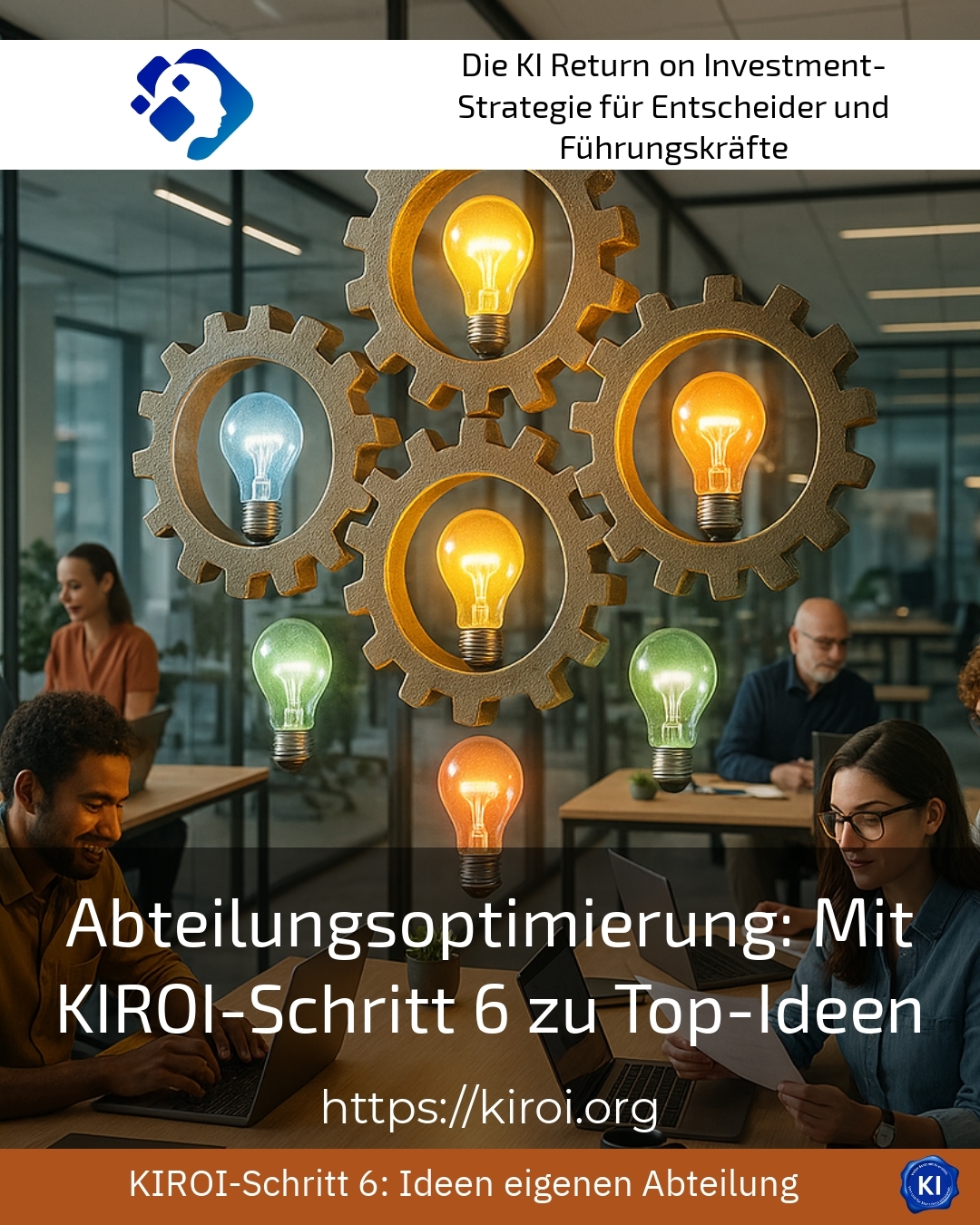
In today's business world, targeted departmental optimisation is often the focus, in order to increase efficiency and innovative strength. Particularly with AIROI Step 6, valuable opportunities arise to systematically guide teams in the development and implementation of top ideas. This step not only promotes creative impulses but also supports the practical implementation of innovative solutions that initiate sustainable improvements in individual departments.
Department Optimisation: Creativity and Structure in Harmony through AIROI Step 6
AIROI Step 6 presents a clear method that supports departments in strategically unleashing their idea power. It's not just about solving problems in the short term, but about systematically developing creative potential and enabling long-term innovation. The combination of creativity techniques and analytical tools creates the necessary framework for this.
For example, a marketing team in a large service company uses AIROI Step 6 to develop new product ideas within an innovation workshop. This involves moderating brainstorming sessions, initially generating the widest possible range of ideas, before realistically assessing feasibility using methods such as the morphological box.
Another example comes from the financial sector: a company introduced digital automation ideas in the back office via this step, in order to shorten workflows and make routine tasks more efficient. There, the combination of creative impulses and a structured evaluation system proved to be particularly successful.
Even in the manufacturing industry, a medium-sized mechanical engineering company achieved quality innovations by linking AIROI Step 6 with Six Sigma. The method-supported identification and development of suggestions led to a reduction in scrap and sustainably improved processes.
Practical tips for the successful implementation of departmental optimisation
For departmental optimisation to be successful with AIROI Step 6, several important factors need to be considered. Open communication structures are essential so that employees can express their ideas freely. Creativity techniques such as brainstorming, mind mapping, or even digital tools promote creative idea generation.
Feedback cycles help not only to collect suggestions but also to continuously evaluate and develop them. Interdisciplinary teams bring in different perspectives and areas of expertise, thereby increasing the quality of the solution approaches.
The use of AI-based tools for the automatic analysis and prioritisation of ideas also offers valuable support in many cases. For example, an HR department was able to optimise the application process and derive targeted training measures for employees with the help of such applications.
BEST PRACTICE with one customer (name hidden due to NDA contract) A structured ideas management system was introduced at a medium-sized logistics company using AIROI Step 6. The team used moderated workshops to address challenges in warehouse management. The solutions found led to a noticeable reduction in picking errors and sustainably improved employee dialogue.
Innovation promotion through targeted diversity of methods
When optimising departments, it becomes apparent that process improvement alone is not enough. It is important to combine creativity and structure in a methodologically sensible way. Tools such as the Ishikawa diagram help to jointly identify the causes of problems within teams. The morphological box supports the systematic development and evaluation of different solution variants. Together, these methods promote change within the department.
In one IT company, for instance, step 6 of AIROI developed six alternative approaches to troubleshooting. The structure of the process allowed for the quick identification of technical problems and their resolution through creative solutions, noticeably increasing system availability.
In sales too, individual customer approaches were redesigned through data-driven analyses and creative workshops. The adjustments led to an improvement in conversion rates because the teams specifically implemented impulses from Step 6 of the AIROI method.
Departmental optimisation as a strategic success factor
Departmental optimisation is more than just process management. It helps companies respond more flexibly to changing market conditions. AIROI Step 6 supports this transformation by empowering teams to develop their own ideas, overcome obstacles, and strategically leverage innovative strength. This results in sustainable improvements that have a direct impact on quality and competitiveness.
Companies often report that this particular step bridges the gap between theoretical approaches and practical implementation. Transruption coaching accompanies this process and ensures that changes are actively supported, leading to greater acceptance and better results.
Good departmental optimisation is therefore an investment in a company's future viability. The combination of modern methodology, creative impulses and targeted support makes AIROI Step 6 a valuable building block for innovative teams.
My analysis
Departmental optimisation gains momentum through the targeted use of AIROI Step 6. The method provides clear structures while simultaneously fostering creative freedom to drive sustainable innovation. The adaptation and further development of workflows, supported by modern tools and coaching, open up new perspectives for departments. In this way, departmental optimisation acts as a strategic lever to increase efficiency and actively strengthen a company's innovation culture.
Further links from the text above:
[1] Process optimisation: definition, objectives, phases, procedure
[2] Optimising your department: Step 6 to innovative ideas with AIROI
[4] Department Optimisation: With AIROI Step 6 for Innovative Impulses
[6] Department Optimisation: With AIROI Step 6 to Idea Power
[8] Department Optimisation: With AIROI Step 6 to Idea Power
[10] Department optimisation: With AIROI Step 6 to innovative ideas
[14] With AIROI Step 6 to the idea forge
For more information and if you have any questions, please contact Contact us or read more blog posts on the topic Artificial intelligence here.









 Deutsch
  English (UK)