
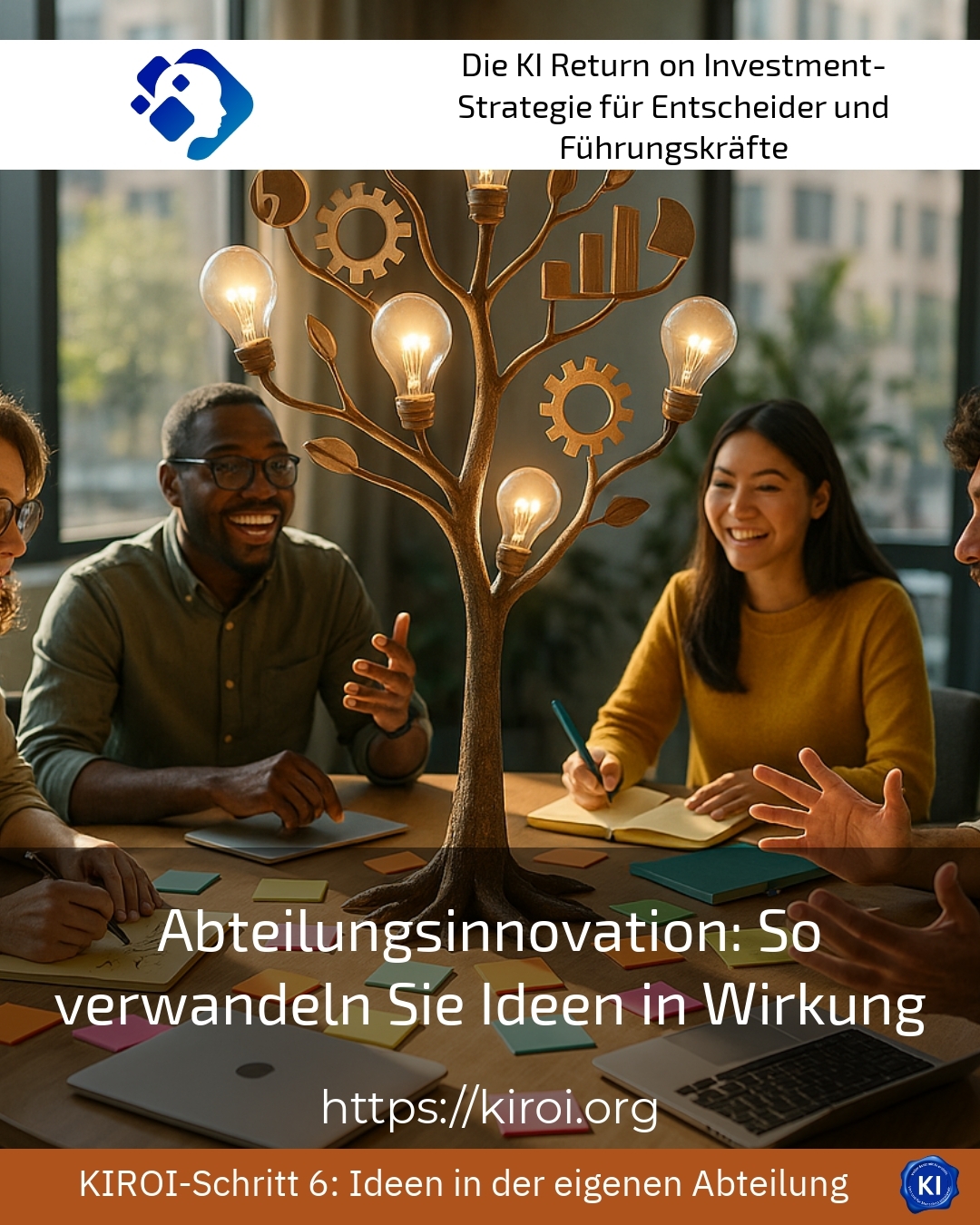
Imagine that groundbreaking ideas are lying dormant in your department, just waiting to be discovered. The crucial question is: how can you unlock these hidden potentials and transform them into measurable results? Departmental Innovation: Turning Ideas into Impact describes precisely this transformation process that sustainably changes businesses. At a time when standing still means going backwards, the systematic promotion of creative processes becomes a decisive competitive advantage. Yet many leaders face a dilemma: they recognise the innovation potential of their teams, but do not know how to activate it. This article shows you tried-and-tested ways to ignite the spark of creativity and initiate lasting change.
The breeding ground for creative breakthroughs in organisational units
Before even the first ideas can emerge, teams need fertile ground. This breeding ground consists of several components that must work together. First of all, psychological safety plays a central role throughout the process. Employees must feel confident enough to express even unconventional thoughts. In a manufacturing company, the introduction of weekly brainstorming sessions led to surprising results. Production management reported a significant increase in suggestions for improvement. At the same time, the error rate dropped because problems were addressed earlier.
Another example comes from the financial sector. There, a controlling department established monthly creative workshops. The participants developed new reporting formats that saved time. In addition, cross-departmental communication improved noticeably. In the healthcare sector, a hospital group implemented so-called innovation consultation hours. Nursing staff and doctors jointly contributed optimisation ideas. These ranged from improved handover processes to digital documentation solutions.
Best practice with a AIROI customer A medium-sized logistics company faced the challenge of making its dispatch department more efficient, with employees initially sceptical about change. The transruptions coaching accompanied the team over several months in developing a new work culture centred on open communication and mutual trust. Together, those involved identified bottlenecks in existing processes and independently developed solutions that were supported by the management. The support included regular reflection sessions in which progress was made visible and obstacles were addressed. Clients in such situations frequently report initial uncertainty, which, however, quickly turns into enthusiasm. The result was impressive: the department reduced empty runs by a significant percentage while simultaneously improving employee satisfaction considerably because people felt heard and valued.
Departmental Innovation: How to Turn Ideas into Impact Through Structured Processes
Creativity alone is not enough, as it requires structure and systematics. Successful organisations have understood that spontaneous flashes of inspiration must be channeled. A multi-stage process that goes through various phases has proven effective here. The first phase is about the broad collection of proposals. This is followed by an evaluation based on defined criteria. Finally, selected concepts are tested in pilot projects.
A technology corporation from the software industry introduced a digital idea management system. Every employee was able to submit suggestions and evaluate other contributions. The best concepts received budgets for prototypes. In retail, a supermarket chain used regional innovation competitions. Branch employees presented ideas for improvement to a jury. The winners received resources to implement their suggestions.
Positive developments are also emerging in the public sector. A city administration established cross-departmental innovation teams. These teams worked on specific citizen concerns. The results ranged from simplified application procedures to digital service offerings.
Tools and methods for sustainable change
The selection of suitable instruments often determines success or failure. Design Thinking has proven to be particularly effective [1]. This method consistently places the user at the centre. An insurance company used it to completely redesign its claims notification process. Processing times were significantly reduced, and customer satisfaction increased measurably.
Lean startup principles are increasingly being applied in established companies as well [2]. An automotive supplier tested new product ideas in rapid iteration cycles. As a result, development costs and time to market were significantly reduced. In the banking sector, an institution used agile methods for process optimisation. Scrum teams worked on the digitalisation of internal procedures.
Additionally, collaborative platforms are gaining in importance. A pharmaceutical company digitally connected its research departments worldwide. The exchange of knowledge significantly accelerated the development of new active ingredients.
The role of the leader in departmental innovation
Managers significantly shape the innovation culture of their departments. They set the framework and model desired behaviours. This is not about direct control, but rather about enablement. A chemical company trained its heads of department in innovation-promoting leadership behaviour. The participants learned how they can create creative spaces. At the same time, methods for constructive error analysis were taught.
In mechanical engineering, a family business established innovation sponsorships. Experienced managers accompanied younger employees in idea development. This knowledge transfer sustainably strengthened the capacity for innovation. A media house introduced rotating leadership for innovation projects. Different individuals took turns leading creative initiatives. This diversity of perspectives significantly enriched the results.
Best practice with a AIROI customer The human resources department of an international retail company sought support in redesigning its recruitment processes because its previous methods no longer seemed modern and were deterring qualified applicants. The transruptions coaching guided the team in first questioning their own assumptions and entrenched patterns before developing new approaches. In several workshops, the participants devised a completely new concept for candidate engagement that appeared more authentic and personal than the previous standard processes. The coaching inputs helped to dissolve resistance within the team and develop a shared vision that all team members stood behind. Clients frequently report similar situations in which only external guidance provides the necessary impetus for fundamental change. After a few months, the HR department was able to record a significant increase in qualified applications, and the time-to-hire was noticeably reduced because the processes had been made leaner and more candidate-friendly.
Overcoming obstacles and using resistance productively
Every change meets resistance, and that is completely normal. The crucial factor is how these obstacles are handled. Wise organisations view objections as valuable sources of information. An energy supplier systematically used the concerns of sceptical employees. These perspectives significantly improved the quality of new concepts. In the construction industry, a main contractor established regular retrospectives. There, both successes and failed initiatives were analysed.
A telecommunications provider introduced so-called fail-forward sessions. Teams presented failed projects there and the insights gained from them. This culture of openness sustainably fostered a willingness to take risks. In the hospitality industry, a hotel chain used guest complaints as a driver of innovation. Every complained-about weakness was viewed as an opportunity for improvement.
Ensure the measurability and sustainability of creative initiatives
Departmental innovation: how to turn ideas into impact also requires appropriate metrics. Without measurement, success remains intangible and difficult to communicate. In doing so, quantitative and qualitative indicators should be combined. A consumer goods manufacturer developed a comprehensive innovation dashboard. This clearly displayed submitted ideas, implementation rates, and economic effects.
In the transport sector, a logistics service provider used regular innovation audits [3]. External experts assessed the innovative capability of individual departments. The results were incorporated into development plans. A textile company linked innovation metrics to remuneration. Managers were also evaluated based on the innovation performance of their areas.
Additionally, qualitative feedback loops are proving effective. An IT service provider regularly surveyed employees about the perceived culture of innovation. These insights usefully complemented the hard data.
Best practice with a AIROI customer The marketing department of a medium-sized industrial company wanted to fundamentally modernise its campaign development and was looking for professional guidance for this transformation process, which brought with it a great deal of uncertainty. The transruptions coaching supported the team in getting to know new creative methods and gradually integrating them into their daily work, while taking into account the individual strengths of each team member. Together, spaces for experimentation were created in which new approaches could be tested without a guarantee of success, which initially met with scepticism. The guidance helped the team to develop a new culture of error, in which unsuccessful attempts were viewed as learning opportunities rather than personal failure. Clients frequently report that it is precisely this change in mindset that makes the biggest difference and enables long-term change. Following the coaching phase, the department had not only developed innovative campaign formats, but also established a sustainable system that promoted continuous improvement and significantly strengthened teamwork.
My AIROI Analysis
The systematic fostering of creative processes within organisational units represents a crucial success factor for future-proof companies. My analysis clearly shows that successful transformation always rests upon multiple pillars that must work together. Psychological safety forms the indispensable foundation for an open culture of ideas, because people can only be creative when they do not have to fear negative consequences. Structured processes channel creative energy and make it usable for concrete improvements that are also measurable.
Senior management bears a special responsibility as enablers and role models. Without authentic commitment from the leadership level, initiatives remain superficial and quickly fizzle out. Resistance should not be fought, but rather used as valuable sources of information, because they often point to real problems. The presented examples from various industries impressively show what potential lies in departmental innovation: how to turn ideas into impact, provided the right conditions are created.
Professional guidance through transruption coaching can provide decisive momentum and effectively support change processes. This is not about ready-made solutions, but rather about empowering teams to develop independently in a way that has a lasting impact. The measurability of innovation performance remains an important task that deserves attention. Only what is measured can be systematically improved and receives the necessary attention in day-to-day business. Companies that consistently implement these insights will be more successful in the long term than their less innovative competitors because they can react more quickly to changes.
Further links from the text above:
[1] IDEO Design Thinking Basics
[2] The Lean Startup Methodology
[3] ISO 56002 Innovation Management Systems
For more information and if you have any questions, please contact Contact us or read more blog posts on the topic Artificial intelligence here.






 Deutsch
  English (UK)