
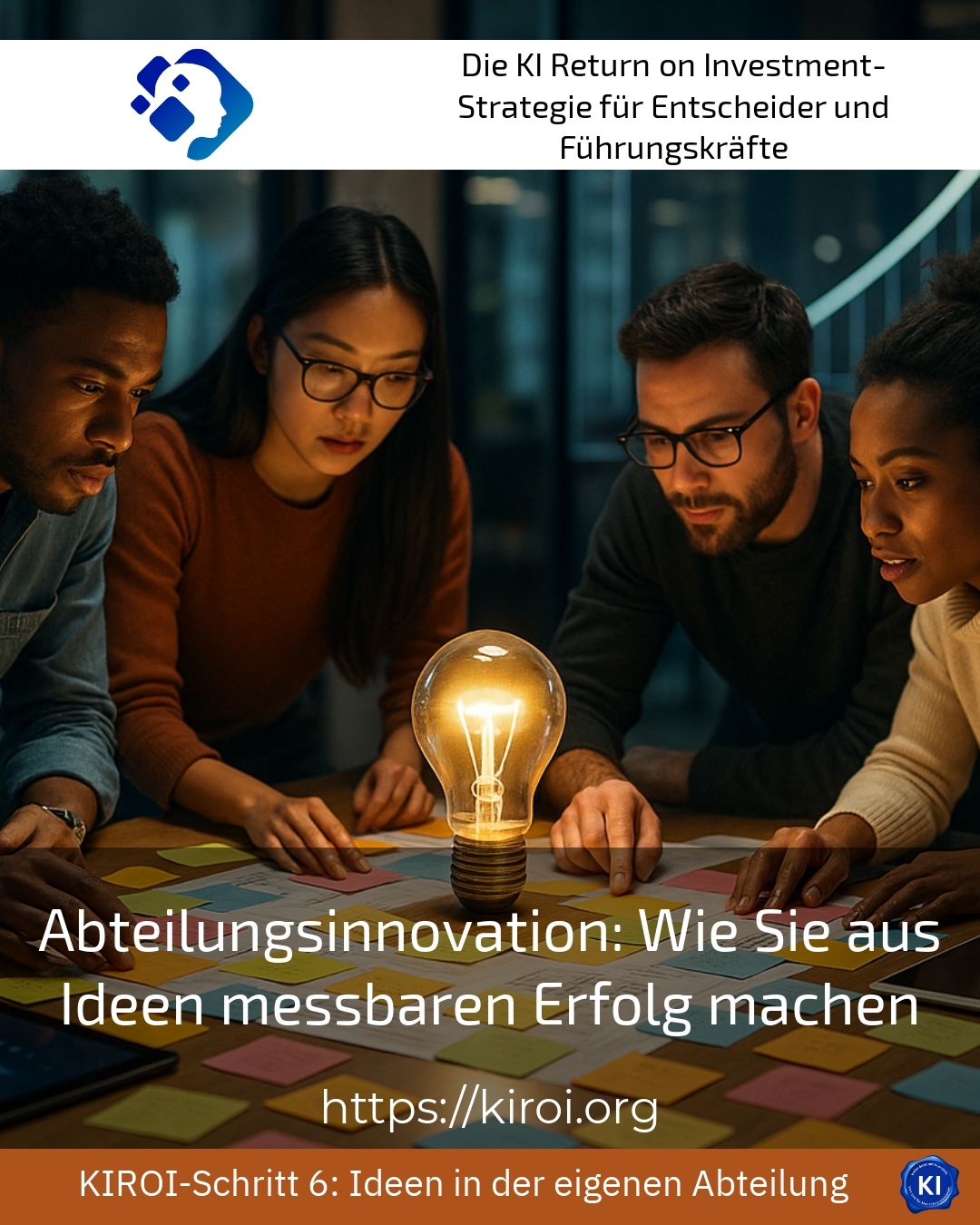
Imagine your department developing groundbreaking ideas that actually make a difference. This is exactly where Departmental Innovation: How to Turn Ideas into Measurable Success Many companies don't fail due to a lack of good ideas. They fail due to systematic implementation. The transformation of creative thoughts into economic results requires structured processes. Targeted support approaches and clear methodologies are essential for this. This article shows you practical ways to achieve this.
The road from idea to departmental innovation
Innovation processes often begin with spontaneous flashes of inspiration from dedicated employees. However, there are often worlds between an initial sketch and successful implementation. Many organisations have creative minds with exceptional visions. Nevertheless, structured frameworks are frequently lacking. These frameworks would accompany the development from concept to product. This is precisely why clients often report frustration within their teams.
For instance, a medium-sized logistics provider developed an innovative route optimisation system. The idea originated during an informal coffee break. Initially, it lay dormant in a drawer for months. Only through systematic support was its potential unlocked. Another example comes from a regional energy supplier. There, technicians identified inefficient maintenance cycles for transformer substations. Their suggestions initially got lost in bureaucratic approval loops. Through transruption coaching, those involved received impulses for better communication. A third company, from the mechanical engineering sector, faced similar challenges. Design engineers had identified improvements for manufacturing processes. However, these suggestions never reached the decision-making level.
Identifying and overcoming obstacles
Clients often come to counselling with recurring themes. Department heads report a lack of acceptance for their proposals. Team leaders describe a shortage of resources for development projects. Project managers lament unclear responsibilities for cross-departmental initiatives. These challenges can be addressed through targeted support. The KIROI methodology offers a proven framework for this.
Let's first consider an example from the pharmaceutical industry. There, a research department developed innovative analysis methods. However, management couldn't quantify their benefit. Without measurable key figures, investment approvals were withheld. A similar situation existed at an automotive supplier. Engineers optimised testing procedures for safety components. The quality department saw no immediate need for action. A chemical company, in turn, struggled with communication barriers between production and development. Suggestions for improvement rarely reached the right contact person.
Best practice with a KIROI customer
A company with a long tradition in industrial manufacturing faced a particular challenge. The production department had gathered numerous optimisation proposals over the years. These ideas lay dormant and unprocessed in various databases and file folders. Management recognised the untapped potential and sought support. Through disruptive coaching, a systematic stocktaking was first carried out. The team identified a total of sixty-three viable concepts from different areas. The next step involved prioritisation based on feasibility and expected benefit. Both financial and qualitative criteria played an important role. Employees received training to better present their proposals. At the same time, management established transparent evaluation criteria for all submitted ideas. Within six months, twelve projects were successfully launched. The savings exceeded the original expectations threefold. Particularly noteworthy was the increased motivation of the workforce. Employees reported a new culture of appreciation in their departments. The structured approach had initiated a cultural change throughout the company.
Measurability as the key to department innovation
Without clear key figures, innovation remains an abstract promise. Decision-makers need comprehensible data for approval. The definition of suitable metrics poses difficulties for many organisations. Transruption coaching supports teams in developing appropriate indicators. The methodology takes both quantitative and qualitative aspects into account.
A telecommunications company impressively illustrates this topic. There, the customer service department wanted to introduce new customer care concepts. Measuring customer satisfaction initially proved complicated. Through targeted support, the team developed meaningful survey instruments [1]. A financial services provider faced a similar situation. The compliance department had designed more efficient auditing procedures. Proving the time savings required precise documentation methods. Another example is a retail company with complex supply chains. The logistics department optimised warehousing processes without quantifiable proof of success.
Defining and applying KPIs effectively
Selecting appropriate performance indicators requires a deep understanding of corporate objectives. Too many metrics lead to confusion and a loss of direction. Too few indicators inadequately represent reality. The KIROI system recommends a balanced approach with a maximum of seven core indicators.
The quality assurance department in the food industry successfully used this approach. The team defined indicators for production scrap and complaint rates. The human resources development department of an insurance group focused on a different area. There, the focus was on employee satisfaction and training success. A construction company, on the other hand, concentrated on safety figures and project completion times [2].
Best practice with a KIROI customer
An internationally operating medical technology company approached us with a specific problem. The Research and Development department continuously generated promising product ideas. However, very few of these concepts actually reached market maturity. The average development time exceeded industry benchmarks by approximately forty percent. As part of our support, we first analysed the existing process structures. In doing so, we identified several bottlenecks in the approval procedures between different departments. Communication between Development and Regulatory Affairs proved to be particularly problematic. Through targeted workshops, we were able to clarify and document mutual expectations. The team developed a dashboard with five key performance indicators. These metrics included development time, resource utilisation, error rate, employee satisfaction, and degree of innovation. Regular review of these metrics enabled early course corrections. After one year, the average development time had been reduced by twenty-seven percent. The number of successful product launches increased by thirty-five percent in the same period. Employees reported increased job satisfaction due to clearer structures.
Cultural factors in departmental innovation
Technical processes alone do not guarantee sustainable innovation success. Corporate culture plays a decisive role in making ideas a reality. Employees must feel safe to contribute even unconventional suggestions. Tolerance of errors and constructive feedback form important cornerstones of an innovation-friendly atmosphere.
A software company recognised these connections after several failed initiatives. The development department shied away from radical suggestions for fear of criticism. This attitude fundamentally changed through cultural change support. A manufacturing company from the textile industry had similar experiences. The production management had established a strict hierarchical culture. Suggestions for improvement from machine operators rarely found an audience. A service company in the healthcare sector struggled with silo thinking between specialist departments [3]. Nursing staff and administrative employees barely communicated with each other.
Psychological safety as a success factor
Clients often report uncertainty when introducing new ideas. This psychological hurdle prevents valuable contributions to organisational development. Transruption coaching supports leaders in creating safe spaces. The methodology provides impetus for appreciative feedback processes.
In a consulting firm, this approach led to remarkable changes. Junior consultants, for the first time, dared to propose improvements to established methods. An industrial group established regular innovation workshops at all hierarchical levels. Participation quadrupled within a few months. A retail company set up anonymous idea portals for more reserved employees.
Sustainable implementation of innovation successes
The successful implementation of an idea does not mark the end of the process. Sustainable embedding requires continuous attention and care. Many organisations experience a gradual relapse after initial successes. Support through structured methodologies can counteract this phenomenon.
An energy utility company vividly illustrates this dynamic. There, the technical department had successfully implemented innovative maintenance concepts. After a year, the first signs of declining adherence began to show. A logistics company observed comparable developments in optimised picking processes [4]. The initial enthusiasm gave way to gradual routine without continuous improvement. A financial institution had made similar experiences with digitised customer service processes.
My KIROI Analysis
A systematic review of numerous client projects reveals recurring patterns in successful innovation initiatives. Organisations that generate measurable success from their ideas share certain characteristics. They have clear processes for idea evaluation and prioritisation. At the same time, they foster a culture of psychological safety and constructive feedback. The combination of structured methods and cultural openness proves to be particularly effective.
The KIROI methodology addresses both dimensions equally. It provides tools for the procedural design of innovation projects. At the same time, it supports leaders in the cultural transformation of their departments. The importance of measurability in all cases considered appears particularly noteworthy. Without quantifiable proof of success, even brilliant concepts get lost in bureaucratic structures.
Transruptions-Coaching positions itself as reliable support for projects surrounding these challenges. The methodology does not prescribe rigid recipes, but rather develops individual solution approaches. Every organisation brings its own prerequisites and framework conditions. Recognising this uniqueness forms the foundation of successful consulting relationships. The analysed examples impressively demonstrate the potential of systematic innovation support. Organisations can indeed transform their treasure trove of ideas into economic value. The path to achieving this requires patience, consistency, and professional support.
Further links from the text above:
[1] Harvard Business Review – Innovation Management
[2] McKinsey – The Eight Essentials of Innovation
[3] Forbes – Innovation Section
[4] MIT Sloan – How to Measure Innovation
For more information and if you have any questions, please contact Contact us or read more blog posts on the topic Artificial intelligence here.











 Deutsch
  English (UK)