
Why do the most promising concepts so often fail to be implemented within the company itself?
This question concerns numerous decision-makers in organizations of all sizes. They invest considerable resources in workshops and strategy sessions. Yet the results often remain unapplied in day-to-day operations. The reasons for this are multifaceted and range from structural barriers to cultural obstacles. Departmental Innovation In this context, it represents a crucial lever that management can consciously activate. It is precisely here that well-structured coaching comes into play; it not only provides impulses but also supports lasting changes. transruptions coaching supports teams and leadership figures in projects related to this important development process.
The role of the leader as a catalyst for departmental innovation
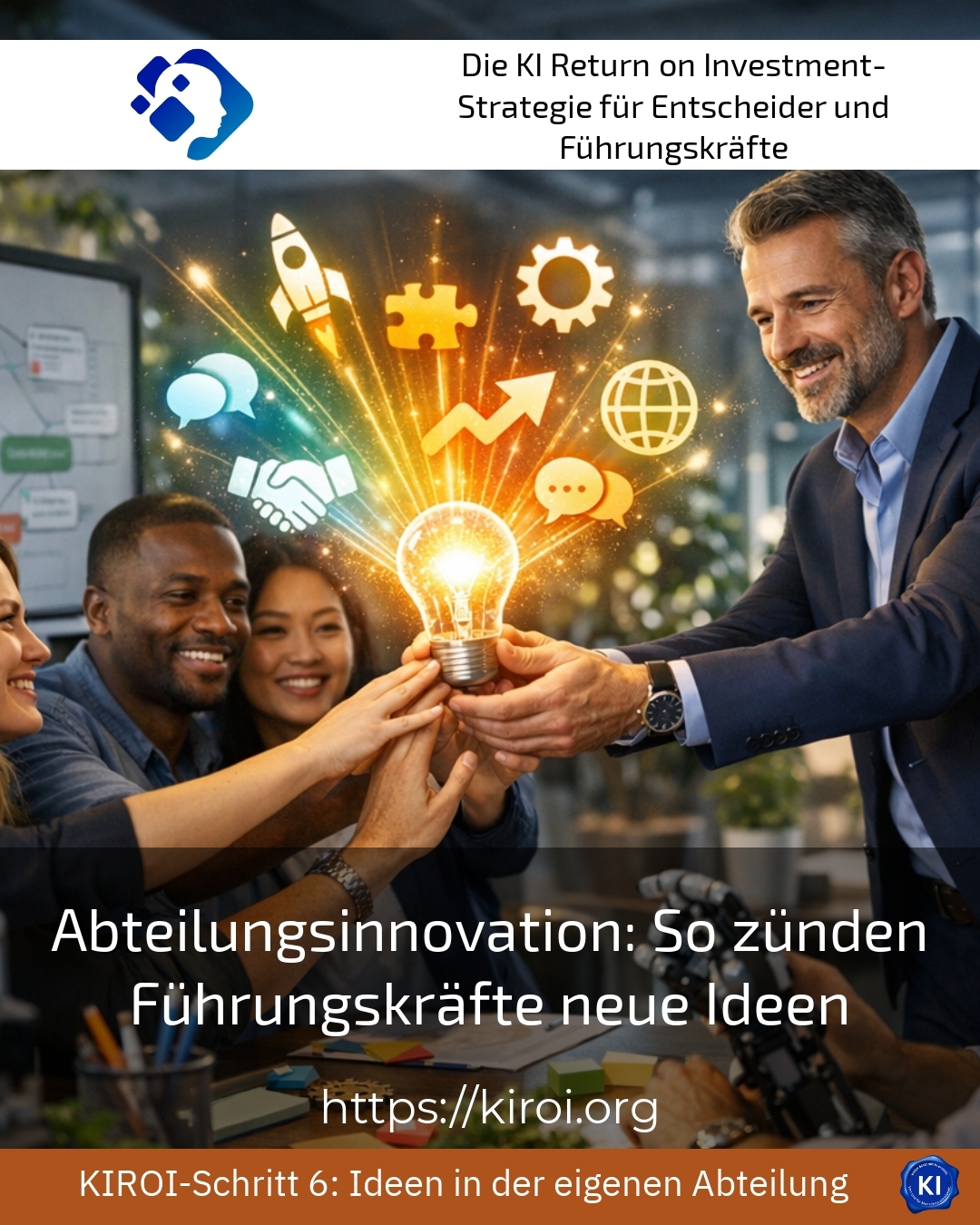
Leaders significantly shape the culture of their departments through their daily actions. They decide on the scope of freedom and resources. At the same time, they send important signals through their communication. Employees are very attentive to which behaviors are rewarded or sanctioned. In a manufacturing company, for example, the deliberate decision of a department manager led to remarkable changes. She made thirty minutes available weekly for unstructured brainstorming sessions. This simple measure signaled the team a genuine interest in new approaches to thinking. A manufacturer from the mid-market used a similar approach and established so-called innovation breakfasts. In these informal meetings, employees from the production department could share their observations and suggestions for improvement. And so the idea for an optimized tool storage system emerged from a casual remark by a shift supervisor. This change saved the company considerable time on each assembly process.
Another example comes from the logistics sector. There, a team leader recognized the untapped potential of his drivers. He asked them to take photos of unusual solutions from other companies during their trips. This collection of images became a source of inspiration for the entire team. Because the manager showed genuine appreciation for these contributions, participation steadily grew.
Best practice with a AIROI customer In a medium-sized manufacturing company, the management approached us because despite numerous initiatives, the desired improvements had not materialized. The employees were frustrated and often regarded new projects as just another waste of time. As part of our support, we first analyzed the existing communication channels between the hierarchical levels. It turned out that although suggestions were collected, they were rarely followed up. Together with the management team, we developed a transparent feedback system. Each submitted idea received a personal response within two weeks. This structural change signaled genuine seriousness to the employees. After six months, the participants reported a significantly increased level of participation. The quality of the suggestions also improved noticeably. The inclusion of shift supervisors proved to be a powerful multiplier. They took on the role of bridge builders between the shop floor and management. The company was thus able to implement several process improvements that brought measurable efficiency gains.
Create structural prerequisites for creative breakthroughs
Without suitable frameworks, even the best intentions remain ineffective. Management should therefore consciously create structures that allow for experimentation. In the automotive sector, a supplier has introduced so-called sandbox projects [1]. These small experimental areas allow teams to try new approaches without the pressure of immediate profitability. Errors are seen as learning opportunities and not sanctioned. A chemical company pursues a similar approach with its innovation labs. There, interdisciplinary teams work on issues that arise from day-to-day operations. The spatial separation from the usual work environment supports creative thinking.
Time-based freedoms also play an important role in Departmental Innovation. A manufacturer of industrial components grants its engineers half a day per month for self-selected development projects. This time is fixed in the calendar and protected from short-term demands. As a result, several patent-worthy solutions have already emerged from this initiative. Because the company management communicates these successes internally, the program’s acceptance is growing continuously.
Resource allocation as proof of trust
Providing budget for experiments sends strong signals to the workforce. A plant builder provides each department manager with a small innovation fund annually. Through these funds, decisions can be made independently. The only requirement is a brief documentation of the findings. A packaging manufacturer goes one step further and funds visits to companies outside the industry. These cross-industry excursions regularly bring surprising insights. A visit to a toy manufacturer, for example, inspired a completely new closure mechanism.
Cultural factors and their importance for sustainable change
Structures alone are not enough to bring about lasting changes. The corporate culture ultimately determines the success or failure of initiatives. Therefore, leaders must work on the psychological safety of their teams [2]. In an environment that punishes mistakes, employees will not take risks. A machine tool manufacturer has therefore introduced explicit error celebrations. At these events, teams report on failed experiments and the lessons learned from them. The public appreciation for these reports changed the risk appetite across the entire company.
An electronics manufacturer takes a different cultural approach with its reverse mentoring program. In this program, younger employees mentor experienced leaders on new technologies and work methods. This reversal of the traditional hierarchy fosters mutual respect and openness. The leaders themselves experience what it feels like to enter uncharted territory. This experience often increases their understanding of the uncertainties in their teams.
Best practice with a AIROI customer A service company in the technical sector approached us because collaboration between departments was stagnating. Each department was primarily optimizing its own KPIs, which led to friction losses at the interfaces. The management recognized the problem, but could not find a common point of approach. As part of our support, we initially conducted individual interviews with all involved parties. These conversations revealed different perceptions of the same situations. Subsequently, we conducted a multi-day workshop in which the teams analyzed customer journeys together. This customer-centric perspective shifted the focus away from internal turf wars. The participants themselves developed proposals for new collaboration formats. The introduction of rotating interdepartmental visits proved particularly effective. Employees spent a day each in a different department. The understanding gained as a result of this improved cooperation significantly, and today the management reports that there are significantly fewer conflicts at the interfaces.
Communication as a catalyst for departmental innovation
The way leaders communicate significantly influences the willingness to innovate. Open questions invite others to contribute, while closed questions often only confirm what has already been said. A food producer specifically trained its leadership team in Socrates-style conversation management. This technique encourages independent thinking among employees. Instead of presenting ready-made solutions, leaders now encourage employees to come up with their own insights.
A pharmaceutical company uses storytelling as a communication tool for change processes. Success stories from other fields are vividly told and presented not just as numbers. This emotional approach reaches people on a deeper level. But also the admission of one’s own uncertainties by leaders creates a sense of trust. A manager of a medium-sized company regularly begins important meetings by asking about his or her own blind spots.
Practical Tools for Everyday Management
In addition to cultural and structural measures, executives also need concrete methods. Design Thinking has established itself as a helpful approach in many organizations [3]. A consumer goods manufacturer is successfully using this method for the development of internal processes. This strict user-centric approach leads to more practically applicable solutions. A construction company adapted the method for its construction site teams. There, joint prototyping sessions are now solving persistent interface problems.
Retrospectives, originally originating from agile software development, are increasingly being applied in other areas. An energy provider conducts monthly team retrospectives. These structured reflection rounds continuously identify potential for improvement. Because the implementation of small measures occurs immediately, the participants experience self-efficacy. A textile company uses a simplified variant with only three questions at the end of each week.
Visualization techniques also support the development of shared ideas. A furniture manufacturer works with large-scale wall murals that represent projects and their connections. This visual communication significantly facilitates understanding of complex projects. Digital collaboration tools are also increasingly being adopted in traditional industries. A metal manufacturer uses virtual whiteboards for cross-location creative sessions.
My AIROI Analysis
The guidance provided to numerous organizations in change projects has yielded important insights. Departmental Innovation It is not achieved through individual spectacular measures, but through continuous work on many screws at the same time. Leaders often underestimate their own role as role models in everyday life. Small gestures of appreciation for new ideas often have a greater impact than formal programs. Psychological safety within the team is an indispensable foundation. Without it, even the best structural frameworks will fail to achieve their intended effect. transruptions coaching accompanies leaders and their teams in designing these multifaceted change processes. We provide inspiration and support in developing individual solutions. Clients often report breakthroughs that were made possible by a different perspective. The combination of methodological expertise and process-oriented support proves particularly effective. Organizations that consistently follow this path develop greater adaptability in the long run. They become more resilient to external changes and use change as an opportunity. The examples presented here demonstrate different approaches to this path of development. The appropriate starting point depends on the specific starting situation. Therefore, a careful analysis of the existing culture and structures forms the first step in any support.
Further links from the text above:
[1] Harvard Business Review – Innovation Topic
[2] McKinsey – Psychological safety and leadership development
[3] IDEO Design Thinking
For more information and if you have any questions, please contact Contact us or read more blog posts on the topic Artificial intelligence here.







 Deutsch
 English (UK)