
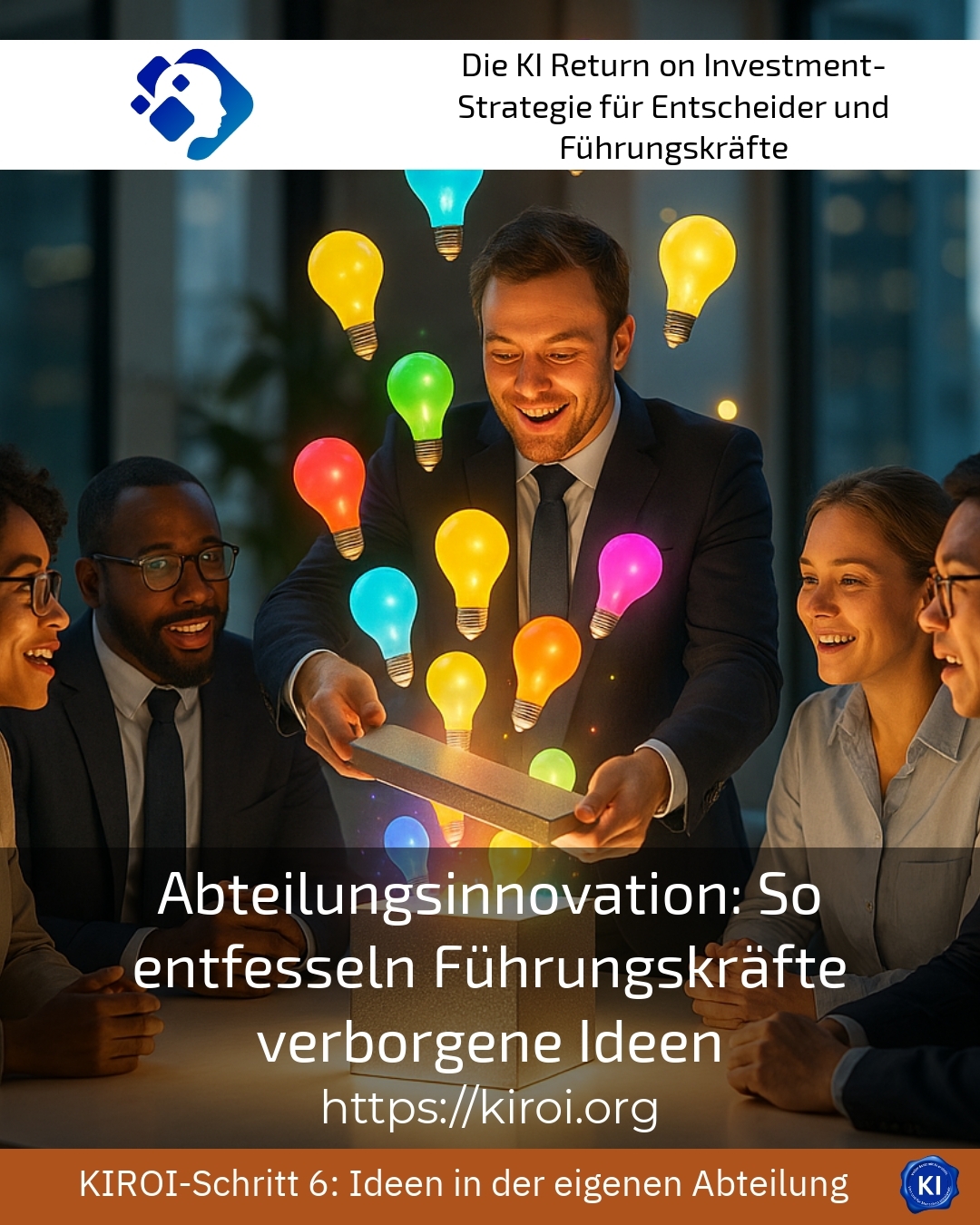
Imagine groundbreaking concepts lying dormant within your organisation, just waiting to be discovered. Many leaders underestimate the creative potential of their teams, letting valuable opportunities slip through their fingers. Departmental innovation is the key to sustainable growth and competitive advantage. But how can these hidden treasures be unearthed? This article presents proven methods and inspiring practical approaches. You will learn how, as a leader, you can establish a culture of openness. Transruptions coaching will accompany you as a valuable partner on this journey.
Why hidden ideas emerge in organisations
In almost every organisation, unwritten rules and hierarchies exist. These structural realities can stifle creative impulses before they are even voiced. Employees often hold back because they fear negative consequences. The fear of rejection or criticism is particularly inhibiting to the free flow of ideas. Clients often report situations where their suggestions were ignored. These experiences shape behaviour and lead to a culture of silence.
A typical example can be found in the production of consumer goods. Here, assembly line workers notice optimisation potential in packaging processes on a daily basis. However, they rarely dare to mention it. The situation is similar in customer service, where employees gain valuable insights into customer needs. These insights often do not reach the decision-making level. In the field of logistics, drivers regularly identify inefficient routes. Without structured channels, however, such observations remain without consequence.
The reasons for this phenomenon are varied and complex. Time pressure plays a significant role in suppressing creative thoughts. Rigid processes leave little room for experimental thinking. Furthermore, many organisations lack a systematic way of recording suggestions for improvement. Transruption coaching supports leaders in identifying these barriers. Together, strategies are developed that can reactivate the flow of ideas.
Fostering departmental innovation through psychological safety
Psychological safety forms the foundation for creative development in teams. This term describes a working environment where people can take risks. No one needs to fear being punished for mistakes or unusual ideas. Research shows that such environments lead to significantly more innovation [1]. Creating this atmosphere requires continuous work on the company culture.
This principle can be particularly well observed in retail. There, a company introduced weekly creative meetings where every idea was welcome. The results surprised everyone involved in a positive way. Sales staff proposed new presentation concepts that increased revenue. In the hospitality industry, a hotel experimented with anonymous suggestion boxes for all hierarchical levels. The submitted suggestions significantly improved both the guest experience and employee satisfaction. A financial services provider established monthly innovation days without performance pressure.
Best practice with a AIROI customer A medium-sized company in the technical services sector faced a particular challenge when its management noticed increasing stagnation in internal improvement suggestions. The executive board approached transruptions-coaching to analyse the situation and jointly develop solutions. In several workshops, the participants identified key hindrances that were blocking creative exchange. It emerged that employees found previous experiences with rejected suggestions demotivating. The coaching accompanied the introduction of a new idea management system that focused on transparency and appreciation. Every submitted suggestion received personal feedback from a manager within ten working days. Particularly innovative concepts were presented and acknowledged at team meetings. After six months, the company recorded a significant increase in submitted ideas. The quality of suggestions also improved noticeably because employees elaborated on their thoughts more thoroughly. Several concepts led to measurable cost savings and process improvements in various departments.
Establish concrete measures for greater openness
The implementation of psychological safety requires concrete actions from leadership. Regular one-on-one conversations build trust and enable open exchange. Leaders should actively seek suggestions for improvement and show genuine interest. Admitting their own mistakes by superiors is particularly trust-building. Studies confirm the positive influence of such role-modelling on team culture [2].
In healthcare, a clinic established so-called "no-blame" error conferences. These meetings focused exclusively on learning opportunities and systemic improvements. A software company introduced retrospectives where all levels of hierarchy participated as equals. Senior management deliberately took a subdued role. In the education sector, a university experimented with interdisciplinary innovation labs.
Systematically build structures for departmental innovation
In addition to the cultural dimension, successful idea development also requires structural support. Clear processes help to channel and further develop creative impulses. Without appropriate frameworks, even the best suggestions will fizzle out ineffectively. The design of these structures should take into account the specific circumstances of the organisation. Standard solutions rarely work without adjustments to the respective context.
An automotive supplier implemented a three-stage evaluation system for submitted ideas. First, an expert panel checked the technical feasibility of each proposal. Subsequently, an economic team assessed the financial potential of the concepts. Finally, an innovation council decided on the implementation of promising projects. In the energy sector, a utility company established quarterly innovation competitions with attractive prizes. The best ideas received budgets for piloting and further development. A media company set up a central platform for idea exchange across departmental boundaries.
Transruption coaching supports organisations in developing tailored structures. Existing processes are analysed together and potential for improvement is identified. Implementation takes place in stages to avoid overwhelm and enable sustainable change. Leaders receive impulses for their personal role in the innovation process.
Using Digital Tools as Catalysts
Modern technologies open up new possibilities for idea management within organisations. Digital platforms enable low-threshold participation irrespective of location or time. Collaborative tools foster exchange between different departments and locations. Artificial intelligence can support the recognition of patterns in submitted suggestions [3]. However, the selection of suitable tools should always take user needs into account.
In the insurance sector, a company utilised an app for mobile idea submission, enabling field staff to capture and share spontaneous ideas directly. A retail group opted for virtual brainstorming rooms for cross-site workshops, with the anonymity feature also encouraging more reserved individuals to participate. In the pharmaceutical industry, a knowledge platform networked researchers from various laboratories worldwide.
Best practice with a AIROI customer A renewable energy organisation was looking for ways to improve collaboration between its various branches, as the individual sites had largely been working in isolation. Transruption coaching supported the introduction of a digital innovation network over several months. First, the needs and expectations of employees in all branches were surveyed and analysed. Based on this, a bespoke platform was created, taking both technical and social aspects into account. Particular emphasis was placed on an intuitive user interface, so that all age groups could participate easily. Gamification elements such as point systems and virtual awards increased motivation for active participation. Over two hundred suggestions for improvement were submitted within the first quarter. The high quality of cross-site collaboration was particularly noteworthy. Teams from different regions jointly developed solutions for similar challenges. These synergistic effects positively surprised management and impressively confirmed the chosen approach. The project demonstrates how digital tools, combined with thoughtful guidance, can drive sustainable change.
Leadership Behaviour as the Key to Departmental Innovation
The attitude of leaders significantly influences their teams' willingness to innovate. Genuine interest in employees' ideas is infectious and motivating. Conversely, indifference or devaluation can permanently stifle creative impulses. Conscious reflection on one's own leadership behaviour is therefore an important starting point. Clients often report unconscious patterns that limit their effectiveness.
In mechanical engineering, a production manager consciously changed his reaction to unusual suggestions. Instead of immediately formulating counterarguments, he first asked in-depth questions. This small change in behaviour encouraged his team to be more open. In the advertising industry, an agency manager established regular, non-judgemental creative sessions. All ideas were documented equally and subsequently evaluated together. A construction company introduced tandem conversations between experienced and young employees.
Transruption coaching provides leaders with impetus for the further development of their communication patterns. Personal strengths and areas for development are identified in confidential discussions. The support is practical and oriented towards concrete everyday challenges. Leaders develop a deeper understanding of their impact on others.
Recognising diversity as a driver of innovation
Varied and diverse teams demonstrably generate more innovative solutions. Different perspectives enrich discussions and prevent blind spots in thinking. The conscious promotion of diversity therefore supports an organisation's innovative capacity. This is not only about demographic characteristics, but also about ways of thinking and backgrounds of experience [4].
In the food retail sector, one company benefited from the integration of different generations. Younger employees brought digital expertise, while experienced staff shared proven knowledge. A technology group deliberately fostered exchange between commercial and technical departments. The resulting synergies led to marketable innovations. In the tourism industry, an operator relied on international teams for product development.
My AIROI Analysis
Observations from numerous projects clearly show that untapped potential exists in almost every organisation. However, unleashing hidden ideas requires a systematic approach on multiple levels simultaneously. Cultural changes form the foundation upon which structural measures can be built. Leaders play a central role in shaping an innovation-friendly environment.
The examples presented demonstrate how varied the paths to success can be. There is no universal solution that works in every context. Rather, approaches must be adapted to the specific circumstances of the respective organisation. Transruption coaching supports this individual development process through tailor-made guidance.
Of particular importance, it seems to me, is the realisation that sustainable changes take time. Quick successes are possible, but profound cultural transformation happens step by step. Patience and perseverance pay off in the long term and create real competitive advantages. Investing in an organisation's innovative capacity proves worthwhile in many ways. In addition to economic benefits, employee satisfaction and employer attractiveness also increase significantly. These positive side effects reinforce the original impulse and create a virtuous cycle.
Further links from the text above:
[1] Harvard Business Review – Psychological Safety Research
[2] McKinsey Insights – Organisational Performance
[3] Gartner – Innovation Management Insights
[4] Deloitte Insights – Diversity and Innovation
For more information and if you have any questions, please contact Contact us or read more blog posts on the topic Artificial intelligence here.






 Deutsch
  English (UK)