
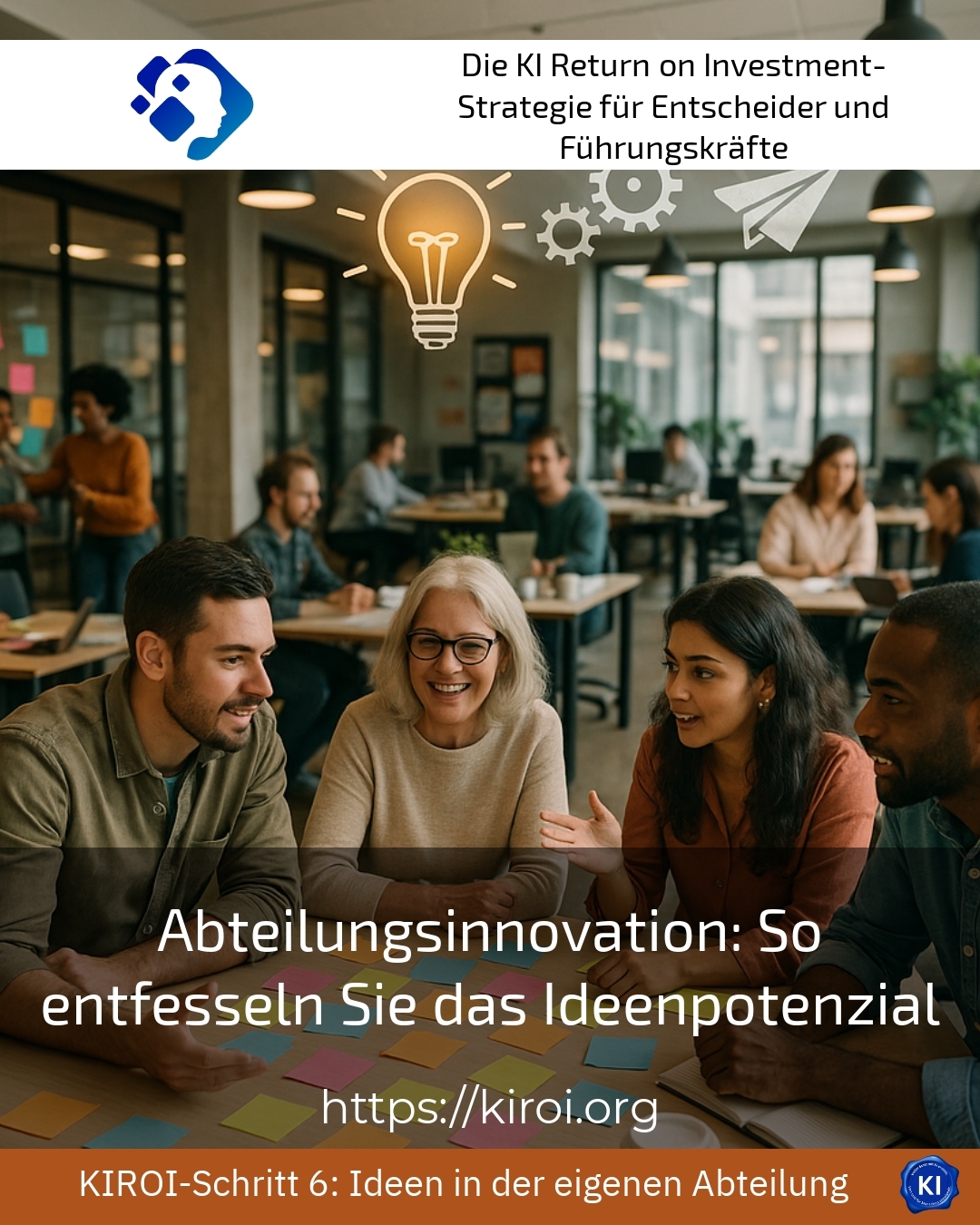
Imagine that hundreds of brilliant ideas are dormant in your organization, waiting to be discovered. Every day, valuable insights are lost because no one systematically captures or develops them. The Departmental Innovation offers a powerful lever here to unlock hidden potential and drive sustainable change. In a time when technological change is sweeping across all industries, the ability to continuously innovate becomes a crucial competitive factor. This article shows you practical ways to unleash creative energy and harness it in a structured manner.
Why traditional structures often block the potential for ideas
Traditional hierarchies and rigid processes often act as invisible barriers to creative thinking. Employees are not willing to bring unconventional ideas to the table because they fear negative consequences. This fear of failure paralyzes even the most talented minds in companies of all sizes. In manufacturing companies, for example, production managers regularly report that improvement suggestions from machine operators have been ignored for years. Only through targeted workshops did these companies discover the optimization opportunities that existed directly on the production line. Similar experiences are encountered by retail companies, whose cashiers receive customer feedback daily that is never systematically evaluated.
This phenomenon is particularly evident in service industries. Bank employees in customer contact often develop intuitive solutions for recurring problems. However, these solutions remain within the personal experience of individual individuals. Insurance companies struggle with similar challenges in claims processing. Claim handlers find creative ways to speed up processes without ever documenting them. We also see in the healthcare sector that nursing staff develop innovative care approaches. These approaches are rarely shared or scaled up in a structured manner. The Departmental Innovation It starts right here and creates spaces for systematic knowledge transfer.
Psychological security as the foundation of department innovation
Without a climate of trust, even the best ideas management systems remain ineffective. People need to feel that their contributions are valued, regardless of the outcome. Google has demonstrated in extensive studies [1] that psychological safety is the most important success factor for teams. Pharmaceutical companies are already using these findings extensively in their research departments. There, managers encourage their teams to openly discuss even failed experiments. Automotive suppliers establish so-called fail-forward cultures in their development departments. Software companies hold regular retrospectives in which mistakes are viewed as learning opportunities.
Best practice with a AIROI customer A medium-sized logistics company approached the transruptive coaching team with a special challenge. The management noticed that despite high employee satisfaction, hardly any improvement proposals were submitted. In several coaching sessions, we worked together to identify the root causes and identified a deeply ingrained culture of error. Previously, the company had publicly criticized proposals that turned out to be impractical. This practice, although dated years ago, continued to live on in the collective memory of the workforce. Together, we developed a three-stage program for cultural change. First, management began by openly addressing their own mistakes in team meetings. Next, we conducted moderated idea workshops in which all suggestions were initially collected without judgment. Finally, we established a reward system that also recognized submission, not just successful implementation. After six months, the number of submitted proposals increased by over three hundred percent. The company was able to realize annual savings in the six-digit range solely through employee ideas. This change did not arise from new systems, but from the consistent work on the company culture.
Methods for systematic idea generation in teams
Simply calling for ideas rarely leads to lasting results. Instead, teams need structured formats that actively stimulate creative thinking. Design Thinking has established itself as an effective method across industries [2]. Telecommunications providers are using this approach to develop customer-oriented service offerings. Energy providers are using Design Thinking workshops to conceive new business models for renewable energy. Food manufacturers are developing product innovations based on real customer needs.
The Brainwriting method also offers interesting possibilities for different team configurations. In this method, participants write down their ideas in writing before they are discussed in the group. This technique prevents dominant personalities from influencing the discussion too early. Advertising agencies use Brainwriting intensively for campaign development. Architecture offices use the method during the early design phases of complex construction projects. Consulting companies use it to generate diverse solutions for client problems. Departmental Innovation It benefits from this method especially because it more effectively engages introverted team members.
Digital tools to support creative processes
Modern software solutions can significantly accelerate the innovation process and democratize it. Idea management platforms enable the submission and evaluation of proposals independently of the location. Chemical companies use such systems to bring ideas together from worldwide locations. Mechanical engineering companies connect their development departments with sales and customer service. Technology companies rely on gamification elements to increase participation in idea processes. These platforms create transparency and show employees what happens to their proposals.
Collaborative whiteboards like Miro or Mural effectively support virtual brainstorming sessions. Media companies coordinate creative teams across different time zones. Fashion retailers develop product concepts with internal and external partners on these platforms. Consulting firms use the tools for joint strategy development with their clients. These digital tools do not replace personal interaction, but rather meaningfully complement it. The Harvard Business Review emphasizes that hybrid formats often deliver the best results [3].
Best practice with a AIROI customer An international engineering company sought guidance in implementing a digital idea management system. The previous practice was based on an outdated proposal system with paper forms and long processing times. Clients often report frustration in such situations from both the submitters and the reviewers. In the transruptions coaching project, we jointly developed a requirement profile for the new platform. We paid special attention to low access barriers and quick feedback loops. The implementation took place in stages, starting with a pilot department in the area of quality management. This department proved particularly suitable because a culture of continuous improvement already existed there. After a successful pilot phase, we rolled out the system to other departments. We adapted the processes to the specific needs of each department. A crucial success factor was the training of innovation ambassadors in each department. These individuals serve as contact points and motivators for their colleagues. Today, the company has a consistently high participation rate and has generated several patent-worthy ideas from its workforce. The guidance provided by external expertise helped avoid typical implementation errors and ensure the project was quickly successful.
The role of the leader in departmental innovation
Executives play a crucial role in determining whether creative initiatives flourish or are stifled in their infancy. Their attitude and behavior send strong signals to the entire organization. Successful innovation management requires the willingness to relinquish control and to allow experimentation. Hotel chains that adhere to these principles enable their front-desk staff to make independent decisions regarding guest satisfaction. Retail chains grant store managers leeway to make local product adjustments. Construction companies entrust construction managers with the authority to implement process improvements on-site.
At the same time, leaders must learn to provide constructive feedback without destroying motivation. Rejection of an idea should always be accompanied by a comprehensible explanation. Financial service providers specifically train their leaders in this skill. Industrial companies establish formalized evaluation processes with clear criteria. Technology companies use peer reviews to distribute decisions across a broader group of people. These practices strengthen employee trust in the entire innovation process. McKinsey emphasizes the importance of leadership commitment for successful transformations [4].
Create resources and timeframes for creative work
Innovation rarely occurs under constant pressure and with full utilization of all capacities. Organizations need deliberately created spaces where employees are allowed to experiment. The famous twenty percent time concept originally originated in the technology industry. Electronics companies grant dedicated time budgets for self-selected development projects to engineers. Pharmaceutical companies establish innovation labs that operate in parallel to their day-to-day business. Consumer goods manufacturers organize regular hackathons for rapid prototyping.
Spatial design also influences the creativity of teams in various ways. Open spaces for spontaneous encounters promote the informal exchange of ideas between departments. Insurance companies design their offices with creative zones and retreat areas. Media companies deliberately create places where different professional groups meet. Automobile manufacturers set up innovation centers that are deliberately separated from the operational business. These physical spaces signal that creative thinking is desired and valued.
From idea to implementation: structures for sustainable change
Many organizations fail not because of a lack of good ideas, but because of their failure to implement them consistently. The transition from concept to realization requires clear processes and defined responsibilities. Telecommunications companies establish stage-gate processes with defined milestones and decision points. Chemical companies use portfolio management approaches to prioritize their innovation projects. Machinery manufacturers rely on agile methods to bring ideas to market more quickly.
Involving relevant stakeholders from the outset significantly increases the probability of success. Food companies incorporate production and quality assurance early in product development. Financial institutions integrate compliance experts as early as the ideation phase of new services. Retail companies test concepts in selected pilot branches before widespread rollout. This early involvement avoids costly course corrections in later project phases. The Departmental Innovation becomes an integral part of the value chain in this way.
Best practice with a AIROI customer A traditional family business in the food industry was looking for inspiration for modernizing its innovation culture. The existing structures had worked for decades, but were increasingly reaching their limits. In intensive discussions with the management team, we first developed a shared vision of the future. This vision described how the company wanted to approach innovation in five years. Subsequently, we analyzed the existing processes and identified bottlenecks and obstacles. A central problem was the lack of connection between sales and product development. Customer feedback often took several months to reach the developers. Together, we established a system of regular cross-functional meetings between the two departments. Additionally, we introduced a digital Kanban board that made the status of all innovation projects transparent. The support provided by the transruptions coaching team lasted nine months. During this time, we also trained internal moderators who can continue to run the new formats independently. Since then, the company has significantly reduced its time-to-market for new products. At the same time, employees report higher satisfaction because their ideas are now producing visible results more quickly.
My AIROI Analysis
Systematic unleashing of ideas requires far more than individual measures or tools. It is a profound cultural change that requires time, patience, and consistent leadership. Organizations that successfully embark on this path first invest in psychological safety as a foundation. They establish structured methods and digital tools that systematically support creative thinking. Leaders learn to redefine their role and create spaces for experimentation.
The examples from different industries show that there is no universal recipe for success. Each organization must find its own path that fits the existing culture and structure. External support often helps to identify blind spots and avoid typical stumbling blocks. The combination of methodological expertise and industry know-how creates particularly effective interventions. It remains important to recognize that department innovation is not a one-time project but a permanent practice.
Long-term success is not measured solely by the number of ideas generated or projects implemented. What is crucial is the organization’s ability to continuously learn and adapt. This ability to learn becomes a crucial competitive advantage in a rapidly accelerating world. Companies that invest in their innovation culture today secure their future viability sustainably. The approaches presented in this article offer diverse starting points for their own path. The first step is to honestly analyze the current situation and prioritize areas for action.
Further links from the text above:
[1] Google re:Work – Understanding Team Effectiveness
[2] Interaction Design Foundation – Design Thinking
[3] Harvard Business Review – Innovation Topics
[4] McKinsey – Insights on People and Organisational Performance
For more information and if you have any questions, please contact Contact us or read more blog posts on the topic Artificial intelligence here.










 Deutsch
  English (UK)