
Have you ever wondered why some departments seem to develop innovative solutions effortlessly, while others, despite their best intentions, remain stuck in a creative standstill?
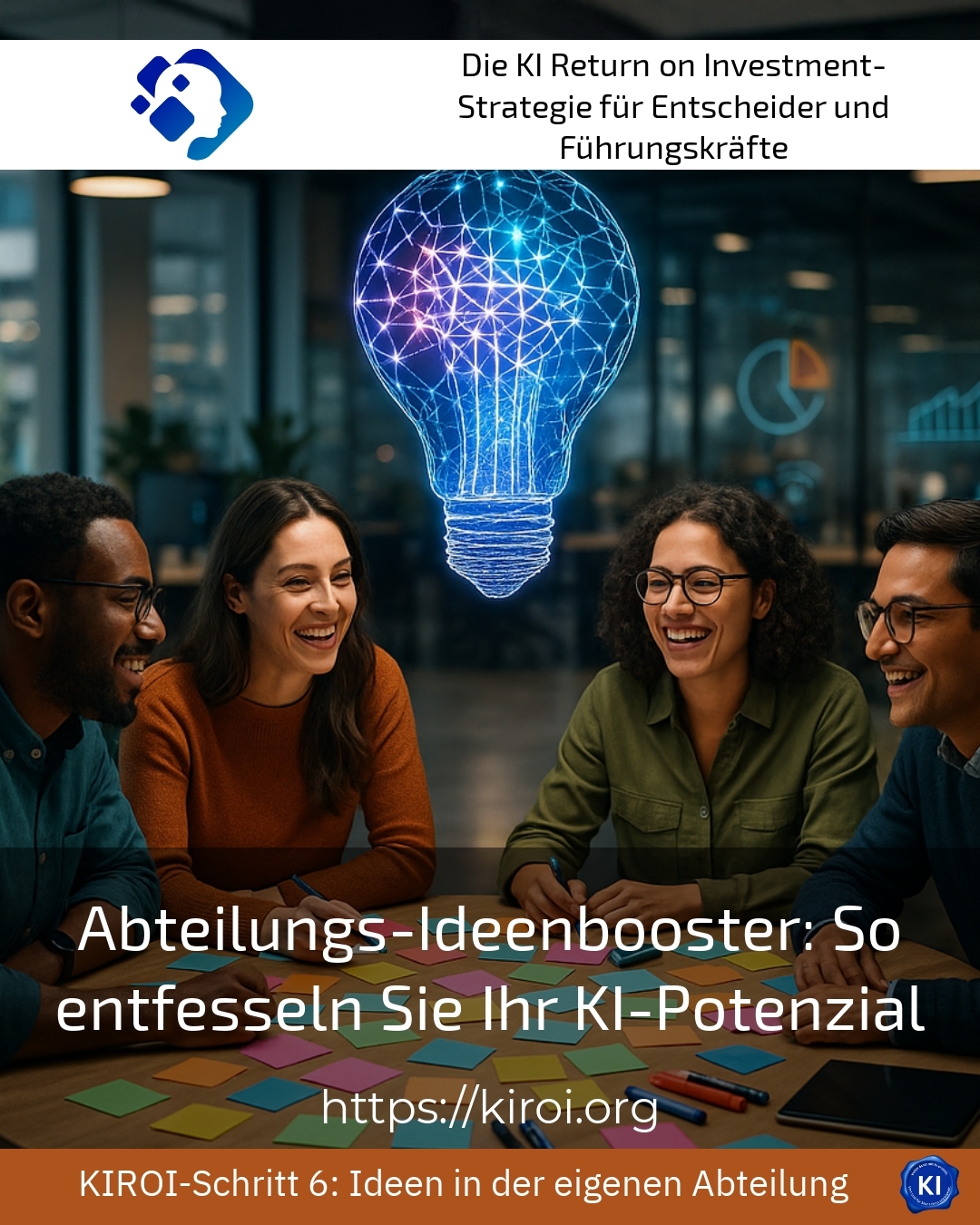
The answer often lies in the systematic use of intelligent technologies that are powerful Departmental Idea Booster It can work. In a time when companies are faced with increasing competitive pressure, executives are looking for ways to unleash the creative potential of their teams. Many clients report similar challenges. They experience how traditional brainstorming methods reach their limits. At the same time, the pressure to generate innovations faster and more efficiently is growing. This is where intelligent support through modern technologies can help teams embrace completely new perspectives and develop previously undiscovered solutions.
The hidden creative roadblocks in modern work environments
Many organizations face a paradoxical problem. On the one hand, they have highly skilled employees with enormous expertise. On the other hand, these teams often fail to fully harness their creative potential. The reasons for this are diverse and range from ingrained mindsets to time constraints that make genuine innovation nearly impossible.
In the financial sector, for example, risk management departments are struggling to develop new approaches to fraud detection. The compliance teams in insurance companies are looking for innovative ways to efficiently implement regulatory requirements. And the product development departments of banks are wrestling with the question of how to design digital services that truly inspire customers. In all of these cases, a systematic approach can help. Departmental Idea Booster provide valuable insights.
The challenge lies in the fact that expert knowledge alone is not enough. Teams need tools that help them look beyond the boundaries of their own field of expertise. They need methods that break through established patterns of thinking and open up fresh perspectives.
Best practice with a AIROI customer
A medium-sized financial services company approached us with a specific challenge. The customer service department had not produced any significant process innovations for years, despite the employees being highly motivated and possessing deep technical expertise. As part of a transruptive coaching process, we guided the team in using intelligent systems as sparring partners for idea generation. The results surprised all involved, as within just six weeks the team generated more actionable improvement suggestions than in the previous three years combined. Particularly noteworthy was that the intelligent technology did not replace the creativity of the employees; rather, it enhanced it and directed it in new directions. The team members reported that through the systematic use of the digital assistant, they were asked questions they would never have considered themselves. These unexpected perspectives led to innovative approaches in customer communication, which have now been successfully implemented.
The department idea booster as a strategic tool
The systematic integration of intelligent technologies into the innovation process of a department requires more than just the provision of appropriate tools. It is rather about creating a culture in which digital assistance is perceived as an enrichment rather than a threat. This cultural change is best achieved when it is professionally supported.
In the field of asset management, advanced teams are already using intelligent systems to conceptualize new investment strategies. Insurance mathematicians rely on digital support when developing innovative pricing models. And compliance departments in investment companies can benefit from intelligent assistants to help them navigate regulatory gray areas creatively and legally.
The key lies in the right methodology. Teams that act intelligently do not use technology as an oracle that provides ready-made solutions. Instead, they use digital assistance as a catalyst that accelerates and enriches the creative process. Often, ideas emerge that neither humans nor machines could have developed alone.
Practical use cases for the Department Ideas Booster
The specific deployment possibilities are as diverse as the challenges departments face. In practice, certain use cases have proven particularly valuable because they deliver measurable results quickly while simultaneously fostering the acceptance of the technology within the team.
Credit departments in banks are using intelligent systems to explore alternative creditworthiness assessment methods. This leads to innovative approaches that can meaningfully complement traditional scoring models. Business customer support departments are developing personalized service concepts with digital support. Treasury departments of large corporations rely on intelligent assistance when developing strategies for liquidity optimization.
It is always crucial that human expertise remains at the center. Technology supports and accompanies, but it does not replace the expertise and experience of the team members.
Overcoming resistance and creating acceptance
Clients often report initial resistance within their teams when it comes to integrating intelligent technologies into their work routine. These reservations are understandable and should be taken seriously. At the same time, experience shows that they can be overcome with the right approach.
In securities processing, for example, employees initially expressed concerns that intelligent systems could make their work redundant. However, through targeted training and initial success stories, this skepticism turned into enthusiasm. The employees realized that the technology allowed them to focus on more demanding and creative tasks.
We are observing similar developments in controlling departments that are using intelligent assistance for innovative reporting concepts. Likewise, in the personnel development of financial institutions, new approaches to employee development are emerging through digital support. The conclusion is obvious: Success depends significantly on the type of implementation.
Best practice with a AIROI customer
An insurance company commissioned us to support the claims department in integrating intelligent technologies. The initial situation was challenging, as the long-standing employees were skeptical of the innovation and feared that their expertise could be undermined. Within the transruptive coaching process, we developed a step-by-step implementation plan together with the team that took the concerns seriously while at the same time highlighting the opportunities. The decisive breakthrough came when an experienced claims officer used the intelligent assistant to analyze a complex claim case, arriving at a solution that saved the company significant costs while simultaneously increasing customer satisfaction. This positive experience quickly spread within the team, leading to a fundamental change in attitude. Today, all the department's employees use the technology regularly and report a significant increase in their job satisfaction, because they can now focus on the truly interesting and challenging cases.
The right accompaniment makes the difference
The path to successful use of Department Ideas Boosters It is rarely linear. Teams need support to fully exploit the capabilities of technology while avoiding typical pitfalls. This is where professional guidance comes into play; it not only imparts technical expertise but also considers the human aspect of change.
In practice, this is evident, for example, in fund management teams that want to use intelligent systems for market analysis. Without appropriate guidance, such teams tend to underestimate the technology or attribute too much authority to it. We observe similar patterns in legal departments of banks that employ digital assistance for contract analysis. Likewise, departments of corporate communications that utilize intelligent tools for crisis communication benefit from professional guidance.
Transruptions coaching positions itself clearly as a support for projects involving the integration of intelligent technologies [1]. The focus is on empowering teams to handle the new opportunities independently and competently.
Sustainable anchoring in everyday work
The biggest challenge in implementing new technologies often lies not in the initial implementation but in its sustainable integration into daily workflows. Many organizations experience that initial enthusiasm wanes after a few weeks and old habits return.
To prevent this, it is recommended to establish clear structures and routines. In the credit risk analysis, this means, for example, scheduling fixed timeframes for creative sessions with intelligent support. Customer advisory teams in private banks integrate digital idea generation into their weekly meetings. And departments for process optimization systematically use the technology in every new improvement project.
Experience shows that teams that establish such routines work significantly more innovatively in the long run than those that use the technology sporadically. The key lies in continuity and systematic integration into existing workflows.
My AIROI Analysis
The systematic use of intelligent technologies as ideation amplifiers represents a paradigm shift in the way departments can develop and implement innovations. Based on the guidance of numerous projects in the financial and insurance industry, it can be concluded that success depends on several factors that interact with each other and reinforce each other.
First and foremost, the attitude of management is crucial. When department heads demonstrate and actively use technology as a benefit, their teams follow suit. Equally important is the gradual introduction, which allows employees to build confidence in the new way of working without feeling overwhelmed.
Furthermore, the analysis shows that the best results are achieved when intelligent assistance is understood as a complement to human creativity and not as a substitute. Teams that find this balance report a significant increase in both the quantity and the quality of their ideas. The future belongs to those organizations that understand how to unleash the potential of their employees through intelligent support without losing sight of the human component [2].
The AIROI-methodology provides a structured framework for this, which takes into account both technical and human aspects and helps teams develop a sustainable innovation culture.
Further links from the text above:
[1] Disruptions Coaching for Digital Transformation
[2] AIROI-Master plan for sustainable AI integration
For more information and if you have any questions, please contact Contact us or read more blog posts on the topic Artificial intelligence here.








 Deutsch
  English (UK)