
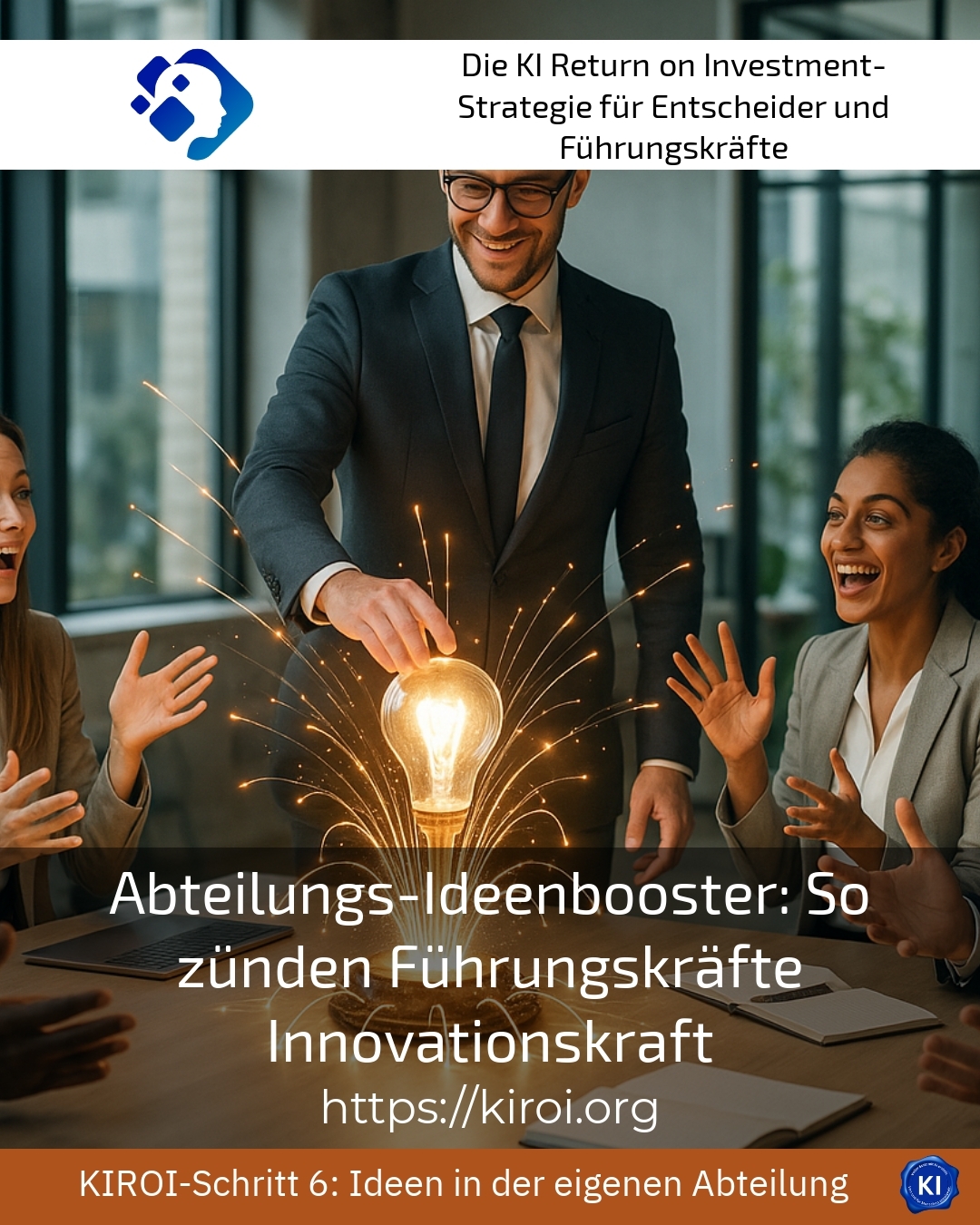
Imagine that your department suddenly develops groundbreaking ideas. Employees bring in proposals that revolutionize processes. The Departmental Idea Booster That’s exactly what makes it possible. Leaders often ask how they can unlock dormant potential. They are looking for ways to unleash creative energy. It’s not about complicated methods. It’s about smart impulses and the right support. In this article, you’ll learn how modern leadership unleashes innovation. You’ll also get to know proven approaches from different industries. At the same time, you’ll discover how transruptive coaching can support your projects [1].
Understand the fundamentals of creative department management
Creativity does not arise in an empty void. It requires fertile ground and the right framework conditions. Leaders play a crucial role in this. They shape the environment in which new ideas can grow. A mechanical engineering company introduced open lunchtime discussions. Engineers exchanged ideas about unusual problem solutions. Within a few months, three patentable improvement proposals had emerged. A logistics company established monthly creative hours. Warehouse workers developed a new picking system. The error rate dropped by a considerable forty percent. A software house organized weekly hackathons. Developers programmed solutions for everyday customer problems. Several of these prototypes were later turned into successful product features [2].
The Departmental Idea Booster It starts with a simple insight: people have ideas when they feel secure. Psychological safety forms the foundation of any innovation culture. Leaders therefore need to create spaces where unfinished thoughts can be expressed. Mistakes are not punished there, but seen as learning opportunities. Clients often report on blockages in their teams. These often arise from unconscious signals from the leadership level. A critical look, a disparaging comment can suffice. Suddenly, creative voices become silent. Transruptive coaching supports leaders in self-reflection. They recognize hindering behavioral patterns and develop supportive alternatives.
The department idea booster as a strategic leadership tool
Innovation does not happen by chance. It requires strategic planning and consistent implementation. Leaders need clear structures for idea management. One pharmaceutical company implemented digital idea platforms. Employees submitted proposals and evaluated other contributions. The best ideas received budgets for pilot projects. A financial services provider established cross-departmental innovation circles. Representatives from various departments met regularly. They combined different perspectives to develop novel solutions. An energy provider established an internal innovation agency. Employees could work there temporarily on their own projects. Several of these initiatives resulted in new business areas [3].
Best practice with a AIROI customer
A medium-sized automotive supplier faced major challenges. The departments worked in isolation from each other. Valuable synergies remained untapped, and innovations stagnated. The management team sought a solution to this problem. As part of a transruptive coaching project, we analyzed the existing structures. We identified communication barriers between the development departments. At the same time, we recognized untapped creative potential among the professional staff. Together, we developed a three-stage innovation program. The first stage included training for all management personnel. They learned techniques to promote creative processes. The second stage established cross-departmental project teams. These teams worked on concrete improvement proposals. The third stage implemented a transparent reward system. Successful ideas were publicly acknowledged and rewarded. After twelve months, the company achieved remarkable results. The number of submitted improvement proposals tripled. Three innovations were registered as patents. Employee satisfaction increased by twenty percent points.
Concrete methods for more innovation in teams
Theory alone is not enough. Leaders need practical tools for everyday life. Design Thinking offers a structured framework for innovation processes. A telecommunications company trained all team leaders in this method. They applied the principles to customer complaints. From complaints, they came up with improvement suggestions and new service offerings. A retail company used reverse brainstorming. Teams considered how they could annoy customers to the maximum. From these insights, they developed positive measures. A construction company implemented the Six Thinking Hats method. Project teams considered problems from six different perspectives. The quality of the decisions improved measurably [4].
The department idea booster benefits from digital tools. Collaboration platforms enable asynchronous idea development. Employees can submit ideas anytime and anywhere. An insurance company introduced virtual whiteboards. Teams collaborated there to jointly sketch out new process flows. Participation in innovation projects increased significantly. A media house used AI-supported analysis tools. These identified patterns in customer feedback. From these patterns, editorial teams developed new content formats. A consulting company implemented gamification elements. Employees collected points for innovative contributions. The playful component significantly increased motivation.
Identifying and overcoming obstacles
Innovation often encounters resistance. Understanding this is the first step towards overcoming it. Time constraints are considered the most common obstacle to creative work. Therefore, leaders must consciously create spaces for freedom. A chemical company introduced eras of no innovation. During these hours, operational routine was explicitly prohibited. Employees devoted themselves exclusively to new ideas. A trading company eliminated unnecessary meetings. The time gained was invested by teams in experimental phases. A technology company reduced reporting requirements. Leaders focused more on substantive work [5].
Cultural barriers often prove more persistent. A culture of perfectionism inhibits creative impulses. Leaders must communicate the value of unfinished ideas. A machine builder established prototyping workshops. Teams built quick models without the expectation of perfection. From these models, sophisticated products later emerged. A hospital operator introduced learning circles. Medical staff shared experiences with failed treatment approaches. From mistakes, systematic improvements were derived. Transruptive coaching accompanies leaders through cultural change processes. Together, we develop strategies for sustainable transformation.
Best practice with a AIROI customer
An authority in the public service struggled with innovation blockages. Hierarchical structures prevented the free flow of ideas. Employees did not dare to bring improvement proposals. The fear of negative consequences paralyzed creative initiative. In the coaching process, we worked with the entire leadership team. First, we thoroughly analyzed the existing communication patterns. We recognized subtle signals that intimidated the employees. Unconsciously, supervisors sent messages of rejection. Together, we developed a program for appreciative communication. Leaders learned to actively ask for ideas. They practiced taking even unconventional proposals seriously. In parallel, we established anonymous channels for reticent employees. These channels enabled the risk-free submission of suggestions. After six months of intensive coaching, initial successes were evident. The number of improvement proposals continuously increased. Several administrative processes were fundamentally optimized. The employees reported on a changed atmosphere. They felt included and valued.
Sustainable embedding of an innovation culture
Unique initiatives quickly fade away. Sustainable innovation culture requires continuous nurturing. Leaders must create structures that are sustainable. An industrial company embedded innovation in its goals and objectives. Each leader was measured on innovation metrics. A service company integrated creative elements into onboarding processes. New employees learned innovative thinking from the outset. A craft business established innovation sponsorships. Experienced employees mentored younger colleagues in the development of ideas [6].
The Departmental Idea Booster It works by being regular. Innovation routines anchor creative thinking in everyday work. A food manufacturer introduced weekly innovation minutes. In short sessions, teams shared current observations and ideas. A fashion company established monthly trend scouting sessions. Employees presented inspirations from different fields. A tourism company organized quarterly innovation days. The entire workforce then worked on forward-looking projects. Transruptive coaching provides the impetus for such sustainable structures. We support companies in implementing and maintaining them.
The department idea booster in practice
Successful innovation combines top-down and bottom-up approaches. Leaders set the framework, and employees fill it. An electronics manufacturer skillfully combined both perspectives. The management defined strategic innovation areas. Within these areas, teams had free rein. A healthcare provider used hybrid innovation formats. In-person workshops complemented digital collaboration platforms. The variety of formats appealed to different personality types. An educational institution implemented innovation teams. Leaders and employees collaborated to develop new concepts [7].
Measuring innovation success requires differentiated metrics. Quantitative metrics alone are too limited. A real estate company developed a multidimensional evaluation system. It considered idea count, implementation rate, and economic impact. A transportation company also included qualitative indicators. Employee surveys complemented hard metrics meaningfully. An energy company introduced innovation scorecards. These made progress visible and comparable at the departmental level.
My AIROI Analysis
After intensive work on the topic, I draw a clear conclusion. Innovation in departments depends largely on the leadership culture. Technical tools and methods effectively support the process. However, they cannot replace an open, appreciative atmosphere. Leaders bear responsibility for the creative climate. They must be willing to critically question their own behaviors. Transruptive coaching offers a protected space for reflection.
The examples presented show the diversity of possible approaches. There is no one-size-fits-all solution for all companies. Each organization must find its own path. Industry, corporate culture, and employee structure all play a role. What works in a technology company does not necessarily apply to the public sector. That is why I recommend individual analysis and tailored concepts. Transruptive coaching supports this development process in a collaborative manner. We provide guidance without imposing pre-determined solutions.
Investing in innovation culture pays off in the long run. Companies with a strong innovation culture are more resilient. They adapt more quickly to market changes. At the same time, they increase their attractiveness as employers. Creative employees seek environments that value their ideas. Building such a culture requires patience and consistency. Short-term programs fail without lasting impact. Only continuous work on the fundamentals leads to success.
Further links from the text above:
[1] AIROI Master Plan for Managers
[2] Harvard Business Review – Innovation Insights
[3] McKinsey – Innovation Practice
[4] IDEO Design Thinking Resources
[5] Gallup Workplace Insights
[6] MIT Sloan Management Review – Innovation
[7] Forbes Innovation Hub
For more information and if you have any questions, please contact Contact us or read more blog posts on the topic Artificial intelligence here.









 Deutsch
 English (UK)