
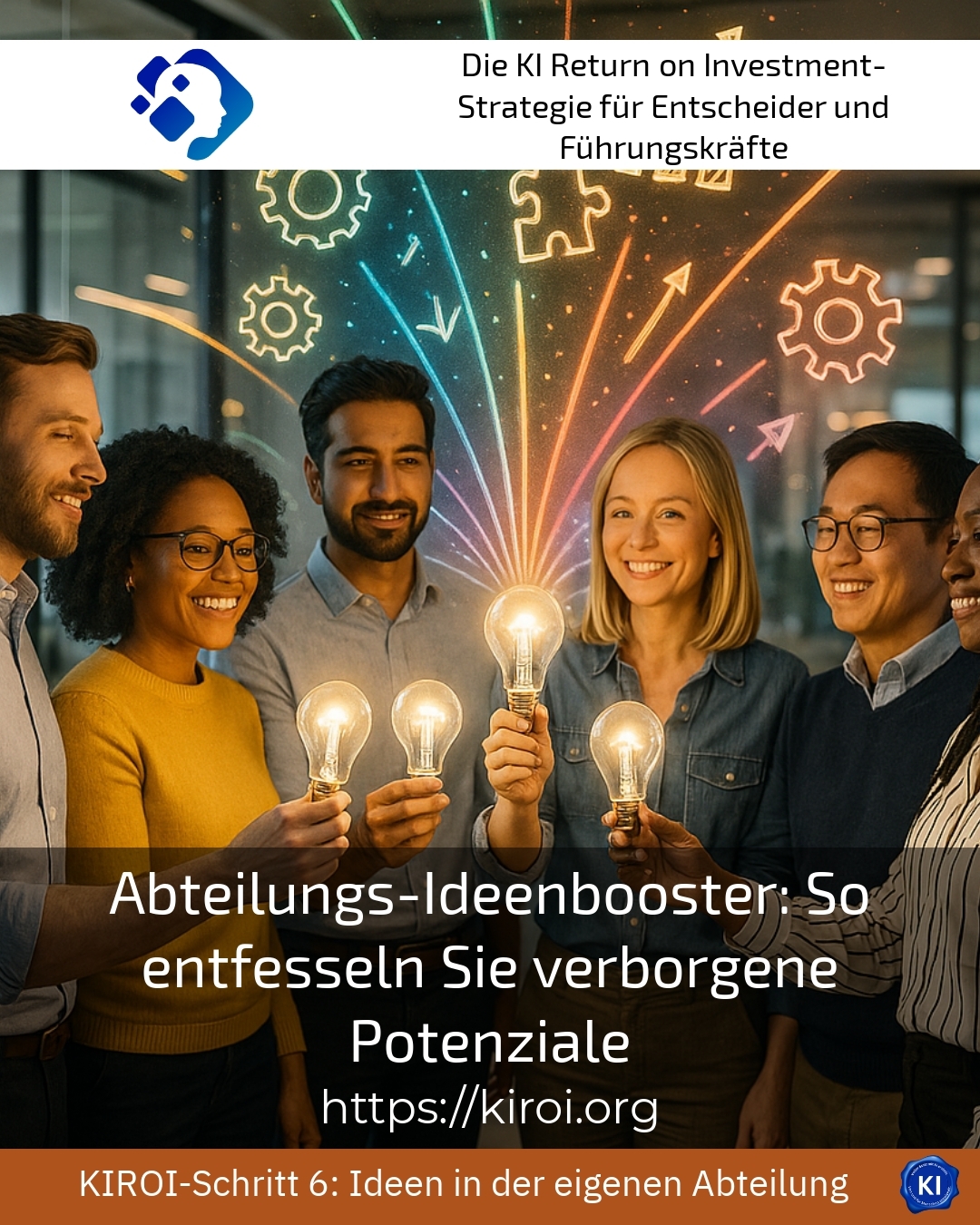
Imagine that within your company, there are ideas lying dormant, just waiting to be discovered. The Departmental Idea Booster can unearth these very hidden treasures and lead your team to new heights. Many leaders report that they underestimate the creative potential of their employees. Yet, the best innovations often arise where no one expects them. In this post, you will learn how to systematically unlock new impulses. You will get to know proven methods that have already transformed numerous organisations. At the same time, we will show you how transruptions coaching can support you in this process.
Why hidden potential in teams often remains undiscovered
Many organisations suffer from a culture of reticence. Employees don't voice their ideas because they fear rejection. Hierarchical structures exacerbate this phenomenon. A clerk in accounting may have brilliant suggestions for improving digital processes. Yet, they remain silent, believing they won't be heard. A team leader in sales observes customer needs daily that no one else sees. Nevertheless, she doesn't share her insights with product development. Such situations are not the exception, but the rule in German companies.
The reasons for this reluctance are manifold and often deeply rooted in the company culture. Sometimes, there is simply a lack of a forum where ideas are welcomed. In other cases, previous negative experiences have destroyed trust. Clients often report situations where their suggestions were ignored or even ridiculed. These experiences shape behaviour long-term and lead to a culture of silence. The first step towards change is to recognise and acknowledge these dynamics.
The Departmental Idea Booster as a Catalyst for Innovation
A structured approach can overcome these barriers and enable real transformation. For instance, within the financial services sector, a medium-sized bank revolutionised its processes. Counter staff developed an app idea for senior citizens, which is now used by thousands of customers. In the logistics industry, a warehouse worker proposed a new picking system. This system reduced errors by more than forty percent and significantly increased efficiency. A care home in the Munich area improved its staff scheduling through suggestions from the cleaning personnel. These examples demonstrate that innovation can come from anywhere.
The key lies in creating safe spaces for creative thinking. Psychological safety is not a side issue but an absolute prerequisite. When people are not afraid of consequences, they share their thoughts more freely. They dare to express unconventional suggestions. Transruption coaching supports organisations in establishing precisely this culture. It provides impetus on how leaders can build and maintain trust.
Best practice with a KIROI customer
A medium-sized mechanical engineering company with around three hundred employees approached us because its innovative strength had declined. Management observed that fewer and fewer suggestions for improvement were being submitted, even though market pressure was increasing at the same time. As part of our coaching process, we identified several causes for this development. Firstly, we established that the existing suggestion scheme was too bureaucratic and slow. Employees had to fill out extensive forms and often waited months for feedback. Furthermore, there was a lack of transparency regarding what actually happened with submitted ideas. We supported the company in introducing a digital platform for idea management. This platform enabled quick feedback and made the status of each idea visible. In addition, we established monthly innovation meetings where departments presented their suggestions. Within six months, the number of submitted ideas increased by more than two hundred percent. Three of these ideas led to patentable product improvements with significant market potential. Employee satisfaction in the affected departments improved measurably and sustainably.
Methods for activating the departmental idea booster
There are numerous proven techniques for systematically unlocking creative potential. Design Thinking has proven to be highly effective across many industries [1]. An automotive supplier used this method to redesign its manufacturing processes. The results exceeded all expectations and led to significant cost savings. In the insurance industry, a team developed new customer services using Design Thinking. These services achieved high satisfaction ratings among policyholders in a short period. A retail company used this method to redesign its stores to be more customer-friendly.
Besides Design Thinking, other approaches also offer valuable impulses for idea generation. Edward de Bono's Six Thinking Hats method systematically promotes different perspectives [2]. Brainstorming sessions with clear rules can also yield astonishing results. It is important here that criticism is held back at first and all ideas are welcome. In the pharmaceutical industry, research teams often use so-called ideation sprints for new active ingredient combinations. Hospitals rely on interprofessional workshops to optimise treatment paths. Software companies regularly hold hackathons, during which innovative solutions emerge.
The role of leaders in the departmental idea booster
Leaders play a crucial role in unlocking innovation potential. They must embody what they expect from others. A department head who doesn't share ideas themselves will hardly foster creativity in others. In the hospitality industry, this is particularly evident in successful concepts. Restaurant chefs who encourage their team create culinary innovations with great impact. In the construction industry, an open leadership style has led to revolutionary sustainability concepts. A hotel manager who listened to their employees developed an award-winning service concept.
The task of leaders is not to have the best ideas themselves. Rather, they should create frameworks in which others can shine. This means allocating time for creative thinking and providing resources. It also means viewing mistakes as learning opportunities and not punishing them. Disruption coaching supports leaders in developing this attitude. It accompanies them on the path to an innovation-promoting leadership culture.
Best practice with a KIROI customer
A municipal administration with several hundred employees was looking for ways to modernise its public services. The challenge was that many long-serving employees were sceptical of change. They had experienced projects that failed in the past. Our coaching approach initially focused on the leadership, sensitising them to their role as role models. We supported them in establishing a new culture that embraced mistakes and creating spaces for experimentation. Subsequently, we facilitated cross-departmental workshops where employees could contribute their ideas for improvement. The response was overwhelming and exceeded all expectations of the administrative leadership. Older employees, in particular, brought in valuable experiential knowledge that had never been tapped before. A case worker with thirty years of professional experience proposed a simplified application process. This idea was piloted and led to significantly shorter processing times. Citizens praised the improved quality of service in numerous feedback submissions. The administration is now planning to extend the approach to further departments.
Digital tools to support creative processes
Modern technologies can significantly facilitate and accelerate idea generation and management. Collaboration platforms enable teams to work together, even across spatial distances [3]. In the telecommunications industry, distributed teams use such tools for continuous innovation. Banks are using artificial intelligence to systematically analyse customer feedback for areas of improvement. Energy suppliers are using digital twins to test new process ideas risk-free. Craft businesses are documenting their knowledge in digital databases for future generations.
It is important to view technology as a tool rather than an end in itself. The best software is useless if the culture is wrong and people do not use it. A hospital implemented a complex idea management system that no one used. This only changed fundamentally when management actively invited people to use it. A trading company had similar experiences with its innovation platform. The breakthrough came when initial success stories became visible and were celebrated. In the media industry, such tools work particularly well with digitally savvy teams.
Overcoming obstacles and creating sustainable structures
The path to an innovative organisation is rarely straightforward and requires perseverance. Resistance is normal and should be taken seriously rather than ignored. Often, sceptical voices have valid objections that can contain valuable insights. An mechanical engineer learned about quality risks of a new product idea through critics. This feedback led to important adjustments before market launch. In the textile industry, a critical employee prevented a costly misinvestment. A software company improved its product planning by integrating sceptical developer voices.
Sustainability requires embedding innovation processes within the organisational structure. One-off workshops quickly fade if no follow-up activities are planned. Regular routines such as monthly idea rounds, on the other hand, create lasting change. In the chemical industry, quarterly innovation days have proven and established themselves. Insurance companies form permanent innovation teams with rotating members from various departments. Public utility companies firmly integrate idea development into their annual planning and budgeting. Transruption coaching supports organisations in designing such sustainable structures.
My KIROI Analysis
Working with numerous organisations has shown me that hidden potential is everywhere. It's just waiting to be discovered and utilised. The biggest challenge is rarely a lack of ideas, but rather the culture. When people feel safe to share their thoughts, remarkable innovations arise. I repeatedly observe how surprised leaders are when they learn about the knowledge that lies dormant within their teams. A departmental idea booster is therefore not a one-off event, but a permanent attitude.
My experience shows that three factors are crucial for success. Firstly, there needs to be genuine commitment from leadership, going beyond lip service. Secondly, safe spaces for creative thinking must be created and nurtured. Thirdly, perseverance is necessary, as cultural change takes time and doesn't happen overnight. Organisations that embrace these three elements experience amazing transformations. They discover talents they never knew existed. They develop solutions that differentiate them in the market and excite customers. And they create working environments where people are happy to give their best. These are the true fruits of a lived innovation culture.
Transruption coaching can effectively support and accelerate this process. It provides impetus, asks the right questions, and provides guidance during implementation. It's not about ready-made solutions, but about empowering self-development. Organisations learn to recognise and systematically utilise their own potential.
Further links from the text above:
[1] IDEO Design Thinking
[2] Six Thinking Hats – De Bono Group
[3] MURAL – Visual Collaboration Platform
For more information and if you have any questions, please contact Contact us or read more blog posts on the topic Artificial intelligence here.











 Deutsch
  English (UK)