
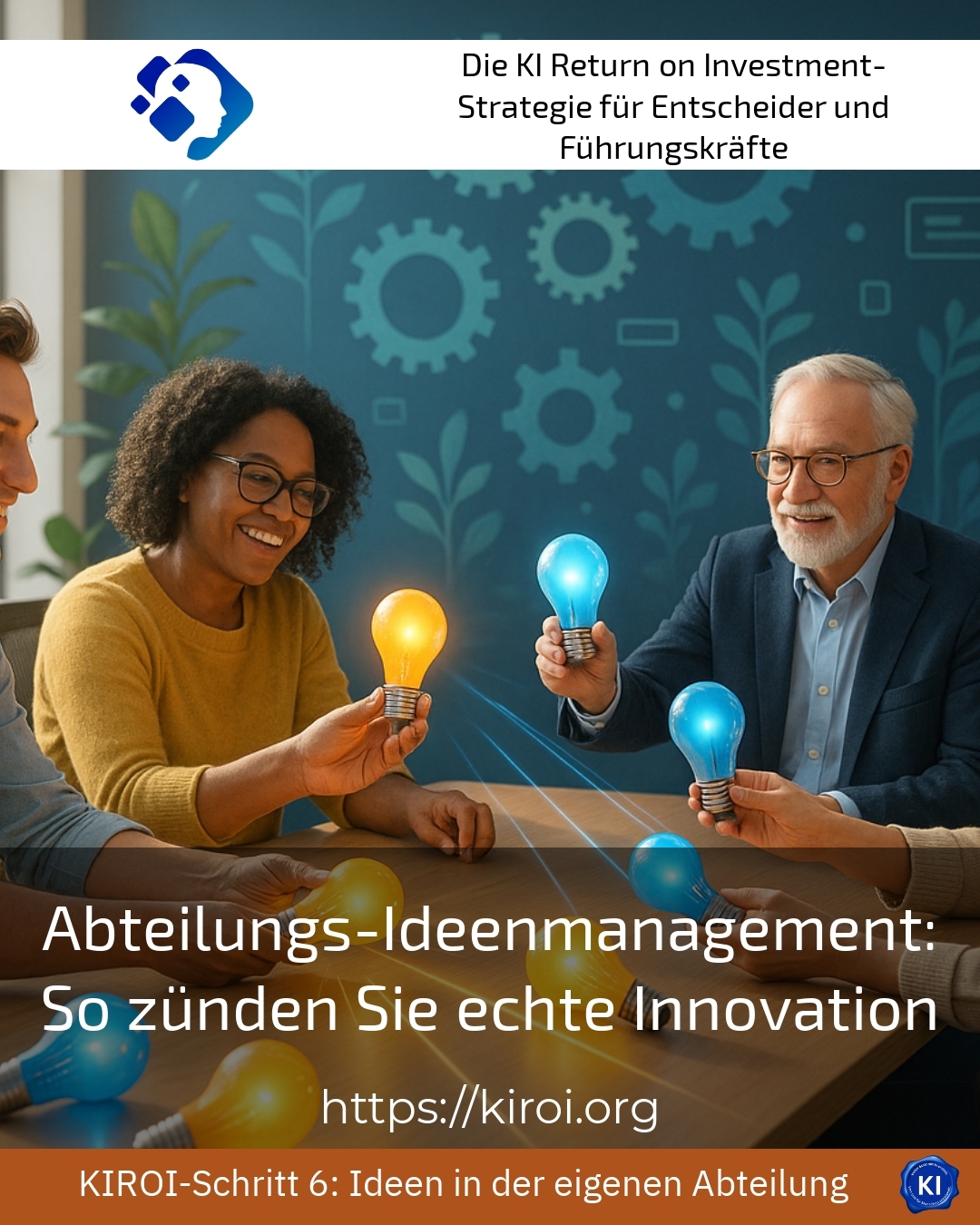
Imagine your employees develop ground-breaking ideas every day. However, these ideas disappear into virtual drawers. This is precisely where a well-conceived Departmental idea management It transforms hidden flashes of inspiration into real competitive advantages. Today, businesses face the challenge of systematically fostering creativity. At the same time, they need to achieve measurable results. The good news is that with the right structures, you can unleash untapped potential. This article shows you tried-and-tested ways. You will discover how you can sustainably embed a culture of innovation.
Why structured departmental idea management has become indispensable
The business world is changing rapidly and unpredictably. Companies therefore continually need fresh impetus from all hierarchical levels. A manufacturing company in the mechanical engineering sector recognised this necessity at an early stage. The engineers had developed numerous suggestions for improving manufacturing processes. However, a systematic channel for submission and evaluation was lacking. Following the introduction of structured innovation processes, the number of implemented ideas tripled. A logistics company faced similar challenges in the area of route optimisation. The drivers possessed valuable practical knowledge regarding traffic bottlenecks. It was only through regular innovation workshops that these insights could be systematically captured. A financial services provider, in turn, used digital platforms to collect customer service improvements. The field advisors submitted an average of twelve actionable proposals per month.
Managers frequently report untapped innovation potential within their teams. While they recognise the value of creative employees, suitable structures for capturing ideas are often lacking. Transruption coaching can offer valuable support here for projects involving innovation culture. It helps companies to develop appropriate frameworks. The individual starting point is always at the heart of the analysis.
Understanding the psychological foundations of a successful ideas culture
People only develop creative solutions when they feel secure. Psychological safety forms the foundation of every successful innovation initiative. A technology company in the field of software development therefore introduced open feedback sessions. The developers were now able to present even unpolished concepts without fear of criticism. A pharmaceutical company established anonymous submission options for sensitive suggestions for improvement. The laboratory assistants use this channel particularly intensively for safety notices. A retail company specifically trained its managers in appreciative communication. The sales employees subsequently submitted significantly more ideas for customer approach.
Best practice with a AIROI customer
A medium-sized company from the automotive supply industry approached us with a clear problem. The department heads complained about a lack of willingness to innovate within their teams. At the same time, there was frustration among employees about unheard suggestions for improvement. Our analysis uncovered several structural weaknesses in the existing suggestion scheme. The evaluation criteria were opaque and feedback was provided far too late. Together, we developed a multi-stage transformation plan for the entire company. First, we defined clear processes for idea submission and evaluation. Every proposal received initial, qualified feedback within five working days. We introduced monthly innovation meetings at department level, accompanied by trained moderators. The managers received coaching sessions on the appreciative evaluation of ideas and constructive criticism. After six months, the number of submitted proposals had tripled. The implementation rate rose from twelve to an impressive thirty-eight percent. Particularly pleasing was the increased employee satisfaction in the regular surveys. Employees now felt perceived as active co-creators of the company's development.
Implementing practical methods for effective departmental idea management
The selection of suitable methods depends heavily on the corporate culture. Not every technique suits every type of organisation equally well. An energy supplier successfully experimented with design thinking workshops for customer service innovations. The call centre employees thereby developed completely new approaches to handling complaints. A construction company relied on BarCamps, where site managers presented their process innovations. The informal setting fostered open dialogue across departmental boundaries. A media company used digital collaboration platforms for cross-site idea development [1]. Editors from different cities were thus able to jointly devise new formats.
Many companies come to us with the issue of stagnating innovation processes. They are looking for ways to break up entrenched structures. Transruption coaching provides impetus here for sustainable change. The support encompasses both strategic and operational aspects. Clients frequently report noticeable improvements within a few months.
Using digital tools as catalysts for department-level ideas management
Technology can considerably accelerate and simplify innovation processes. Modern platforms enable transparent idea evaluation by all participants. An insurance company introduced an AI-powered idea platform for product innovations [2]. The algorithms automatically identified synergies between various proposals from different departments. A retailer used gamification elements to boost motivation in the innovation process. Branch employees collected points for submitted and implemented suggestions for improvement. A consulting firm implemented virtual innovation spaces for international teams [3]. Consultants from various countries jointly developed new consulting approaches for complex client projects there.
Nevertheless, the technology remains just one tool among many. It does not replace human creativity and intuition. Rather, it assists with the structuring and documentation of ideas. The right balance between digital and analogue elements determines success.
Developing and empowering leaders as drivers of innovation
Without dedicated leaders, even the best innovation initiatives regularly fail. Managers must become role models for creative thinking and open communication. A chemical company trained its team leaders in agile management methods for innovation projects. As a result, the departments independently developed new approaches to quality assurance. A telecommunications provider established innovation sponsors at every hierarchical level of the company. These multipliers actively promoted the submission and further development of ideas. A food producer linked innovation metrics with the objectives of the executives. Consequently, the department heads invested significantly more time in creative team formats.
Best practice with a AIROI customer
An internationally active industrial company asked us for support with leadership development. Middle managers showed little willingness to promote their teams' innovation ideas. They regarded such activities as a distraction from the operational day-to-day business of their departments. We began with a comprehensive analysis of the existing leadership culture and incentive systems. In doing so, we found that innovation performance was not taken into account in performance appraisals. Together with the Human Resources department, we developed a new competency model for managers. The promotion of innovation was integrated into annual performance reviews as a measurable core competency. We designed a special development programme for the company's middle management level. The participants learned techniques for creative team leadership and idea evaluation. They intensively practiced appreciative communication, including when rejecting proposals. After a year, the culture of innovation in the departments involved had changed perceptibly. The managers now regularly invested time in structured innovation formats with their teams. The employee survey showed significantly improved scores for the perceived openness to innovation of their direct superiors.
Learning to recognise resistance and overcome it constructively
Change processes regularly meet with resistance in established organisations. This is particularly true for innovation initiatives that question existing routines. A steel producer specifically identified sceptics and involved them early on in pilot projects. The critical voices thus became valuable ambassadors for the new suggestion scheme. A hospital group transparently addressed concerns regarding workload due to lean processes. Nursing staff were now able to submit improvement ideas digitally in just a few minutes. A transport company openly allayed fears of job losses due to process optimisations. Communication consistently emphasised the development opportunities provided by saved resources for all participants.
Measuring and making successes visible for sustainable motivation
What is not measured is quickly forgotten. Clear metrics make the value of innovation activities tangible and comprehensible. A mechanical engineering company calculated the return on innovation for each implemented idea in detail. The impressive figures convinced even sceptical controlling departments of the value added. A textile manufacturer publicly published the most successful innovators in the internal newsletter every month. This recognition motivated other employees to submit their own suggestions for improvement on a lasting basis. An IT service provider consistently linked innovation contributions to the bonus system for all hierarchy levels [4]. The financial incentives increased participation in idea management measurably and permanently.
At the same time, intangible forms of recognition should not be underestimated either. A personal letter of thanks from the management can be very motivating. Public recognition at company events creates additional appreciation for innovators. Experience shows that combining different forms of incentives achieves the best results in the long term.
My AIROI Analysis
The systematic promotion of innovation at departmental level is proving to be a decisive competitive factor. Companies that establish structured processes for idea development benefit in multiple ways. They make targeted use of the collective knowledge of their workforce for continuous improvements. At the same time, they noticeably increase employee satisfaction through genuine opportunities for participation. The technological prerequisites for effective idea management are more accessible today than ever before. Modern platforms enable transparent, rapid and fair evaluation processes for all participants. Artificial intelligence can assist in recognising patterns and synergies between different proposals. Nevertheless, the human factor remains crucial for the sustainable success of any innovation initiative. Leaders must act as role models and create psychological safety within their teams. Employees need time and space for creative thinking alongside their day-to-day operational business. The corporate culture must be able to accept experiments and even failures as opportunities for learning. Transruption coaching can effectively support companies in shaping these complex transformation processes. The external perspective helps to identify blind spots and introduce new impulses. A successful culture of innovation does not emerge overnight, but through consistent, patient development work. However, the investment pays off several times over through increased competitiveness and engaged employees.
Further links from the text above:
[1] McKinsey: Innovation needs a structure
[2] Harvard Business Review: Innovation Topics
[3] Gartner: Innovation Insights
[4] Forbes: Innovation
For more information and if you have any questions, please contact Contact us or read more blog posts on the topic Artificial intelligence here.









 Deutsch
 English (UK)