
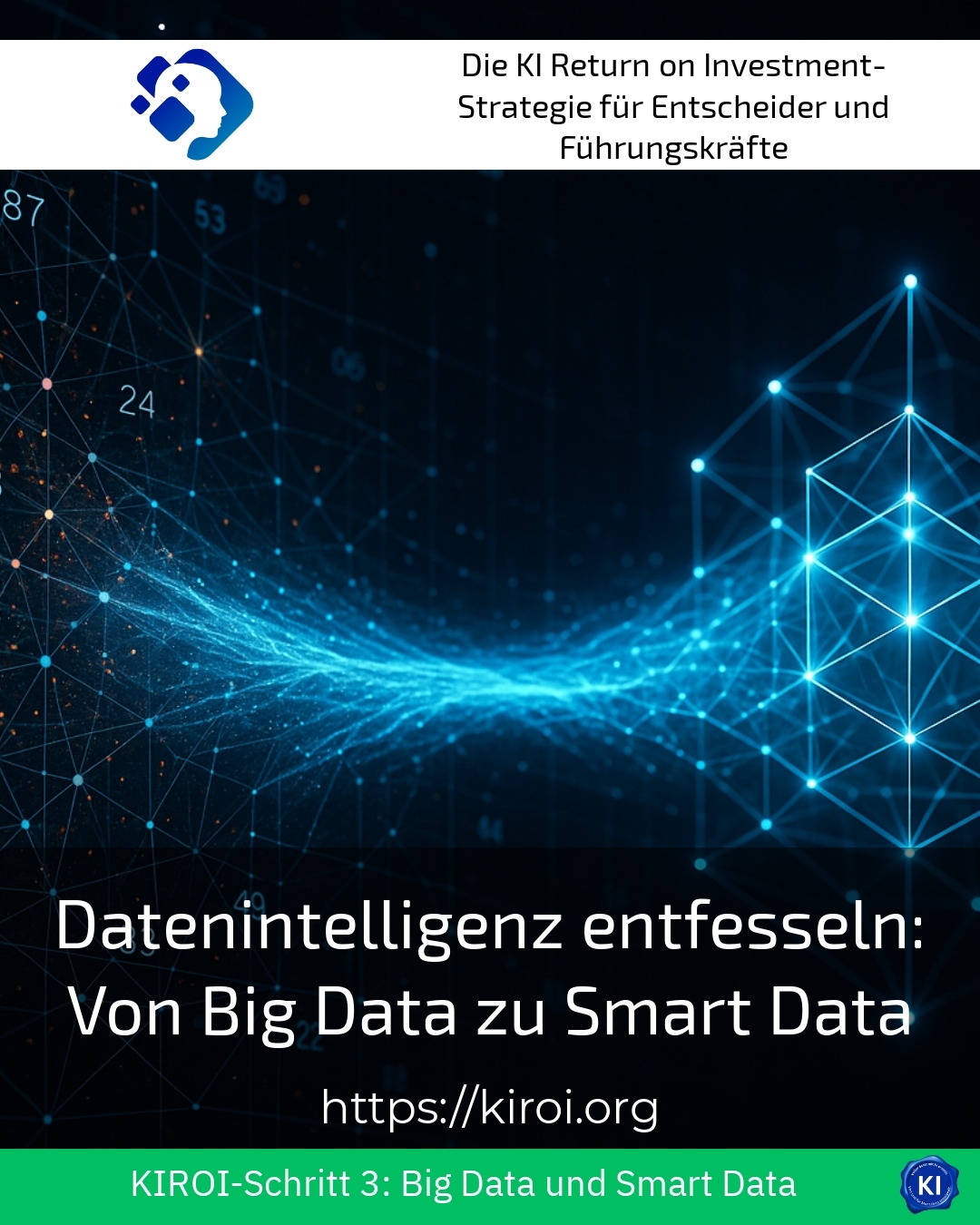
Imagine your company has inexhaustible amounts of data, yet no one knows what insights lie dormant within. This is precisely where the decisive transformation that is revolutionising organisations worldwide comes into play. The transformation From Big Data to Smart Data describes a fundamental paradigm shift in the modern business world. While previously the mere collection of information was considered a competitive advantage, leading minds now recognise an uncomfortable truth: data volumes alone do not create added value. It is only through intelligent processing, analysis, and contextualisation that raw columns of numbers are transformed into strategically valuable insights. This article accompanies you on a journey through the fascinating world of data intelligence and shows how companies can generate sustainable competitive advantages from the flood of information.
Understanding the Evolution of Data Processing: From Big Data to Smart Data
The history of digital data processing reads like a chronicle of exponential growth. Just a few decades ago, megabytes were considered vast amounts of storage. Today, individual sensors produce that amount of data within seconds. Companies therefore find themselves in a paradoxical situation. They have more information than ever before in human history. At the same time, many decision-makers feel less informed than ever. This discrepancy is explained by a fundamental misunderstanding. Many organisations confuse data quantity with data quality. However, the real breakthrough only occurs when raw information becomes contextualised insights. It is precisely this process that defines the transition From Big Data to Smart Data as a strategic necessity.
The foundations of this change are based on three essential pillars. Firstly, data must be relevant to specific business questions. Secondly, it needs to be of sufficient quality for reliable analyses. Thirdly, decision-makers require timely access to prepared insights. Only when these three factors interact does data intelligence unlock its full potential. Companies frequently report similar challenges on this journey. They struggle with isolated data silos, inconsistent data formats, and a lack of analytical expertise. However, these hurdles can be systematically overcome. The following sections illustrate concrete paths towards successful transformation.
Practical application areas of intelligent data usage
The practical implementation of data intelligence is evident across numerous business areas. In customer analysis, intelligent systems enable personalised communication in real-time. Marketing departments use these insights for targeted campaigns with higher conversion rates. In sales, predictive models help identify promising leads. Service teams anticipate customer concerns before they even arise. Product developers gain valuable insights into actual usage patterns. Finance departments optimise liquidity planning through more precise forecasts. HR managers identify attrition risks early and act proactively. These examples illustrate the breadth of application possibilities. Each function benefits in its own specific way from analysed information.
Best practice with a AIROI customer
A medium-sized retail company with multiple locations had been collecting transaction data, customer feedback, and logistics information across various systems for years. Management realised that this valuable information was largely going to waste. As part of a transruption coaching, we supported the company in developing an integrated data strategy. First, we jointly identified the most relevant business questions that should be answered through data analysis. Subsequently, we consolidated the various data sources into a unified platform. The team received input for developing dashboards for different user groups. Within a few months, the decision-making culture fundamentally changed. Branch managers made location-specific assortment decisions based on local sales patterns. The central purchasing team optimised order quantities through improved demand forecasting. The marketing department increased the effectiveness of its campaigns through targeted customer engagement. Executives frequently reported a completely new understanding of their business processes. The transformation supported the company in sustainably strengthening its competitive position and achieving operational excellence.
Technological Foundations for the Transition from Big Data to Smart Data
The technological framework for intelligent data utilisation has evolved considerably in recent years. Cloud platforms now enable scalable data processing without massive upfront investment. Machine learning methods automate complex analysis processes and recognise patterns in large volumes of data. Visualisation tools make insights accessible and understandable to a broad user base. Real-time processing systems deliver up-to-date information for time-critical decisions. All these technologies together form the foundation of modern data intelligence. However, the focus must not lie solely on technology. The best infrastructure remains ineffective without clear objectives and competent people.
Three specific examples illustrate the technological possibilities particularly clearly. A logistics company uses sensor data from its vehicle fleet for predictive maintenance. This reduces unplanned downtime and significantly cuts repair costs. A retailer analyses customer flow in its branches using anonymised movement data. These insights are incorporated into optimised store layouts and staff planning. A financial service provider detects fraudulent transactions through real-time pattern recognition. These examples show how diverse the applications for intelligent data utilisation are.
Organisational Prerequisites for Sustainable Data Intelligence
Technology alone does not transform a company. The crucial success factor lies in the organisational embedding of data intelligence. Leaders must actively demonstrate and demand data-driven decision-making. Employees need access to relevant information and the competence to interpret it. Processes must be designed to systematically capture and ensure the quality of data. An open culture of error encourages experimentation with new analytical approaches. These cultural factors often determine the success or failure of data initiatives.
In the context of transruption coaching, we support organisations in precisely these change processes. It repeatedly becomes apparent that technical and cultural transformation must go hand in hand. For example, a manufacturing company introduced regular data retrospectives. Teams reflect together on which decisions were data-based and what results were achieved. An insurance company established cross-functional analysis tandems of subject matter experts and data scientists. This collaboration improved both the quality of the analyses and their practical relevance. A healthcare provider trained its leadership in the interpretation of key figures. This led to well-founded discussions instead of superficial presentations of numbers.
Best practice with a AIROI customer
A professional services company faced a unique challenge. The company possessed extensive project data from numerous customer projects spanning many years. However, this information lay dormant in various systems and documents without any systematic preparation. Management wanted to make this knowledge usable for improved project planning and resource allocation. As part of our support, we first developed a framework for the structured capture of project experiences. Subsequently, the team implemented automated processes for extracting relevant key figures from existing data sources. The linking of project data with customer feedback and employee assessments proved particularly valuable. This resulted in multidimensional success profiles for various project types. Project managers were then provided with a tool for more realistic effort estimation for new orders. The staffing team was able to better match employee skills with project requirements. The sales department used the insights for more precise quote calculations and improved margin management. This holistic approach to knowledge utilization helped the company to measurably increase its profitability while simultaneously improving customer satisfaction.
Challenges on the path to a data-driven organisation
The path to data intelligence is rarely straightforward. Organisations encounter typical obstacles that can slow progress. Data quality issues often represent the biggest barrier. Incomplete, outdated, or inconsistent data leads to flawed analyses and undermines trust in data-driven decisions. A lack of data governance exacerbates this problem. Without clear responsibilities and standards, chaotic data landscapes emerge. Integrating different systems and data sources requires significant technical and organisational effort. Furthermore, data privacy requirements impose important limits on analysis and usage. However, these challenges can be systematically addressed.
Three practical examples illustrate typical approaches to solving these problems. A telecommunications provider introduced automated data quality checks at the source, significantly improving the quality of downstream analyses. An energy supplier established a central data competence centre as a point of contact for all specialist departments. This pooling of expertise accelerated analysis projects and improved their quality. An industrial company developed a phased model for step-by-step data migration to a unified platform. This pragmatic approach enabled quick successes with simultaneous long-term consolidation.
Ethical Dimensions of Data Use in a Business Context
Intelligent data use raises important ethical questions. Organisations have a responsibility to handle information with care. Transparency with customers and employees regarding data use builds trust. Algorithms must be checked for fairness and potential biases. The protection of sensitive information requires appropriate technical and organisational measures. These ethical aspects deserve special attention in all data initiatives. Responsible organisations establish clear guidelines and control mechanisms.
The practical implementation of ethical principles is evident in concrete measures. A recruitment agency anonymises applicant data before algorithmic pre-selection to avoid unconscious discrimination. an insurer makes the workings of its risk models understandable and explainable to customers. A retail company transparently informs about the use of customer data and offers comprehensive control options. These examples show that data intelligence and ethical action do not have to be contradictory.
My AIROI Analysis
The Transformation From Big Data to Smart Data represents one of the most significant transformation processes in modern corporate management. From my experience in numerous consulting projects, key success patterns are emerging. Firstly, organisations must clearly define their specific business questions before investing in technology. The focus should always be on tangible added value, not on technological perfection. The cultural dimension of the transformation deserves at least as much attention as the technical implementation.
Organisations that adopt an iterative approach are particularly successful. They start with manageable pilot projects, learn from their experiences, and scale successful approaches. This methodology reduces risks while simultaneously building internal competencies. Involving subject matter experts in analysis projects proves to be a critical success factor. Truly valuable insights are only generated by combining data expertise and business understanding. Leaders play a key role as exemplars and champions of data-driven decision-making.
The way From Big Data to Smart Data It is not a one-off initiative, but a continuous development process. Organisations that successfully navigate this journey create sustainable competitive advantages through better decisions and higher agility. The investment in data intelligence pays off in the long term, but requires patience, perseverance and strategic commitment from senior leadership. Transruption coaching can support organisations on this path and provide valuable impetus for successful transformation [1].
Further links from the text above:
[1] Disruptions Coaching for Digital Transformation
For more information and if you have any questions, please contact Contact us or read more blog posts on the topic Artificial intelligence here.









 Deutsch
  English (UK)