
Have you ever wondered why some companies seem to make the right decisions effortlessly, while others are literally drowning in a sea of information?
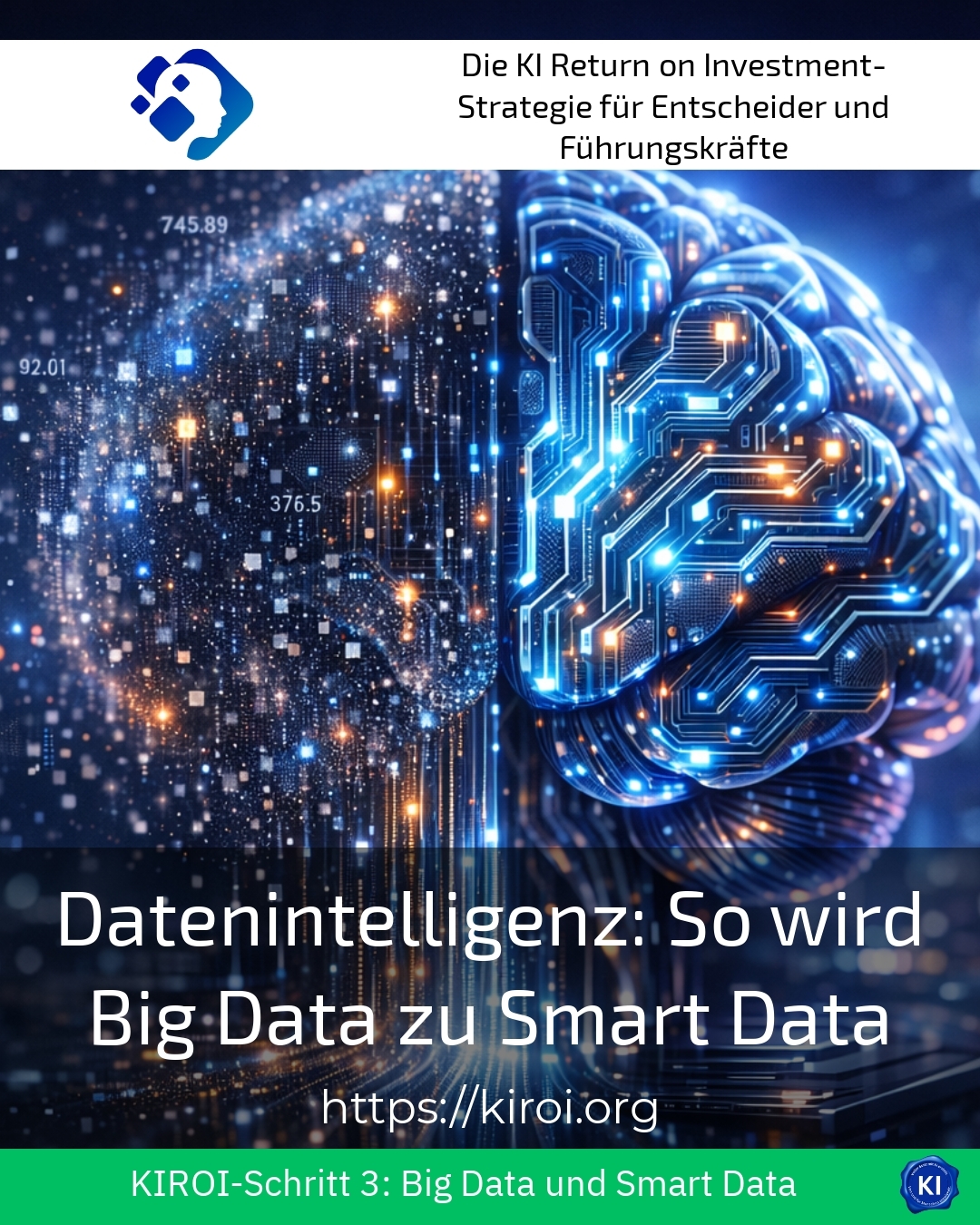
The answer lies in a fundamental change in the way data is used that is revolutionizing numerous industries right now. Data intelligence: This is how Big Data becomes Smart Data – this transformation describes a process in which raw numerical data is transformed into valuable insights. Companies today collect more information than ever before. But simply accumulating data volumes does not create added value. Only intelligent processing and context-based analysis enable informed decisions. In this article, we explore how this development works in practice and what opportunities it offers.
From data deluge to strategic resource
The challenge begins with the volume of available information, as billions of data points are generated worldwide every day in their raw form, which at first may appear to be of little value. Sensors in production facilities continuously collect temperature values and machine performance. Cash register systems log every single sales transaction. Logistics platforms track delivery routes in real time. And customer service departments document all inquiries and complaints. These information streams form the foundation for intelligent analyses.
However, practice often shows a disappointing picture. Many organizations store enormous amounts of data. However, they only actually use a fraction of it productively. This is where the transformation process begins, in which unstructured raw data is filtered and enriched. This leads to actionable insights. For example, a medium-sized machine manufacturer recognized recurring failure patterns through systematic analysis of its maintenance logs. This insight enabled preventive maintenance measures. A trading company, in turn, linked weather data with sales figures. This enabled it to significantly optimize its order quantities for seasonal products.
Best practice with a AIROI customer
An internationally operating automotive supplier faced the challenge of making its quality control more efficient, while traditional testing procedures were time-consuming and still allowed for the occasional passage of defective components. As part of a transruptive coaching process, we first analyzed all available data points from the manufacturing process. It turned out that valuable information already existed, but it lay dormant in various systems in isolation. By combining machine sensor data, environmental parameters, and historical error logs, the team developed a predictive model. This model now identifies potential quality deviations during the manufacturing process. The rejection rate has now decreased by almost thirty percent in the following months. At the same time, the manual testing workload has significantly decreased. Today, the employees report a significantly more relaxed working atmosphere. They can focus on really critical inspection steps, instead of routinely inspecting each component individually.
Data intelligence as a competitive advantage in SMEs
Clients often report that they feel overwhelmed by the sheer number of available technology solutions, which is why a structured approach to the topic is needed. Data intelligence: This is how Big Data becomes Smart Data It becomes all the more important. SMEs often have decades of accumulated experience. However, this knowledge is rarely available in digital form. Integrating implicit expert knowledge with systematically captured process data opens up enormous potential.
An example from food production illustrates this point impressively. A family-run bakery used the expertise of its long-time bakers. They intuitively knew when the dough had reached the perfect consistency. Through sensor technology and machine learning, this knowledge was digitized. Today, an assistant system also supports less experienced employees. The product quality remains consistently high. Another example comes from the metalworking industry. There, a company combined order data with machine utilization data. The resulting transparency enabled a significantly more precise scheduling for customers.
Notable developments are also being seen in the customer service area. A service company systematically analyzed incoming support requests. From this, it identified patterns that indicated common problems. Preventive information campaigns significantly reduced the volume of requests. At the same time, customer satisfaction increased due to faster problem resolution.
Understanding and applying technological fundamentals
Technical infrastructure forms the backbone of any successful data initiative, with modern cloud solutions making entry significantly easier today because they provide scalable storage and computing capabilities without requiring high initial investment. Machine learning algorithms recognize patterns in complex datasets. These patterns often remain hidden to the human eye. Visualization tools make results understandable. This also allows departments without programming skills to benefit.
For example, a logistics company implemented a dashboard for fleet managers. It combines real-time data on vehicle locations and delivery status. Managers now make more informed decisions. Delays are detected and communicated earlier. An energy provider, in turn, uses consumption forecasts from historical data. These influence the purchasing strategy in the electricity market positively. A third example concerns retail. Algorithms analyze cash register data and visitor flows there. The results are used to inform product assortment decisions and personnel planning.
Cultural change as a success factor for data intelligence
Technology alone does not guarantee success; ultimately, it is up to people to determine whether data-based insights lead to better decisions. A data-driven corporate culture requires openness and a willingness to learn. Leaders play a crucial role as role models. They should actively ask for data and transparently justify decisions.
Experience shows that resistance often arises from uncertainty. Employees sometimes fear that their expertise will be devalued. Transruptive coaching can provide valuable insights in this regard. It helps teams integrate new working methods. The combination of human intuition and machine analysis often proves particularly effective. An insurance company trained its claims handlers on using analytical tools. They quickly recognized the benefits for their daily work. Complex claims cases could be handled more efficiently. A construction company established weekly data reviews. There, construction managers discussed key figures and deviations together. The collegial exchange fostered continuous improvements.
Best practice with a AIROI customer
A mid-sized pharmaceutical company was looking for ways to accelerate its research and development processes without compromising quality standards, which presented a particular challenge given strict regulatory requirements. As part of our support, we initially identified all the data sets that had emerged during clinical trials. This information was available in disparate formats and systems. By developing a unified data platform, researchers were able to make cross-references between different studies for the first time. Side effect profiles could now be compared and evaluated more systematically. The time from the discovery of a promising active substance to market readiness was significantly shortened. At the same time, the quality of documentation for regulatory approval procedures improved significantly. The scientists reported a real liberation, because they were finally able to work in a structured way, instead of having to struggle with fragmented documentation.
Consideration of data protection and ethical responsibility
With increasing analytical capabilities, so does the responsibility for careful handling of sensitive information, which is why data protection concepts should be considered from the outset and not be perceived as a restriction only at a later stage. Personal data requires special care. Anonymization and pseudonymization offer proven approaches in this regard. Transparency towards the data subjects creates trust and acceptance.
For example, a healthcare provider developed clear guidelines for patient data. Employees received training on data protection-compliant working practices. A financial institution implemented automated deletion deadlines for information that was no longer needed. This significantly reduced the risk of data breaches. A staffing agency adapted its applicant management processes to comply with the GDPR. Candidates received full transparency about the use of their data.
Practical steps for implementing smart data strategies
The journey from unused data repositories to Data intelligence: This is how Big Data becomes Smart Data it requires a structured approach that takes into account both technical and organizational aspects [1]. The first step typically involves a review of existing data. What data already exists within the company? Where are they stored? Who has access to them?
This is followed by prioritizing application cases. Not every possible analysis promises the same added value. Rapid successes in manageable pilot projects create motivation. They demonstrate the practical benefits to skeptics. A chemical company began by analyzing energy consumption [2]. The identified savings potential funded further digitization projects. A textile manufacturer initially focused on complaint analyses. The insights gained improved product quality measurably. A media house evaluated usage data from its online offerings. Content decisions are based on sound insights from now on.
Partnerships with specialized consulting firms can accelerate the onboarding process. External expertise meaningfully complements internal competencies. The combination often leads to more sustainable results. This does not mean using off-the-shelf solutions. Instead, tailor-made concepts are created through a collaborative dialogue.
My AIROI Analysis
Transforming raw data into actionable insights represents one of the central management challenges of our time; while technological progress does indeed open up impressive possibilities, the actual success factor lies in its intelligent application to concrete business problems. From my consulting experience, I know that successful Data intelligence-Always start projects based on the specific needs. They do not prioritize the technology. They first ask about the business benefits [3].
Organizations that successfully take this path share several common characteristics. They have clear responsibilities for data quality and data usage. They continuously invest in the training of their employees. They cultivate a culture of transparency and constructive handling of errors. And they do not view data analysis as a one-time project; they see it as an ongoing learning process.
The examples from a wide variety of industries demonstrate the enormous potential of this development. At the same time, they illustrate that patent recipes do not exist. Each organization must find its own path. Professional guidance can provide valuable insights. It helps avoid typical pitfalls and achieve results more quickly. The future belongs to those who not only protect their valuable data but also actively use it. The tools are ready. The only question left is: When do you start?
Further links from the text above:
[1] Bitkom – Guide to Big Data and Data Analysis
[2] Fraunhofer Society – Research on Artificial Intelligence and Data Analysis
[3] McKinsey Digital Insights – Strategies for data-driven companies
For more information and if you have any questions, please contact Contact us or read more blog posts on the topic Artificial intelligence here.










 Deutsch
 English (UK)