
Data intelligence as the key to targeted data utilisation
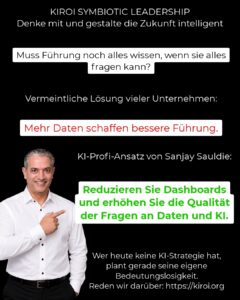
Data intelligence is increasingly important in today's business world. Companies are faced with a flood of data, but the sheer volume alone does not guarantee value. Rather, it is about how companies intelligently analyse and use this data. Data intelligence provides crucial support here by paving the way from mere data collection to concrete, actionable insights. Decision-making processes are thus accelerated and risks are reduced.
Examples from various sectors illustrate how data intelligence can support. In retail, companies use special algorithms to analyse purchasing habits in order to create personalised offers. In healthcare, intelligent data analyses improve diagnostic accuracy through automated image evaluation. In logistics too, data intelligence enables the optimisation of delivery routes and contributes to cost reduction.
Data intelligence in the interplay of Big Data and Smart Data
The difference between Big Data and Smart Data is central to successfully unlocking data intelligence. Big Data describes large volumes of diverse raw data, which are often unstructured and complex. While they form the foundation, they pose the challenge of being used economically. This is where Smart Data comes into play: it is extracted from Big Data using intelligent algorithms and comprises high-quality, targeted, and contextually relevant information.
Companies from the financial sector use Smart Data to better assess risks in real-time. Media streaming portals optimise recommendations through the targeted analysis of relevant viewer data. Automotive manufacturers can make more precise predictions for maintenance and production using Smart Data.
Another example is the use of AIROI 3, a platform that combines Big Data and Smart Data to truly enable data intelligence. It helps companies to quickly and efficiently extract relevant information from the flood of data and make it usable for operational and strategic decisions.
Practical support through transruption coaching
Many companies already have extensive datasets but struggle to implement a tailored data strategy. Transruption coaching helps with this by supporting individual data intelligence projects and assisting with the deployment of the correct technologies.
In the field of medical technology, the integration of AI methods for image analysis has been achieved through such support. The result is more precise diagnoses and more efficient workflows. For a manufacturing company, the focus on Smart Data led to a reduction in production errors and increased punctuality.
BEST PRACTICE with one customer (name hidden due to NDA contract) This online retailer used data intelligence to deeply analyse customer data. This led to targeted cross-selling campaigns, which significantly increased sales while simultaneously improving customer loyalty.
Tips for effective use of data intelligence
To successfully implement data intelligence, companies should consider the following steps:
- Ensuring data quality: only high-quality data yields reliable insights.
- Develop a clear data strategy: define objectives and relevant questions.
- Select appropriate technologies, such as AI tools and machine learning for automated evaluations.
- Involve technical expertise to accompany and interpret data processes.
- Continuous adjustment of strategies to respond to new challenges and data sources.
This prevents large volumes of data from becoming a burden. Instead, companies create added value with data intelligence – whether through precise forecasts, optimised processes, or improved customer experiences.
Examples of practical successes
In the insurance industry, data intelligence enables the rapid processing of claims based on relevant historical and external data. E-commerce companies benefit from personalised offers generated with smart data, which increase conversion rates. In the energy supply sector, data-intelligent solutions help to analyse consumption patterns and develop energy-efficient strategies.
My analysis
Data intelligence is not an abstract concept, but a practical approach to making large and diverse datasets usable. The combination of Big Data and Smart Data creates the necessary context and quality to successfully manage business processes. Support from specialised coaches, such as within the framework of transruptions coaching, helps companies to realise these potentials. Overall, data intelligence leads to more efficient processes, customer-centric offerings and safer decisions. Companies that embrace these impulses benefit from tangible competitive advantages.
Further links from the text above:
What is data intelligence and what does it mean? [1]
Big data vs. smart data: is more always better? [2]
Unleash Data Intelligence: AIROI 3 – Big Data Meets Smart… [5]
Why Data Intelligence is the key to your… – Comeco [7]
For more information and if you have any questions, please contact Contact us or read more blog posts on the topic Artificial intelligence here.










 Deutsch
  English (UK)