
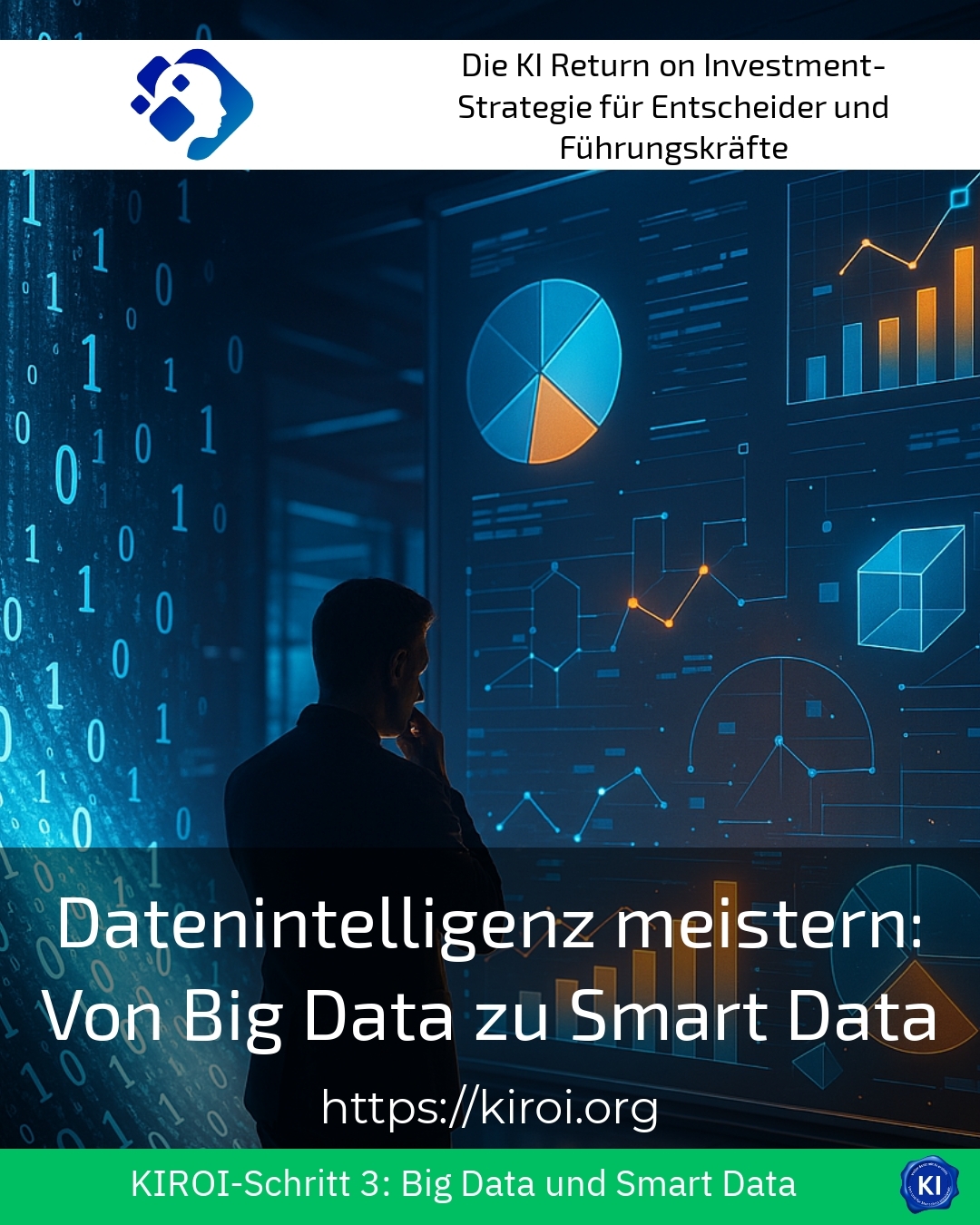
In a world that produces billions of data points every day, companies face a colossal challenge, because the sheer volume of information overwhelms traditional analysis methods and demands new approaches that can extract valuable insights from the digital noise. The journey from big data to smart data describes precisely this transformation process, where it is no longer a matter of collecting as much data as possible, but rather of making the right data usable at the right time for the right decisions. Whoever understands this change and actively shapes it not only positions themselves as a pioneer in their market segment, but also unlocks entirely new opportunities for value creation and customer loyalty.
The fundamental shift: why sheer volumes of data are no longer enough
For years, the guiding principle was that more data automatically enables better decisions, but in practice, this assumption has proven to be a fallacy. Companies were literally drowning in data lakes. They were barely able to make sensible use of the information gained. The real challenge lies not in gathering, but in intelligent processing. Organisations therefore need a strategic framework for their data activities. Transruptions coaching supports precisely this realignment [1].
For instance, a medium-sized mechanical engineering company spent years collecting sensor data from its production facilities without gaining any notable benefit from it. The hard drives steadily filled up with terabytes of raw data. However, analyses remained superficial and of little significance. It was only through a structured transformation process that the company was able to identify relevant patterns and implement predictive maintenance. A logistics service provider experienced a similar situation, having recorded vehicle data without deriving route optimisation from it. A retailer, on the other hand, had extensive customer data at its disposal, but did not use it for personalised offers.
Best practice with a AIROI customer
An internationally active automotive supplier faced the challenge that its various production sites operated their own data collection systems, but these did not communicate with each other and therefore did not allow a holistic picture of company performance. The management recognised that valuable optimisation potential remained untapped because correlations between sites were not visible and best practices could not be systematically transferred. As part of a multi-month support process by transruptions Coaching, the company first developed a uniform data strategy that defined clear goals and established responsibilities. Subsequently, the existing systems were gradually harmonised and supplemented with intelligent analysis tools that could automatically identify relevant patterns and generate recommendations for action. The result left a lasting impression on everyone involved, as the scrap rate was reduced by eleven percent within six months. At the same time, planning accuracy improved significantly. The employees also reported a significantly higher level of satisfaction because they could now finally access reliable information.
From Big Data to Smart Data: The path to intelligent data usage
The transition from big data to smart data requires more than just technological upgrades, as it demands a fundamental rethink across the entire organisation and a clear vision of what questions the data is actually supposed to answer. First, companies must define their data strategy. Then follows the technical implementation. In parallel, cultural changes are needed. Employees must understand the value of data-driven decisions [2].
For example, an energy supplier implemented smart meters for its customers and thereby gained detailed consumption profiles that both improved grid planning and enabled personalised energy-saving tips. A pharmaceutical company stopped using clinical trial data solely for approval procedures and also used it to develop new therapeutic approaches through pattern recognition processes. A financial services provider, in turn, linked transaction data with external economic indicators to identify risks earlier and adjust its portfolio accordingly.
Data intelligence as a strategic competitive advantage
Organisations that master data intelligence gain decisive advantages over their competitors because they can react more quickly to market changes, anticipate customer needs more precisely and continuously optimise operational processes. This capability is increasingly developing into a critical success factor. Markets are changing faster and faster. Customer requirements are becoming more complex. Only data-driven companies can keep up.
A telecommunications provider analysed customer usage patterns, enabling it to identify churn risks at an early stage and initiate targeted retention measures. An insurance company developed new prevention offers for its customers based on aggregated claims data. A food manufacturer optimised its production planning by evaluating weather data and seasonal sales patterns.
Practical steps for transforming the data landscape
The journey from big data to smart data often begins with an honest stocktake of existing data assets, analytical capabilities and organisational structures, because only those who know their starting point can plan a realistic route to their destination and estimate the resources required. This analysis often reveals surprising gaps. At the same time, hidden potentials become visible. External guidance helps to identify blind spots. transruptions coaching provides valuable impetus here [3].
During such an analysis, a construction company discovered that valuable project data was slumbering in isolated departmental solutions and was never systematically evaluated. A hospital operator realised that patient data, although extensively documented, was hardly ever used for quality improvements. A retail company found that its various sales channels each maintained their own customer databases without synchronising them.
Best practice with a AIROI customer
A medium-sized company in the chemical industry was struggling with the challenge that while its production processes were highly automated, the data generated was only used for immediate process control and did not generate any strategic added value. The company management recognised this untapped potential and opted for a comprehensive realignment of its data activities, making a point from the outset of actively involving the workforce and taking their concerns seriously. Through structured guidance as part of transruption coaching, the project team initially developed concrete use cases that promised immediate benefit and served as pilot projects. These pilots impressively demonstrated how quality forecasts could be derived from production data to prevent faulty batches before they occurred. The employees experienced the change as support for their daily work rather than a threat to their position, which significantly increased acceptance of the new systems. Following the pilot phase, the company rolled out the solution progressively across all production lines, drawing on the experience gained and the expertise acquired, meaning subsequent implementations proceeded significantly faster and more smoothly than originally planned.
Cultural transformation as the key to success
Technology alone is not enough to master data intelligence, because without a culture that promotes and supports data-driven decisions, even the most advanced analytical tools remain ineffective and gather dust as expensive white elephants in the organisation's digital basements. People need to understand the added value. They require the appropriate competencies. Leaders must act as role models. Mistakes should be viewed as opportunities to learn.
A media company introduced regular data workshops for all departments, thereby promoting an understanding of analytical thinking. An industrial company established data champions in every area who act as multipliers and contact persons. A service company integrated data literacy as a fixed element in its leadership development.
Technological building blocks for intelligent data processing
The technological landscape for data processing and analysis has evolved rapidly in recent years and today offers powerful tools that have also become affordable and manageable for medium-sized enterprises, meaning that the barriers to entry have fallen significantly. Cloud solutions are democratising access. Pre-configured modules are accelerating implementation. Modern interfaces are simplifying integration. Artificial intelligence is automating analysis tasks [4].
A logistics company implemented cloud-based analytics platforms that provided scalable computing capacities without large upfront investments. A retailer used pre-built sales forecasting algorithms that could be quickly adapted to its specific requirements. A healthcare provider linked various data sources via modern API interfaces to create an integrated information system.
My AIROI Analysis
The transformation from big data to smart data represents one of the most significant challenges for many organisations in the coming years, because it simultaneously requires technological, organisational and cultural changes and therefore affects the entire corporate structure. From my observation, clients frequently report that they are initially overwhelmed by the sheer complexity of the topic and do not know where to begin, which is why structured guidance can be particularly valuable, especially in the initial phase.
Successful transformation projects are consistently characterised by the fact that they do not begin with major technological leaps, but with clearly defined, manageable use cases that enable quick wins and strengthen confidence in the overall process. transruptions coaching accompanies precisely these projects. It assists with strategy development. It provides impetus for practical implementation. It helps to avoid typical stumbling blocks.
What seems particularly important to me in this regard is the recognition that data intelligence is not a goal that is reached at some point and can then be ticked off, but rather a continuous development process that must adapt to changing conditions and constantly unlocks new optimisation potential. Companies that internalise this perspective develop a sustainable ability to learn that secures them long-term competitive advantages and equips them for future challenges, regardless of what technological developments the coming years may bring.
Further links from the text above:
[1] McKinsey: The Data-Driven Enterprise
[2] Harvard Business Review: Data Analytics
[3] Gartner: Data om Analytiske Indsigt
[4] Forbes: Big Data Insights by Bernard Marr
For more information and if you have any questions, please contact Contact us or read more blog posts on the topic Artificial intelligence here.









 Deutsch
  English (UK)