
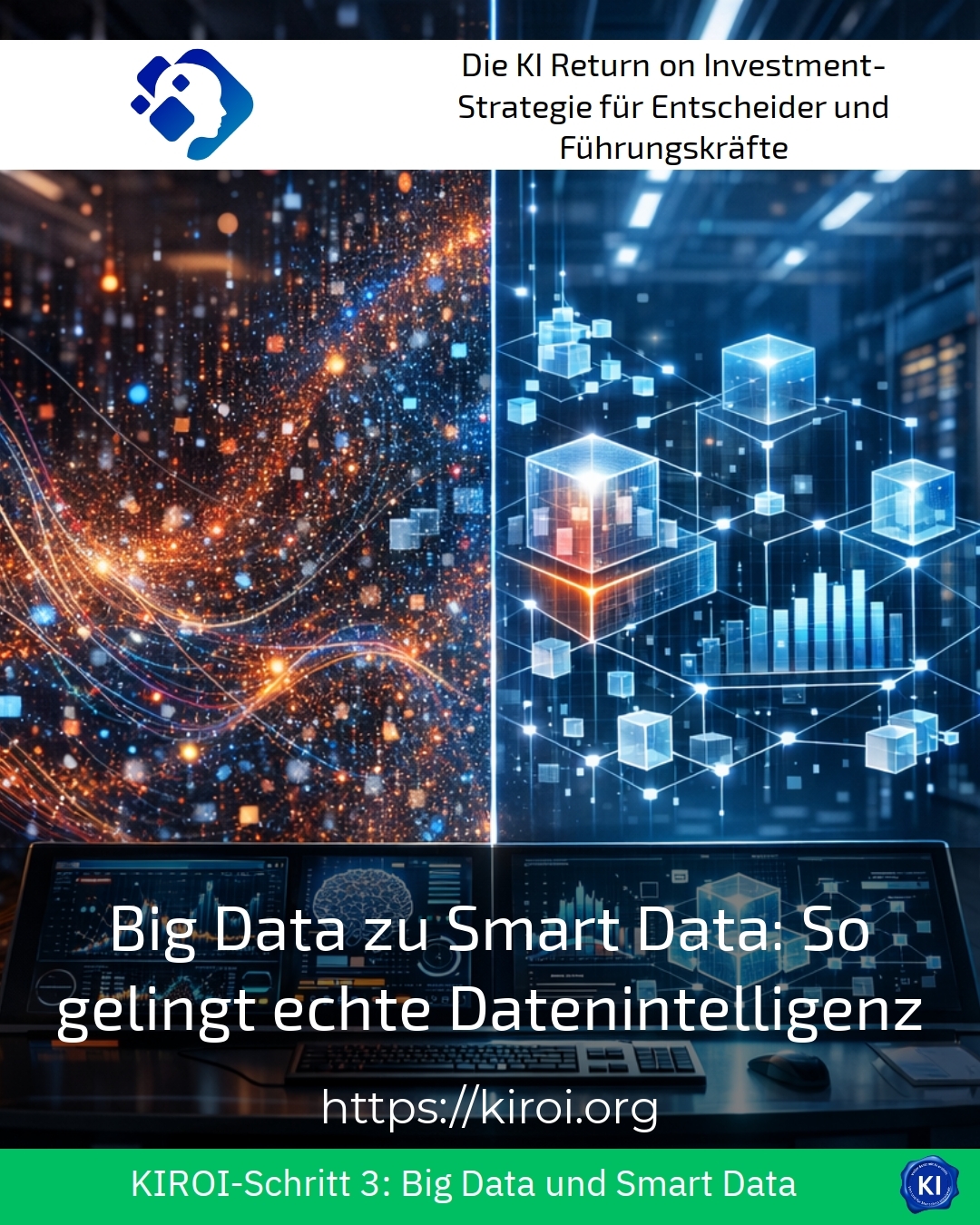
Have you ever wondered why some companies in Bergen drown in information while others can derive precise decisions from it as a matter of course? The transformation of big data into smart data currently represents one of the biggest challenges organizations face, and it is here that often the difference between those who can compete and those who fall behind is decided. This development concerns numerous decision-makers who come to me for coaching because they feel that raw data volumes alone do not create any added value; they can only become real insights through intelligent processing.
The fundamental challenge: From data noise to real insight
The central problem for many organizations is that they collect enormous amounts of information, but often fail to take the crucial step to utilize it effectively, leading to frustration and missed opportunities. The potential is literally in front of them, yet a structured approach to extracting the actual value is often lacking. Many decision-makers report overflowing storage capacities that are continuously growing without leading to actionable conclusions. This creates a paradoxical situation where more information does not lead to better decisions but rather a kind of paralysis due to excess. The transition from big data to smart data therefore requires a fundamental change in perspective that places quality above quantity [1].
In the field of medical care, this problem manifests itself particularly clearly when patient records, laboratory results, and imaging data are stored in different systems and cannot communicate with each other. A hospital collects thousands of data points per patient every day, but the compilation into a holistic health picture rarely occurs automatically and requires manual work by overloaded staff. Similarly, in nursing facilities, vital signs, medication schedules, and movement profiles are recorded separately, although their correlation could provide valuable early indicators of health developments.
Best practice with a AIROI customer
A larger rehabilitation clinic faced the challenge of its various departments using their own documentation systems, which significantly hampered holistic patient care and led to information losses during transfers. As part of our transruptive support, we first analyzed all existing data flows and identified the relevant connections that had previously remained untapped and represented latent potential. Together, we developed a step-by-step approach that combined the most important patient information from physiotherapy, psychological support, and medical care in a central dashboard, thereby creating the foundation for evidence-based therapy adjustments. After the implementation, employees reported significantly improved overview and faster response times in critical changes because they could now see the relationships between different treatment areas at a glance. The ability to identify patterns that would have remained invisible when viewed individually was particularly valuable, such as the correlation between sleep quality and therapeutic progress.
Data intelligence as a strategic success factor in the healthcare sector
The targeted use of preprocessed information can literally save lives in the medical context when used correctly and the right questions are asked of the existing data sets. It is not about collecting more and more information, but rather about intelligently linking the already available data sets and evaluating them contextually. For example, a general practitioner has years of records of his patients that could provide valuable insights into development trends if they were systematically analyzed [2]. Transforming big data into smart data enables preventive interventions in such cases before acute problems arise.
Pharmacies represent another interesting area of application because they possess extensive information about drug interactions and dosing behavior that goes beyond what individual physician practices can monitor. With proper processing, these data sets could provide important clues about potential interactions, especially when patients are treated simultaneously by multiple physicians. In long-term care settings, there are also enormous potential for improvement because continuous monitoring of residents can reveal patterns that indicate emerging health changes.
Technological prerequisites for intelligent data processing
Technical infrastructure forms the foundation for any successful data transformation, with the selection of suitable tools depending on specific requirements and existing structures. Modern analytics platforms now also allow smaller institutions to perform complex analyses without the need for dedicated specialist departments. Preconfigured algorithms support pattern recognition and can often uncover connections that would be missed by human analysts. In radiology practices, for example, such systems can assist in diagnosis by highlighting conspicuous areas in imaging and thereby directing the attention of specialist physicians specifically [3].
Integrating different systems often presents the biggest hurdle, because historically built software landscapes were rarely designed for smooth data exchange. Laboratory information systems do not automatically communicate with practice management programs, and hospital systems speak different languages than outpatient care structures. This fragmentation leads to valuable information remaining siloed and unable to realize its potential, even though technical solutions for interface problems have long been available.
Big Data to Smart Data: Practical Implementation Strategies
The path to true data intelligence leads through several clearly defined steps that should be systematically followed in order to achieve sustainable results and avoid typical pitfalls. First, a thorough inventory is required that captures all available data sources and assesses their quality and timeliness. Many organizations are surprised by the information assets they already possess without ever having systematically exploited them. Transruptive follow-up begins at this point and helps set priorities and develop a realistic roadmap.
In dental practices, for example, there are often years of treatment histories, which could provide valuable insights into successful therapeutic approaches for different patient groups if properly evaluated. Physiotherapy practices have detailed documentation of treatment histories, the analysis of which could provide insight into particularly effective therapeutic combinations. Nutrition consultants also collect extensive information about eating habits and the changes made by their clients, which, when systematically evaluated, would provide important impulses for individualized counseling approaches [4].
Best practice with a AIROI customer
A network of family practice clinics approached us with the question of how they could better utilize their extensive patient data to identify high-risk patients early and initiate preventive measures. The challenge was that the individual practices used different software solutions and lacked a uniform data standard, which initially made the overall analysis seem impossible. As part of our transruptive support, we jointly developed a concept for a unified data layer that could act as a mediating layer between the various systems and combine relevant parameters in a standardized format. Particularly important was the close involvement of the practice staff, who could provide valuable insights into the information that was actually relevant and whose acceptance was crucial for the success of the project. The transformation of big data into smart data was achieved in this case by focusing on a few but meaningful metrics that are now available across practice settings and enable comparisons between different treatment approaches.
Challenges and ethical aspects of data use
The intensive use of health information inevitably raises questions of data protection and ethical responsibility, which must be carefully considered before launching any relevant projects. Patients trust that their sensitive information will remain protected and used only for their direct benefit. At the same time, broader data use could bring significant benefits to the public at large, for example in the research of disease causes or the optimization of treatment methods [5]. This tension between individual privacy and collective benefit requires transparent communication and informed consent.
In hospitals, this problem is particularly evident when research projects want to access clinical data and require the involvement of appropriate ethics committees. The question also arises in nursing homes of whether motion profiles and behavioral analyses of residents are ethically acceptable, even if they are intended to serve safety purposes. The balance between care and monitoring is not always easy to find and requires a sensitive approach that puts the dignity and autonomy of the people involved at the center.
Cultural transformation as a prerequisite for data intelligence
Technical solutions alone are not enough to achieve real data intelligence; at least as important is the cultural readiness of an organization to make decisions based on analysis. Many clients report resistance within their teams when established working practices are questioned and new processes are introduced. The transformation of big data into smart data therefore always requires change management and the involvement of all stakeholders from the outset. Transruptive coaching can provide valuable insights and accompany the change.
In medical practices, for example, different generations often come together, each with very different attitudes towards the use of digital data. They must first find a common denominator. Clinic managers face the task of bringing both the technically-oriented junior doctors and the experienced senior doctors with more traditional working methods on board. The nursing staff, in turn, often has the most detailed insight into the actual processes on the patient bed and should therefore be absolutely involved in developing new data-based processes.
My AIROI Analysis
After numerous follow-ups of transformation projects in the healthcare sector, I am seeing a consistent pattern that goes beyond purely technical aspects and puts the human dimension front and center. The successful implementation of the transformation from big data to smart data is always best achieved when it is not viewed as an isolated IT project but as strategic organizational development that involves all levels and defines clear goals. It has been shown that smaller pilot projects with quickly visible successes are often more effective than large overall concepts that take years to implement and may lose support in the meantime.
In my observation, the biggest stumbling blocks are rarely found in the technology itself, but rather in unclear responsibilities, a lack of support from senior management, and a lack of involvement of operational employees who ultimately have to work with the new systems. Organizations that consider these aspects from the outset and plan sufficient time for training and adaptation achieve significantly better results than those that focus primarily on technical implementation. Experienced coaching can help avoid typical mistakes and shape the process so that it is both technically and humanly successful. Ultimately, data intelligence is not just about algorithms and analysis; it is primarily about empowering people to make better decisions and to use their valuable time for the truly important tasks, namely the care and support of patients.
Further links from the text above:
[1] Bitkom – Data and digitalization
[2] Federal Ministry of Health – Digitalisation in the Healthcare Sector
[3] German Medical Journal – Expert articles on digital medicine
[4] Gematik – Digital health applications
[5] Data Protection Conference – Guidelines on Health Data Protection
For more information and if you have any questions, please contact Contact us or read more blog posts on the topic Artificial intelligence here.









 Deutsch
 English (UK)