
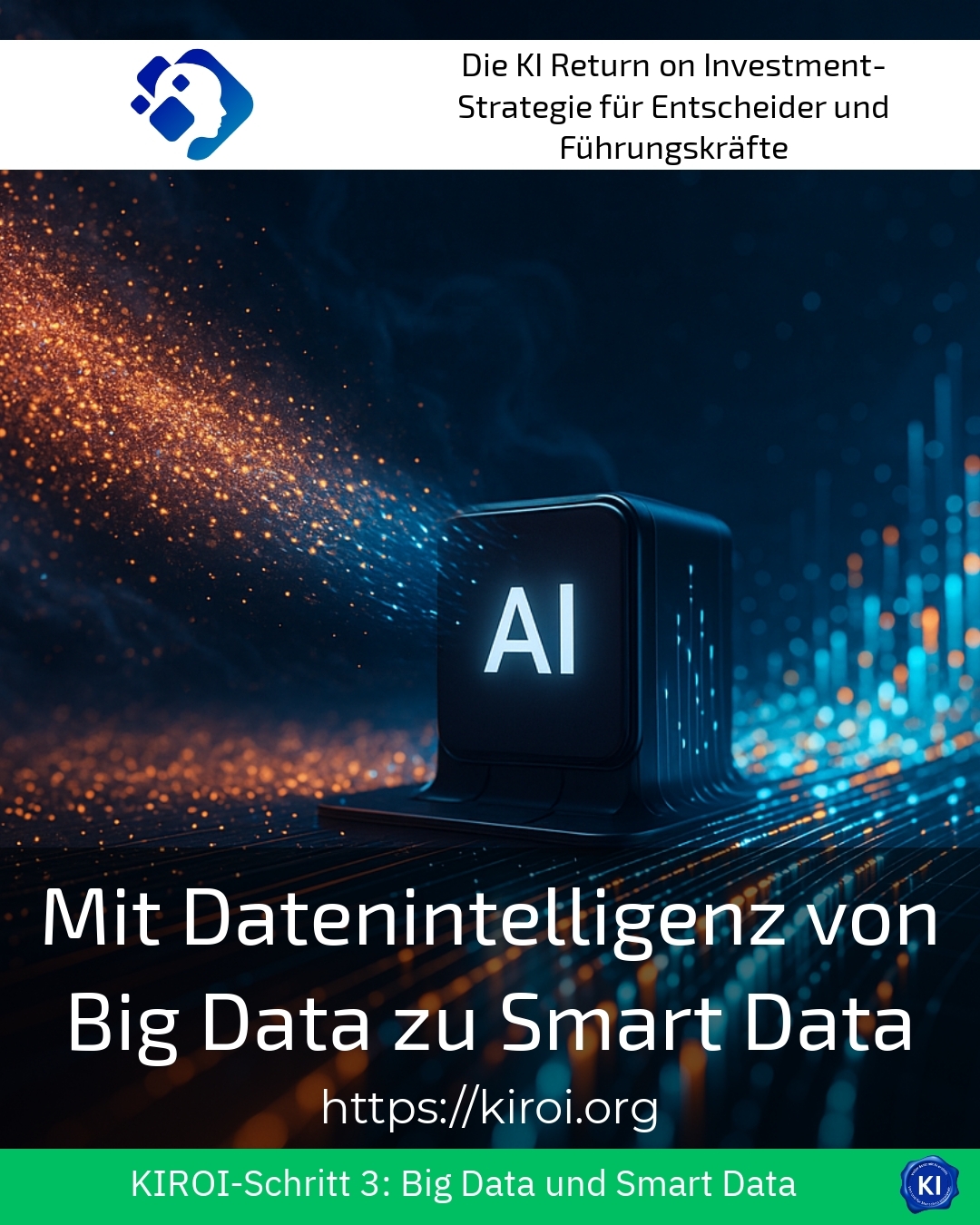
Imagine your company sitting on a gigantic mountain of information, yet no one knows how to extract real insights from it. This is precisely where the transition from Big Data to Smart Data intelligence comes in. Companies today are collecting more information than ever before in the history of business. However, the sheer volume alone does not provide a competitive advantage. Only when usable insights emerge from raw columns of numbers does the real transformation begin. This article shows you how modern organisations are taking this crucial step and what concrete impulses you can take away for your own development.
The Challenge of the Modern Information Overload
Every day, machines, sensors, and digital interactions generate unimaginable amounts of information. Production facilities continuously send status messages to central systems. Customer portals record every interaction in meticulous detail. Logistics networks document every transport step in real-time. This abundance overwhelms many organisations because traditional analysis methods are no longer sufficient. Clients often report a virtual paralysis when faced with these masses of data. They don't know where to start or which information is actually relevant.
For example, a manufacturing company records thousands of sensor values per minute. A retail group stores millions of transaction data points daily. An energy provider continuously monitors the entire supply network. However, without intelligent filtering and structuring, this information remains valueless. It clogs up storage systems and generates high costs with no discernible benefit. The true art lies in extracting precisely those insights from this flood of data that provide a genuine basis for decision-making.
With data intelligence from Big Data to Smart Data: The transformation process
The transition from raw data to intelligent information resources follows a structured process. First, organisations must understand exactly which questions they wish to answer. This is followed by the targeted selection of relevant information sources. Modern algorithms are then employed to identify patterns and uncover correlations. Finally, the results are presented in a way that enables decision-makers to actually use them. This process requires both technical expertise and a strategic understanding of the relevant business objectives.
In the automotive industry, manufacturers use this methodology to optimise their supply chains. They analyse supplier data, production parameters, and quality metrics within an integrated system. In healthcare, intelligent analysis systems support doctors in making diagnoses. They systematically evaluate patient histories, current findings, and scientific knowledge. In retail, this approach enables personalised customer engagement at the highest level. The systems recognise purchasing patterns and anticipate future needs with astonishing precision.
Best practice with a AIROI customer
A medium-sized mechanical engineering company faced the challenge of generating real added value from its extensive production data. The initial situation was characterised by isolated data silos and a lack of transparency regarding actual plant performance. As part of a transruption coaching project, we supported the company in the systematic transformation of its information landscape. First, together with the management team, we identified the key business questions that needed to be answered. This revealed three main areas: quality assurance, maintenance optimisation, and energy efficiency. We then developed an architecture that automatically filters and structures relevant sensor data. Implementation was carried out step-by-step over several months. The result was impressive: unplanned downtime decreased significantly. The quality scrap rate noticeably dropped. Energy consumption per production unit measurably reduced. However, what was particularly valuable was the new decision-making culture that emerged within the company. Managers now made decisions based on robust insights rather than gut feeling. This transformation exemplifies how the shift from Big Data to Smart Data can concretely look like with data intelligence.
Technological Foundations for Intelligent Information Systems
Modern analysis platforms form the technological backbone for this transformation. They combine powerful storage systems with advanced pattern recognition algorithms. Artificial intelligence and machine learning play a central role in this. These technologies make it possible to discover valuable connections, even in unstructured information. A pharmaceutical company, for example, uses such systems to analyse research results [1]. An insurance group uses them for risk assessment and damage prevention. A telecommunications provider uses them to optimise its network management and customer service.
Cloud technology has significantly accelerated and democratised this development. Even smaller organisations can now access computing power that was previously reserved for large corporations. At the same time, data protection and information security place high demands on system architecture. European companies must comply with strict regulatory requirements. These frameworks demand careful planning and professional implementation. Clients often report uncertainty in this area. Support from experienced partners can provide valuable impetus and help to avoid common pitfalls.
Strategic Perspectives for Business Management
The transformation to intelligent information systems is not purely a technical task. It requires a fundamental shift in company culture and decision-making processes. Leaders must learn to integrate data-based insights into their strategy development. Employees need new skills in handling analysis tools and their results. Organisational structures must be adapted to enable quick and informed decisions. This cultural change often accompanies the technical implementation and is at least as crucial for success.
In the financial industry, this transformation has already brought about profound changes. Banks are using intelligent systems for credit risk analysis and fraud detection. Investment companies are relying on algorithmic trading strategies and automated portfolio optimisation. Insurance companies are developing individualised tariffs based on comprehensive risk profiles. In the industrial sector, the transformation enables predictive maintenance concepts and optimised production processes. In the service sector, personalised offers and improved customer experiences are emerging.
Best practice with a AIROI customer
A logistics company with a pan-European network was looking for ways to optimise its tour planning. The existing systems worked with static rules and did not sufficiently take into account current traffic situations. Through our transruption coaching, we jointly developed a roadmap for the intelligent transformation of dispatch processes. The first step involved integrating various information sources such as traffic data, weather data, and historical delivery times. In the second step, we implemented learning algorithms that deduce optimal routes from past experience. The third step included training the dispatchers in using the new system. The results significantly exceeded the management's expectations. Average delivery times demonstrably improved. The fleet's fuel consumption was measurably reduced. Customer satisfaction noticeably increased. Particularly noteworthy was the high acceptance among employees, who perceived the system as genuine support for their daily work. This project impressively illustrates how intelligent information systems can support operational excellence.
Challenges on the Path to Data Intelligence
Despite all odds, companies face significant challenges in this transformation. The quality of existing information is often poor or inconsistent. Different systems speak different languages and are difficult to integrate. Skilled workers with the relevant competencies are scarce and highly sought after in the labour market. The investment costs appear high at first, and the return on investment is difficult to quantify. Resistance from the workforce can significantly delay or even cause transformation projects to fail.
For instance, a chemical company was grappling with historically developed system landscapes resulting from various company acquisitions. A media company faced the challenge of consolidating usage data from numerous channels. A municipal utility had to reconcile regulatory requirements with innovation goals [2]. In all these cases, a structured approach with external support was helpful. Experience shows that successful transformations happen gradually and prioritise quick wins. This builds motivation and trust for subsequent project phases.
The role of Artificial Intelligence in information transformation
Artificial intelligence acts as a catalyst for the transformation of mass data into actionable insights. Modern AI systems recognise patterns that would remain hidden from human analysts. They process information at a speed and depth that would never be achievable manually. At the same time, they continuously learn from new experiences and constantly improve their predictive accuracy. These capabilities make AI an indispensable tool for any serious information transformation.
In agriculture, AI-powered systems support farms in optimising irrigation and fertilisation. They analyse weather data, soil moisture, and plant health in combination. In healthcare, they help doctors in the early detection of disease patterns in patient data. In retail, they forecast demand trends and optimize inventory levels accordingly. These applications show the enormous potential of intelligent information systems for a wide range of industries and use cases.
My AIROI Analysis
The transformation from Big Data to Smart Data using data intelligence is a strategic necessity for companies across all sectors. Those who miss this change risk losing their competitive edge. This is not about technology for technology's sake. It's about the ability to make better decisions faster. Organisations that successfully navigate this path report tangible improvements in efficiency, quality, and customer satisfaction. They develop a new decision-making culture that is based on facts rather than assumptions.
Our experience from numerous support projects shows clear success patterns. Firstly, a clear understanding of the business objectives to be achieved with the transformation is required. Secondly, a realistic assessment of the current maturity level and available resources is necessary. Thirdly, leaders must actively drive change and act as role models. Fourthly, projects should start small and be scaled up step by step. Fifthly, employee involvement and qualification are crucial for sustainable success. Those who adhere to these principles can master the transformation successfully [3].
The shift to intelligent information systems is not a one-off project but a continuous journey. Technologies evolve, business requirements change, and new opportunities constantly emerge. Companies must develop agility and a willingness to learn to remain successful on this path. Guidance from experienced partners can provide valuable impetus and orientation. Ultimately, the ability to leverage information intelligently will determine future competitiveness.
Further links from the text above:
[1] McKinsey Insights on Data Analytics
[2] Bitkom Big Data Analytics
[3] Gartner Definition Smart Data
For more information and if you have any questions, please contact Contact us or read more blog posts on the topic Artificial intelligence here.










 Deutsch
  English (UK)