
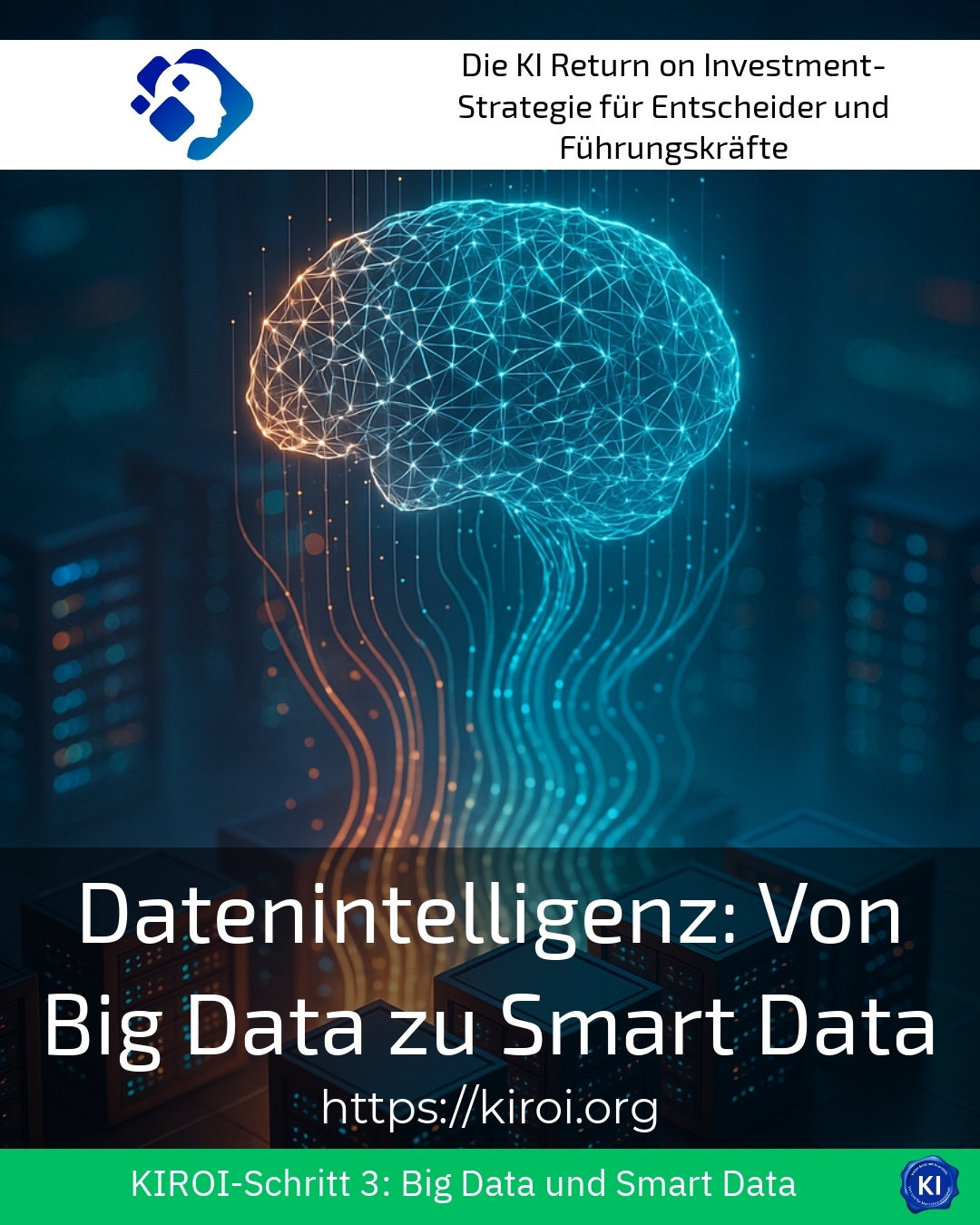
Imagine your company is sitting on a mountain of information, yet nobody knows what gold nuggets are hidden within it. This is precisely where the crucial shift begins, presenting organisations worldwide with completely new challenges. Data Intelligence: From Big Data to Smart Data describes this fundamental transformation, which goes far beyond the mere collection of numbers and facts. While many companies have spent years hoarding the largest possible amounts of data, an increasing number of decision-makers are recognising an uncomfortable truth. The sheer volume of available information does not automatically generate added value. Rather, real benefit only arises when relevant, actionable insights are extracted from this abundance. This development is fundamentally changing business models, decision-making processes and entire industries.
The fundamental paradigm shift in information processing
For decades, the motto in many industries was to collect and store as much information as possible. However, this philosophy led to a paradoxical phenomenon. The more data that was available, the more difficult it became to actually derive actionable insights from it. Managers frequently report feeling genuinely overwhelmed by countless reports and dashboards. The real challenge no longer lies in collection, but in intelligent filtering and interpretation.
This transformation is particularly impressive in the logistics sector. Freight forwarders and transport companies now record millions of data points every day. GPS locations, temperature readings, delivery times and customer interactions flow continuously into central systems. However, without intelligent filtering, this information remains largely useless. It is only through targeted analysis that insights are generated which enable real optimisations.
Transruptions Coaching guides companies precisely through this transition. The support helps to identify relevant connections from the flood of information. Clients frequently report that, prior to working together, they were virtually overwhelmed by their own systems. The coaching process helps to set priorities and develop focused analysis strategies.
Best practice with a AIROI customer
A medium-sized haulage company with over three hundred vehicles was facing a complex challenge. The management had invested in modern telematics systems and were collecting enormous amounts of vehicle data on a daily basis. At the same time, however, there was no clear strategy for deriving concrete recommendations for action from this information. As part of the AIROI support programme, a thorough review of the existing data sources was first carried out. Together, we identified the most relevant parameters for the company’s business objectives. It transpired that only around fifteen per cent of the information collected was actually relevant to decision-making. The rest primarily resulted in storage costs and added complexity. Following the implementation of a focused analysis strategy, the company was able to significantly improve its route planning. Fuel costs were reduced and customer satisfaction increased measurably. The transformation from mere data collection to the strategic use of information took around eight months.
Data Intelligence: From Big Data to Smart Data in Practical Application
The journey from pure information accumulation to intelligent utilisation requires a fundamental rethink. Many organisations have realised that quantity alone no longer represents a competitive advantage. Instead, the quality of analysis is gaining in importance. This shift affects technological, organisational and cultural dimensions alike.
In the field of container logistics, leading ports are impressively demonstrating the potential inherent in this approach. Instead of storing all available sensor data unfiltered, modern terminals focus on specific key performance indicators [1]. These include turnaround times, utilisation rates and forecasts for incoming vessels. This focus generates actionable insights in real time, enabling decision-makers to respond more quickly and knowledgeably to changes.
We are seeing similar developments in the air cargo industry. Here, countless variables that influence the transport process must be taken into account. Weather conditions, customs regulations and capacity bottlenecks interact in complex ways. Intelligent analysis systems help to derive clear options for action from this complexity. Airlines and freight forwarders use these insights for their planning and customer advice.
Quality over quantity as a new guiding principle
The transformation first requires an honest stocktake of the existing information sources. Many companies discover in the process that a significant portion of their gathered information is redundant or outdated. Cleansing and structuring therefore form important initial steps. Only on this basis can advanced analysis methods be deployed meaningfully.
Courier services and parcel logistics providers face special challenges here. They process millions of shipment information records daily. Every single delivery generates numerous data points. From order placement through transport to delivery, new information is continuously created. The art lies in identifying relevant patterns from this stream.
Another example can be found in warehouse logistics. Modern warehouses feature countless sensors and monitoring systems [2]. These continuously record temperature, humidity, movements and inventory. Without intelligent processing, however, this potential remains unutilised. Smart data approaches make it possible to derive proactive maintenance recommendations or inventory optimisations from this information.
Strategic guidance during the transformation
The transition to intelligent information use rarely succeeds without external support. Too many internal thinking patterns and established structures make the necessary change of perspective difficult. Transruption coaching offers valuable guidance for companies during this transition phase. The support encompasses both strategic and operational aspects.
Clients frequently come to us with a feeling of being overwhelmed. They have invested in expensive systems and expect a return on investment. At the same time, there is often a lack of knowledge about how the gathered information can actually be utilised. The coaching process helps to gain clarity and define realistic goals.
Best practice with a AIROI customer
An e-commerce fulfilment service provider was looking for ways to differentiate its services. The company had extensive historical order volumes and customer data spanning several years. However, this information was not being utilised systematically. As part of the AIROI support programme, we jointly developed a strategy for the intelligent use of this information. First, the most relevant key performance indicators for customer satisfaction were identified. The team then implemented a dashboard that visualises these parameters in real time. The analysis of patterns in returns and complaints proved particularly valuable. By identifying problematic shipments at an early stage, the customer service team was able to take proactive action. This led to a noticeable improvement in customer loyalty and word-of-mouth recommendation rates. The entire transformation process took around six months and was supported by regular coaching sessions.
Technological and cultural dimensions of change
Data Intelligence: From Big Data to Smart Data requires not only new technologies, but also changed mindsets. Employees must learn to deal with analytical insights and integrate them into their daily work. This cultural transformation represents the greatest challenge for many organisations. Technical solutions alone are not enough.
This dimension is particularly evident in rail logistics. Here, traditionally minded teams often work with state-of-the-art analysis systems. The acceptance of automated recommendations must be built up gradually. Training and communication play a central role in this. Success stories from within the company are particularly convincing.
International freight forwarders face additional complexities. They have to consolidate information from different countries and systems. Varying standards and formats complicate integration [3]. Intelligent middleware solutions can provide a remedy here. They harmonise heterogeneous data sources into a unified information pool.
Future prospects and continuous development
The described change is not a one-off project, but a continuous process. Technologies are evolving and opening up new possibilities. At the same time, customer expectations and market conditions are constantly changing. Companies must therefore develop a permanent capacity for learning.
The integration of machine learning opens up completely new perspectives here. Algorithms can recognise patterns that remain hidden from human analysts. In transport logistics, for example, this enables more precise demand forecasts. Resources can be used more efficiently and overcapacities avoided.
Cold chain logistics benefits particularly from intelligent analysis systems. Here, even the slightest temperature deviations can cause serious quality problems. Real-time monitoring and automatic alarm systems help to identify such risks at an early stage. The combination of sensor technology and intelligent evaluation creates genuine added value here.
My AIROI Analysis
The transformation from pure information accumulation to strategic utilisation represents one of the greatest challenges of our time for many companies. My experience from numerous accompanying projects shows that success depends essentially on the willingness to undergo cultural change. Technological investments alone rarely lead to the desired result. Rather, organisations must learn to develop a data-driven decision-making culture. Data Intelligence: From Big Data to Smart Data therefore describes not only a technical, but above all an organisational maturation process. Support from experienced coaches can significantly accelerate this process and help avoid typical mistakes. Of particular importance, it seems to me, is the focus on concrete business problems instead of abstract technology debates. Successful transformations always begin with clear questions that need to be answered. Only after that does the selection of suitable methods and tools take place. Companies that follow this approach frequently report surprisingly rapid successes. The insights gained lead to better decisions, more efficient processes and more satisfied customers. The journey is never complete, however, but requires continuous adaptation and further development.
Further links from the text above:
[1] Federal Association for Logistics – Studies on Digitalisation
[2] Fraunhofer-Gesellschaft – Logistics and Supply Chain
[3] Bitkom – Information on data analysis and intelligent utilisation
For more information and if you have any questions, please contact Contact us or read more blog posts on the topic Artificial intelligence here.









 Deutsch
  English (UK)