
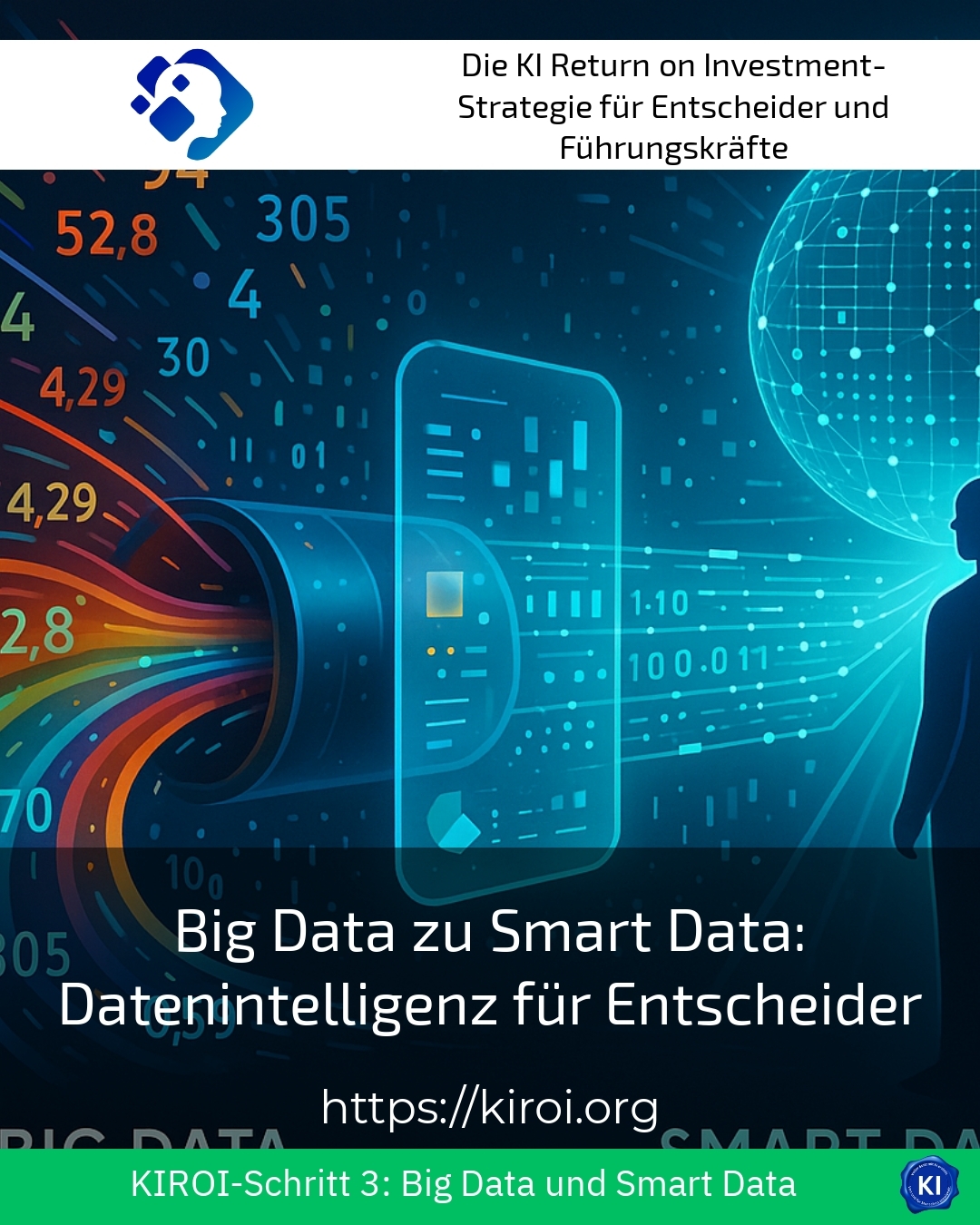
In a world where billions of data records are created daily, leaders face a crucial challenge: how to extract truly actionable knowledge from the sheer volume of information? The transformation of Big Data to Smart Data: Data Intelligence for Decision-Makers This marks a fundamental paradigm shift that goes far beyond technical aspects and influences the strategic direction of entire organisations. For while companies have been collecting data for years without exhausting its potential, today's competitive landscape demands an intelligent, targeted use of these valuable resources, which can make the difference between market leadership and irrelevance.
The evolution of data usage in modern organisations
The history of enterprise data processing has been a remarkable journey from simple spreadsheets to highly complex analytical systems. Initially, organisations collected information primarily for documentation purposes. They stored transactions and customer data without strategic intent. Today, however, forward-thinking leaders recognise the transformative potential. They understand that data can represent the most valuable asset.
This change is particularly impressive in the manufacturing industry. Production plants continuously generate sensor data on temperatures, vibrations, and energy consumption. A medium-sized mechanical engineering company initially only used this information for fault logging. By intelligently linking these data streams, they were later able to develop predictive maintenance concepts. These reduced unplanned downtime by considerable percentages. At the same time, the company significantly optimised its spare parts inventory [1].
Retail provides another insightful example of this development. Retail companies possess extensive till data and customer profiles. The challenge lay in deriving coherent insights from these heterogeneous sources. A grocery retailer implemented a system for analysing purchasing patterns. They combined weather data with sales figures and local event calendars. This allowed them to plan their order quantities more precisely and significantly reduce food waste.
Big Data to Smart Data: Data Intelligence for Decision Makers as a Strategic Imperative
The mere accumulation of data volumes rarely leads to better decisions. Instead, it often results in overwhelm and analytical paralysis for executives. The key lies in the intelligent filtering and contextualisation of information. Only relevant, processed, and timely available insights genuinely support business decision-making processes. This transformation requires both technological and cultural changes within organisations.
This necessity is particularly evident in the healthcare sector. Clinics and hospitals generate enormous amounts of data through imaging procedures and patient records. A maximum-care hospital faced the task of optimising treatment pathways. By analysing historical patient data, it identified patterns in readmissions. This enabled preventive measures and sustainably improved patient care. At the same time, costs for the healthcare system noticeably decreased [2].
The financial industry uses data-driven approaches for risk assessments and fraud detection. Banks process millions of transactions in real time every day. A credit institution developed a system for detecting unusual account movements. The analysis was based on the individual behavioural patterns of each account holder, allowing fraudulent activities to be identified more quickly. The false positive rate decreased significantly, easing the burden on customers and staff.
Best practice with a AIROI customer
An internationally operating logistics company came to us with a complex challenge. The company possessed data from fleet management, warehouse management, and customer interactions. However, this information existed in separate, unconnected systems. Management received extensive weekly reports with hundreds of key figures. Despite this, a clear picture of actual operational efficiency was lacking. As part of the transruption coaching, we guided the management team in defining relevant control metrics. Together, we identified the critical decision points in daily operations. We developed a concept for an integrated dashboard with real-time information. Employees received training in data-driven decision-making. Following implementation, managers reported significantly faster response times to disruptions. Customer satisfaction improved measurably through proactive communication regarding delays. The company was able to optimise its route planning and reduce fuel costs. This case illustrates how guidance on such transformation projects creates sustainable added value.
Technological Foundations of Data Intelligence
The technical infrastructure forms the bedrock for any data-driven initiative. Cloud computing today enables scalable storage and computing capacities for businesses of all sizes. Machine learning and algorithmic methods extract patterns from complex data sets. Visualisation tools translate abstract numbers into understandable representations for decision-makers. However, the integration of various data sources requires careful planning and robust interfaces.
The automotive industry impressively demonstrates the use of cutting-edge technologies. Vehicle manufacturers are analysing telemetry data from connected cars on a massive scale. One automotive group is using this information for continuous product improvement. Feedback on driving behaviour is incorporated into the development of new models. At the same time, the data enable personalised service offers for vehicle owners. This strengthens customer loyalty and generates additional revenue streams [3].
In the energy sector, smart grids are playing an increasingly important role. Energy providers must balance supply and demand in real time. A grid operator implemented a system to forecast consumption behaviour. The analysis included historical data, weather forecasts, and economic indicators. This allowed the company to improve grid stability and integrate renewable energy more efficiently.
Organisational Transformation and Cultural Change
Technology alone does not guarantee success in data-driven initiatives. The human component often determines whether such projects succeed or fail. Employees must be empowered to work with new tools and methods. Leaders need to understand the possibilities and limitations of analytical procedures. At the same time, transformation often requires significant changes to established processes and structures.
The insurance industry is currently undergoing a profound transformation in its ways of working. Insurers traditionally possess extensive claims data and customer information. One insurance company began to use these holdings for personalised tariff models. However, the transition required a rethink across the entire organisation. Actuaries and sales staff now worked more closely together than ever before. The corporate culture changed from reactive claims processing to proactive risk consulting.
Interesting developments in data usage are also evident in the education sector. Universities are analysing student progression data to identify at-risk students. A university consortium implemented an early warning system for study dropouts. Tutors received timely alerts about students needing support. This enabled targeted counselling services to be offered before problems escalated. The success rates for degree completion subsequently improved demonstrably.
Big Data to Smart Data: Data Intelligence for Decision-Makers in Practical Implementation
The practical implementation of data-driven strategies rarely follows a linear path. Rather, they are iterative processes with learning loops and adjustments. Organisations often start with pilot projects in defined areas. Successful approaches are then gradually extended to other business units. Unforeseen challenges regularly arise, requiring flexible responses.
The pharmaceutical industry particularly illustrates the complexity of such transformation projects. Pharmaceutical companies generate enormous amounts of data in clinical trials and research processes. One pharmaceutical company wanted to use this information for faster drug development. The integration of laboratory data, patient information, and scientific literature proved highly complex. Furthermore, strict regulatory requirements for data protection and traceability had to be met. The project took longer than originally planned, but it did deliver groundbreaking insights [4].
The tourism sector uses data analytics for optimised pricing and capacity planning. Hotel chains and airlines were pioneers of dynamic pricing models. A tour operator developed a system for predicting booking trends. The analysis included seasonal patterns, economic indicators, and social media activity. This enabled the company to allocate its marketing expenditure more efficiently. Occupancy rates improved while average revenue per booking also increased.
Best practice with a AIROI customer
A medium-sized trading company approached us with a specific challenge. Management felt overwhelmed by the sheer number of available analysis tools. Different departments were using disparate systems without a coordinated strategy. The resulting flood of data led to conflicting interpretations and decision paralysis. As part of our support, we first developed a shared understanding of strategic priorities. We identified the key performance indicators for the various management levels. Then, we gradually consolidated the fragmented system landscape. Of particular importance was the training of managers in dealing with uncertainties in forecasts. They learned to critically question data-driven recommendations without ignoring them. The transruption coaching accompanied this cultural change over several months. Today, those responsible report clearer decision-making processes and shorter alignment cycles. The investment in this transformation has paid for itself multiple times over through improved market responsiveness.
Ethical Dimensions and Responsible Handling
The increasing availability and use of data raises important ethical questions. Data protection and privacy must be maintained, even when economic interests are involved. Algorithms can reinforce existing biases if they are not developed carefully. Transparency about the use of information builds trust with customers and employees. Organisations have a responsibility for the appropriate handling of the data entrusted to them.
In HR, these areas of tension are particularly evident in recruitment processes. Companies are increasingly using algorithmic methods for pre-selecting applications. A technology company discovered that its system systematically disadvantaged certain groups of applicants. The cause lay in historical hiring decisions that served as training data. The company fundamentally revised its approach and introduced regular fairness audits. This case illustrates the need for continuous critical reflection in data-driven processes [5].
Public administration faces particular challenges in using data. Authorities hold sensitive citizen data and have special duties of care. A city administration implemented an analysis system to optimise public services. In doing so, they had to adhere to strict anonymisation procedures and ensure transparency. The balance between efficiency gains and data protection required intensive coordination with data protection officers.
My AIROI Analysis
Transforming extensive datasets into decision-relevant intelligence represents one of the most significant management challenges of our time. My many years of experience supporting organisations with such endeavours show that technological solutions alone rarely lead to success. Rather, change requires a holistic understanding of strategy, technology, and human factors. Leaders must develop a vision for how data-driven insights can improve their decision-making processes. At the same time, they must not underestimate the practical hurdles in implementation.
The examples presented from various industries illustrate both the potential and the pitfalls. Successful organisations are characterised by a clear focus on business-relevant issues. They avoid the temptation to analyse data for its own sake. Instead, they precisely define which decisions are to be supported by better information. The involvement of all stakeholders and the continuous development of analytical capabilities are crucial success factors.
For the coming years, I expect a further democratisation of analytical tools. Self-service analytics will make specialist departments increasingly independent of central IT departments. At the same time, the importance of data governance and ethical guidelines will continue to grow. Organisations that invest in their data literacy today are creating sustainable competitive advantages. The journey from raw quantities of information to true decision intelligence remains a continuous process. It requires perseverance, a willingness to learn, and the openness to question established ways of thinking.
Further links from the text above:
[1] McKinsey – The Data-Driven Enterprise
[2] WHO – Digital Health Strategy
[3] Gartner – Data and Analytics Insights
[4] FDA – Real World Evidence in Pharmaceutical Research
[5] European Parliament – AI Act and Ethical Guidelines
For more information and if you have any questions, please contact Contact us or read more blog posts on the topic Artificial intelligence here.










 Deutsch
  English (UK)