
Why are so many companies drowning in data, while others draw strategic competitive advantages from the exact same information?
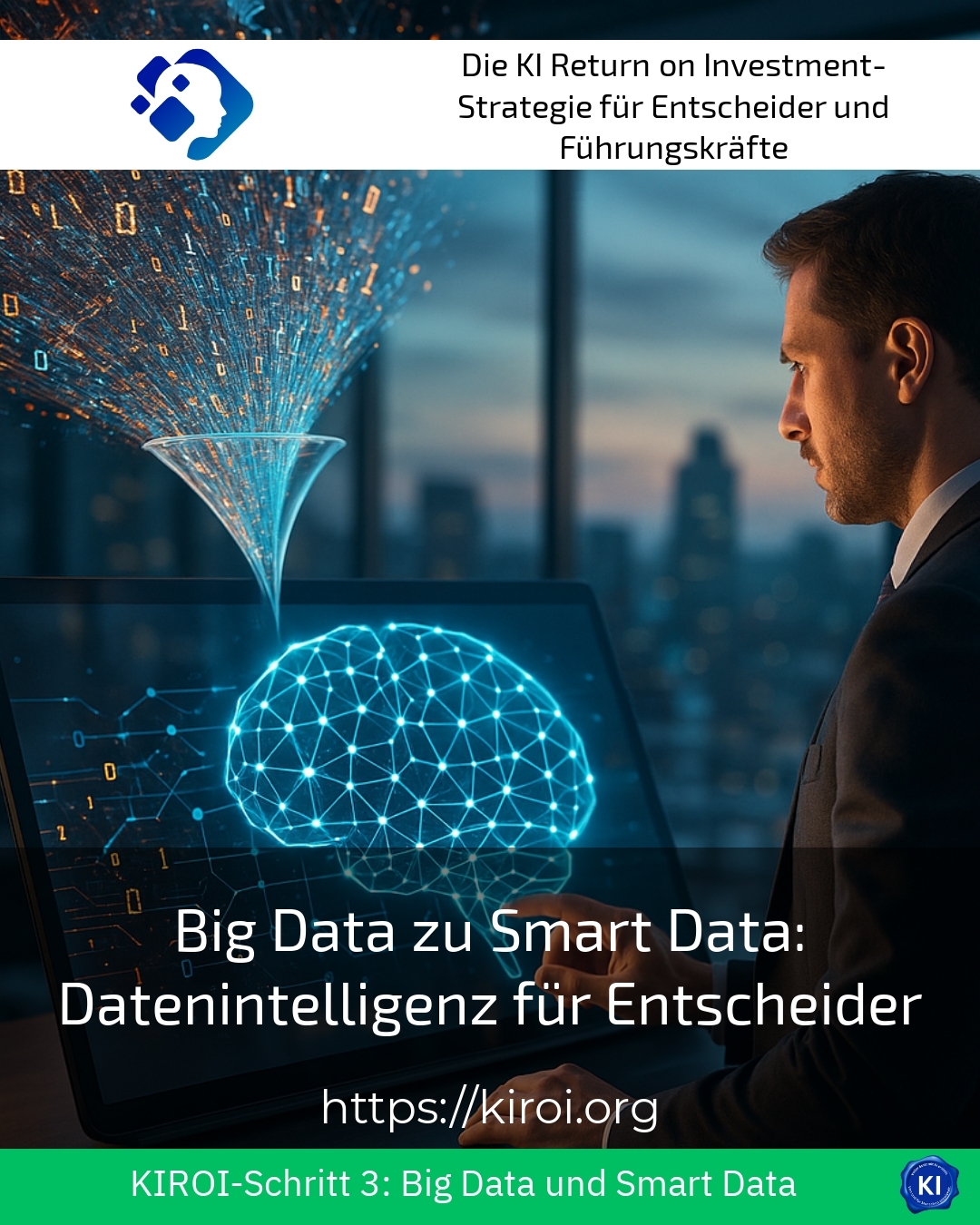
The transformation of Big Data to Smart Data represents one of the most fundamental challenges facing decision-makers today. Clients frequently report overwhelming amounts of data. They do not know where to start. Yet the key does not lie in the quantity of information collected. Rather, the quality of the analysis determines success. The concept of Data intelligence for decision-makers is therefore increasingly gaining in importance. It combines technological possibilities with strategic thinking. In this article, you will learn how modern companies are mastering this change. In addition, you will receive concrete impetus for your own transformation.
Understanding the challenge of the data deluge
Every day, unimaginable amounts of digital information are created worldwide. Sensors capture machine data in real time. Customer interactions leave digital footprints. Supply chains continuously generate movement data. Yet this abundance can quickly become a burden. Without a clear strategy, valuable insights remain hidden. Many organisations therefore collect data without a specific purpose for its use. They hope for future opportunities to use it. However, this approach rarely leads to success.
A medium-sized engineering company stored production data for years. Storage costs rose continuously. At the same time, the know-how for evaluation was lacking. This only changed through a strategic realignment. Another company from the logistics sector struggled with fragmented data silos. Different departments used different systems. Integration seemed impossible. An energy supplier also faced similar problems. Grid data flowed into outdated databases. Modern analysis tools could not be connected.
Best practice with a AIROI customer
An internationally active automotive supplier approached us with a complex issue. The company had more than twenty different data sources. These ranged from quality assurance systems to customer complaint databases. The challenge was to intelligently link these information flows. Together, we first developed a data strategy. This defined clear priorities and utilisation goals. In the next step, we identified the most relevant data sources. In doing so, it emerged that only about thirty percent of the collected data offered genuine added value. The remaining information primarily generated storage and management costs. Through this insight, the company was able to save considerable resources. At the same time, the quality of the analysis results improved significantly. Decision-makers now received focused reports. These provided actionable insights instead of bewildering columns of figures. The transruptions coaching accompanied the entire change process along the way. We provided impulses for the cultural transformation. Employees learned to think and act in a data-driven manner.
Big Data to Smart Data: The path to intelligent data utilisation
The transition from raw data volumes to actionable insights requires a systematic approach. First of all, organisations must define their data strategy. Which questions should be answered? Which decisions require data-driven support? This reflection forms the foundation of all further steps. Only then does the technical implementation follow. Modern analytics platforms can recognise complex relationships. They identify patterns in large datasets. Machine learning algorithms support these processes.
A pharmaceutical company used this methodology to optimise clinical trials. The analysis of historical trial data provided valuable insights. This enabled trial designs to be improved. A retail group applied similar approaches to assortment planning. Sales data was linked with weather data and event calendars. Forecasting accuracy increased significantly. An insurance company also benefited from intelligent data usage. Claims were automatically categorised and prioritised. Processing times were significantly reduced.
Data intelligence for decision-makers in practical application
Leaders do not need raw data. They require processed insights. These must be quickly graspable and actionable. Modern dashboards visualise complex relationships in an understandable way. They display critical metrics at a glance. Alert functions draw attention to deviations. Thus, decision-makers can act proactively. They no longer merely react to past developments. Instead, they anticipate future trends.
A telecommunications provider implemented such a system for customer retention. Churn risks were identified at an early stage. Targeted measures could be initiated. A construction company used predictive analytics for project planning. Delay risks were identified automatically. The project managers received warnings in good time. A hospital also relied on data-supported decision support. Bed occupancy was optimised algorithmically. Waiting times in the emergency department fell measurably.
Don't forget the human element
Technology alone does not solve problems. People need to understand and accept the new tools. Change management therefore plays a crucial role. Employees require training and guidance. They must recognise the added value of the change. Only then will they actively support the new processes. Resistance often arises from uncertainty and a lack of knowledge. Transparent communication can break down these barriers.
A financial services provider initially underestimated this aspect. The new analysis platform was barely used. It was only after intensive training that the situation changed. A chemical corporation took a different approach. It involved employees right from the start. They even helped define the requirements themselves. Acceptance was correspondingly high. A media company also relied on participatory approaches. Editors developed new workflows together with IT experts. The collaboration fostered mutual understanding.
Best practice with a AIROI customer
A large retail chain faced a unique challenge. Branch managers were expected to make data-driven decisions. Yet many of them had no analytical training. The company turned to us for comprehensive support. Together, we developed a multi-stage qualification programme. This imparted not only technical skills. It also fostered a new mindset when dealing with information. Participants learned how to formulate relevant questions. They understood how data could support their daily decisions. At the same time, the analysis tools were simplified. Complex algorithms ran in the background. The interface presented only the essential insights. The transruptions coaching accompanied this cultural shift over several months. We provided impetus for the further development of the leadership culture. The branch managers became genuine data users. The quality of their decisions demonstrably improved. Turnover and customer satisfaction increased in the pilot branches. The programme was subsequently rolled out to all locations.
Ethical aspects of data intelligence for decision-makers
With great data power comes great responsibility. Companies must develop ethical guidelines for data use. Data protection is merely the minimum standard. Beyond that, questions of fairness arise. Algorithmic decisions can have a discriminatory effect. Leaders must be aware of these risks and address them. Transparency towards those affected builds trust. Explainable algorithms enable traceability.
A recruitment agency critically reviewed its selection algorithms [1]. In doing so, unconscious biases were discovered. These were systematically corrected. A bank analysed its credit-granting models [2]. Socio-demographic factors were checked for fairness. The result led to adjustments in the scoring. A technology company also addressed these issues. The usage data of its products was henceforth only analysed in anonymised form. Customers were informed transparently about the data usage.
Understanding technological foundations
Decision-makers do not need to be programmers. However, they should understand the basic principles. Only in this way can they make well-founded investment decisions. Cloud technologies enable scalable data processing. They reduce capital expenditure and increase flexibility. Artificial intelligence significantly expands analytical capabilities. It recognises patterns that humans would overlook. At the same time, it requires high-quality training data [3].
A steel manufacturer migrated its analysis environment to the cloud. Computing capacity could now be flexibly adjusted. Complex simulations only became possible as a result. A food manufacturer relied on edge computing. Data was pre-processed directly in production. Response times for quality deviations were drastically reduced. An airport operator also modernised its infrastructure. Passenger flows were analysed in real time. Capacity planning noticeably improved.
My AIROI Analysis
The way from Big Data to Smart Data is not a purely technical challenge. It requires a holistic transformation approach. Technology, processes and people must be considered equally. In my consultancy practice, I frequently observe one-sided focal points. Companies invest in powerful analytics platforms. However, they neglect the upskilling of their employees. Or they collect data without a strategic utilisation plan. The results then fall short of expectations.
Successful organisations approach things differently. They begin with clear business goals. Which decisions should be improved? What added value is being targeted? Only then follows the selection of suitable technologies. Alongside this, the people are brought along. Change management and upskilling run from the very beginning. This integrative approach distinguishes the most successful transformations.
Data intelligence for decision-makers ultimately means the capability for wise utilisation. It is not about drowning in data. It is about asking the right questions. The technology then provides the appropriate answers. Leaders who develop this competency secure sustainable competitive advantages for their organisations. They make better decisions. They react more quickly to changes. They seize opportunities that remain hidden from others. Transruption coaching can effectively support this development. It accompanies projects concerning data-driven transformation. It provides impetus for cultural changes. The journey is worthwhile for any organisation that wants to remain fit for the future.
Further links from the text above:
[1] AlgorithmWatch – Understanding automated decision-making systems
[2] BaFin – Artificial Intelligence in Risk Management
[3] Bitkom – Big Data and Analytics
For more information and if you have any questions, please contact Contact us or read more blog posts on the topic Artificial intelligence here.









 Deutsch
 English (UK)