
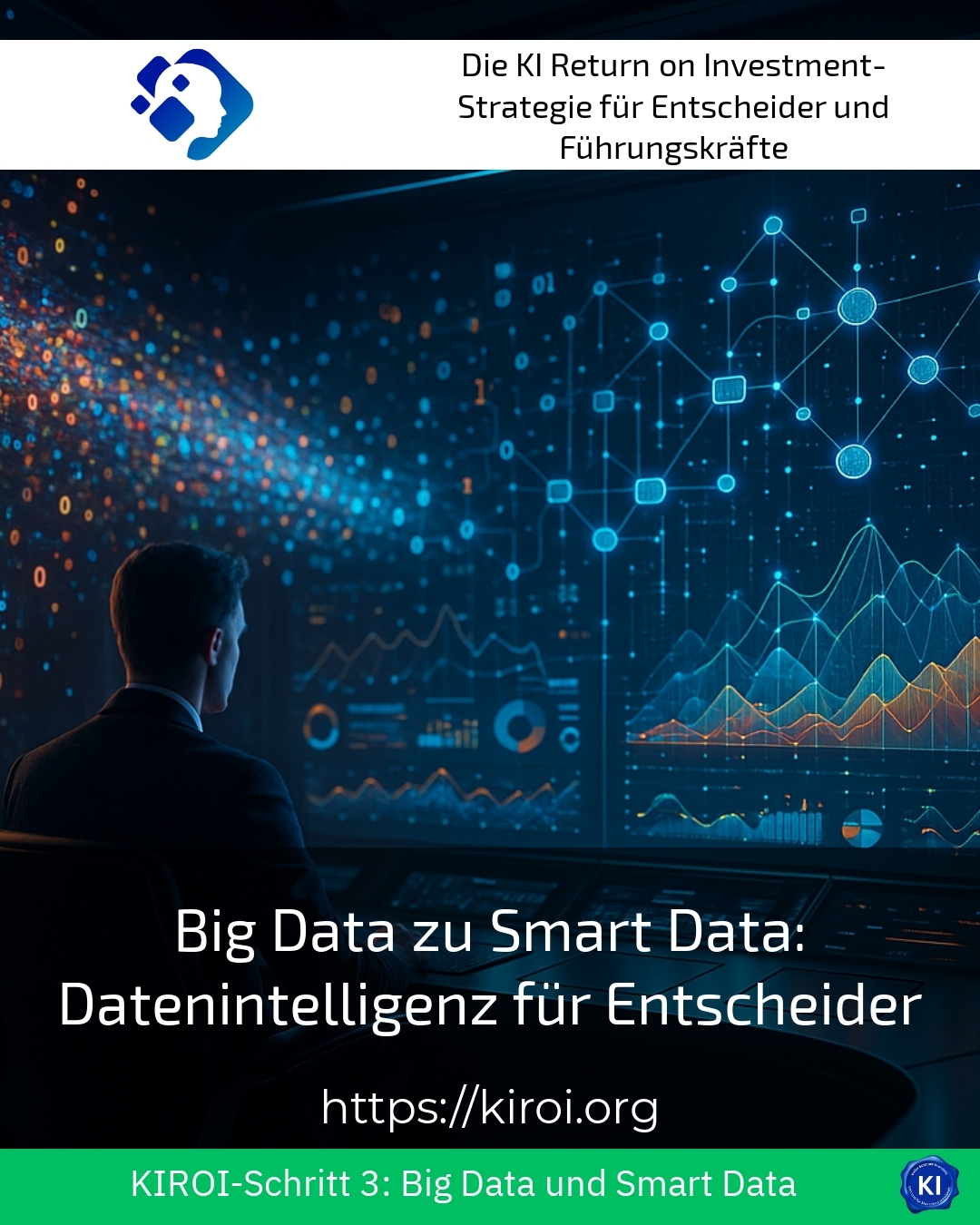
Imagine you are standing in front of a vast ocean of information that grows by billions of new data points every day and becomes so overwhelming that even experienced executives lose their bearings. This is exactly where the transformation from Big Data to Smart Data: Data Intelligence for Decision-Makers It’s no longer enough to simply collect and store data. The real challenge lies in extracting relevant insights from this deluge, enabling strategic decisions and creating competitive advantages. A well-thought-out methodology that considers not only technical aspects but also human factors such as intuition and experience supports you in this journey. This article takes you on a journey through the transformation of raw data into true decision intelligence.
The challenge of massive amounts of data in modern organizations
Modern companies produce unimaginable amounts of digital information every day. This is generated through customer interactions, machine logs, and market observations. At the same time, the complexity of the data landscape is growing exponentially. Executives often report being overwhelmed by this flood of information. The quality of decisions suffers as a result [1].
For example, a manufacturing company collects sensor data from hundreds of machines simultaneously. Each machine generates thousands of measurement points per second. These raw data are initially useless without intelligent processing. Only through targeted filtering can actionable information be generated. For example, a looming malfunction can be detected early on.
In retail, cash register systems continuously collect transaction data. Online stores additionally collect click behavior and dwell times. These data streams must be combined and analyzed. Only then can insights be gained about buying patterns and customer preferences. The challenge lies in making meaningful connections.
Financial institutions process millions of transactions worldwide every day. Each transaction must be examined for fraud risks. Manual checks are no longer possible. Intelligent algorithms take on this task in real time. They detect patterns that would remain hidden to humans [2].
Big Data to Smart Data: Data intelligence for decision-makers as a strategic success factor
The transition from pure data collection to real intelligence requires a fundamental change in perspective. It is no longer about quantity, but about quality. Relevance becomes the decisive criterion for information value. This transformation requires both technical and organizational adaptations. Leaders must actively shape this change.
A logistics company optimized its route planning through intelligent data utilization. Previously, delivery times were only roughly estimated. Today, traffic data, weather conditions, and historical patterns are factored in. The result is more precise delivery windows and more satisfied customers. At the same time, fuel costs have decreased significantly.
Healthcare institutions use patient data to make better treatment decisions. Symptoms are compared with treatment outcomes from similar cases. This provides doctors with valuable real-time decision support. The quality of care is demonstrably improved through these interventions. Patients benefit from more personalized treatment approaches [3].
Best practice with a AIROI customer
A medium-sized company from the manufacturing industry came to us for transruptional coaching support with a classic problem. The organization had collected enormous amounts of production data over the years without deriving any real benefit from them. The management reported frustration because expensive storage systems were purchased, but the quality of decision-making hardly improved. As part of AIROI the project, we first analyzed the existing data landscape together and identified critical bottlenecks. It turned out that only about five percent of the collected data were actually decisive. We guided the management team in defining clearer data requirements and jointly developed filter criteria for the most important business processes. The company subsequently implemented an intelligent dashboard system that presents only refined metrics. Executives report today of significantly faster and more informed decisions because they no longer drown in data streams but instead receive the relevant information they need for their strategic work.
Understanding the technological foundations of data intelligence
Modern analytical tools enable the processing of vast amounts of data in fractions of a second. Machine learning detects patterns that humans cannot perceive. However, these technologies are only tools. The right question before the analysis remains crucial. People define what is considered relevant.
Cloud platforms today offer scalable computing capabilities for complex analytics. Companies no longer need to build their own infrastructure. This significantly lowers the entry barriers for data-driven decision-making processes. At the same time, new challenges arise regarding data security and compliance. Finding this balance requires strategic considerations.
Visualization tools translate complex data patterns into understandable graphics. Executives can thus capture trends at a glance. Interactive dashboards enable deeper analysis when needed. The democratization of data access is permanently changing decision-making cultures. Employees of all levels can argue based on data [4].
Human competence as an indispensable component
Technology alone does not create intelligent decisions. The human factor remains central to successful data strategies. Experienced executives bring contextual knowledge that algorithms lack. They recognize anomalies that machines would classify as normal. This combination of human and machine creates real data intelligence.
A trading company implemented an automated order system for inventory. The algorithm optimized the order quantities based on historical sales data. However, experienced buyers recognized seasonal effects that the system ignored. The combination of algorithmic precision and human intuition led to better results. Both perspectives complement each other optimally.
Insurance companies use data models to assess policy risk. However, experienced underwriters manually examine any suspicious cases. They detect attempts at fraud that are not statistically noticeable. This human level of control prevents erroneous decisions. Algorithms support, but do not replace, the ability to make judgments [5].
Personnel decisions also benefit from data-driven analyses. Applicant management systems filter candidates based on defined criteria. However, the final decision is made by people in conversation. They evaluate soft skills and cultural fit individually. The technology increases efficiency without displacing the human touch.
Big Data to Smart Data: Practically implementing data intelligence for decision-makers
Practical implementation begins with clear goals and defined questions. Companies should first identify which decisions need to be improved. This in turn leads to the necessary data sources. A step-by-step approach reduces risks and creates learning effects. Rapid successes motivate the organization.
An energy provider wanted to improve network stability through predictive maintenance. The project team initially defined critical equipment components as a focus area. Sensor data from these components was collected and analyzed specifically. Predictive models identified impending failures weeks in advance. The unplanned downtime decreased measurably as a result.
In tourism, companies analyze booking patterns for dynamic pricing. Hotels automatically adjust their prices to the expected demand. Airline companies have long been optimizing their revenues per seat. These methods are increasingly being used in small and medium-sized businesses as well. The technical hurdles are now significantly lower than in the past.
Best practice with a AIROI customer
A service company with multiple locations sought support in optimizing its customer support and turned to our transruptions coaching team because management felt it was overlooking valuable customer signals and not utilizing potential. The organization had already been collecting feedback through various channels, but was unable to meaningfully combine and analyze this information. In the joint project, we first identified the various points of contact between the company and its customers and developed a unified scheme for capturing relevant feedback. The coaching guided the management in developing criteria that customer reactions could serve as early warning indicators of satisfaction issues. After implementing an integrated feedback system, the management team reports a significantly improved customer experience because they can now proactively respond to dissatisfaction before customers leave. The company has since significantly increased its customer retention rate, directly attributing this to the new ability to filter out relevant signals from the data noise.
Cultural transformation as the key to success
Technology alone does not sustainably transform organizations. The corporate culture must actively encourage and reward data-driven decisions. Leaders play a crucial role as role models. They must themselves incorporate data into their arguments. Only in this way can a true data culture be created in the company.
Many employees fear being replaced by data-driven systems. Taking these fears seriously is part of successful transformation projects. Open communication about the goals and limitations of technology helps. Training programs build competencies and reduce uncertainties. This creates acceptance and active participation in shaping the future.
A media company implemented data-driven editorial planning. Journalists should take reader preferences into account more. Initially, there was considerable resistance to this control. Management then enabled an open dialogue about opportunities and limitations. Today, the editors use the data as a valuable source of inspiration [6].
Pharmaceutical companies use patient data to develop new active ingredients. Strict ethical standards must be observed. The balance between data intelligence and personal protection requires continuous reflection. Companies that communicate these considerations transparently gain trust. Ethics becomes a competitive advantage.
Data intelligence for decision-makers as a continuous process
The transformation to a data-driven organization is not a one-time project. Rather, it is a continuous process of development and adaptation. Technologies are advancing rapidly and opening up new possibilities. Business models are changing and require different data strategies. Learning and adapting become core competencies.
Automobile manufacturers are increasingly collecting data from connected vehicles. This information enables new service offerings and business models. Predictive maintenance, insurance models, and mobility services are based on it. Companies must constantly identify new usage possibilities. The competition is shifting to the data ecosystem.
Telecommunications providers use usage data to provide personalized tariff recommendations. Customers automatically receive optimized offers based on their behavior. This reduces churn and simultaneously increases customer satisfaction. These applications are continuously evolving. New algorithms continuously improve the accuracy of recommendations.
Agricultural farms are using sensors for soil analysis and weather forecasts. Irrigation is carried out automatically according to plant needs forecasts. Fertilizers are precisely dosed instead of being applied uniformly. This precision agriculture increases yields while reducing resource use. The technology actively supports more sustainable farming methods [7].
My AIROI Analysis
Transforming raw data into real decision intelligence represents one of the most significant challenges for modern leaders, because it touches upon technical, organizational, and cultural dimensions alike and requires a holistic approach. From my consulting practice, I can report that successful projects always begin with clear goals and defined questions, rather than introducing technology for its own sake. The companies that benefit most from intelligent data use have understood that algorithms are not meant to replace human judgment but to complement and reinforce it.
The cultural dimension of this transformation seems particularly important to me, because the best technology is of little use if employees do not accept it or use it incorrectly. Leaders must set a good example by demonstrating data-driven reasoning while simultaneously allowing for intuition and experience. Finding the balance between technical precision and human wisdom is the true art of successful data strategies.
In conclusion, I would like to emphasize that the path to true data intelligence is a continuous process that requires patience, willingness to learn, and strategic thinking. Companies that view this journey as a marathon instead of a sprint will achieve the greatest long-term benefits. Transruptive coaching can provide valuable insights and support organizations in this challenging transformation.
Further links from the text above:
[1] McKinsey: The Data-Driven Enterprise
[2] Gartner: Data & Analytics Insights
[3] WHO: Digital Health Overview
[4] Forbes: Data Visualization Tools
[5] Harvard Business Review: Decision Making
[6] The Economist: Data-Driven Management
[7] FAO: Digital Agriculture
For more information and if you have any questions, please contact Contact us or read more blog posts on the topic Artificial intelligence here.










 Deutsch
 English (UK)