
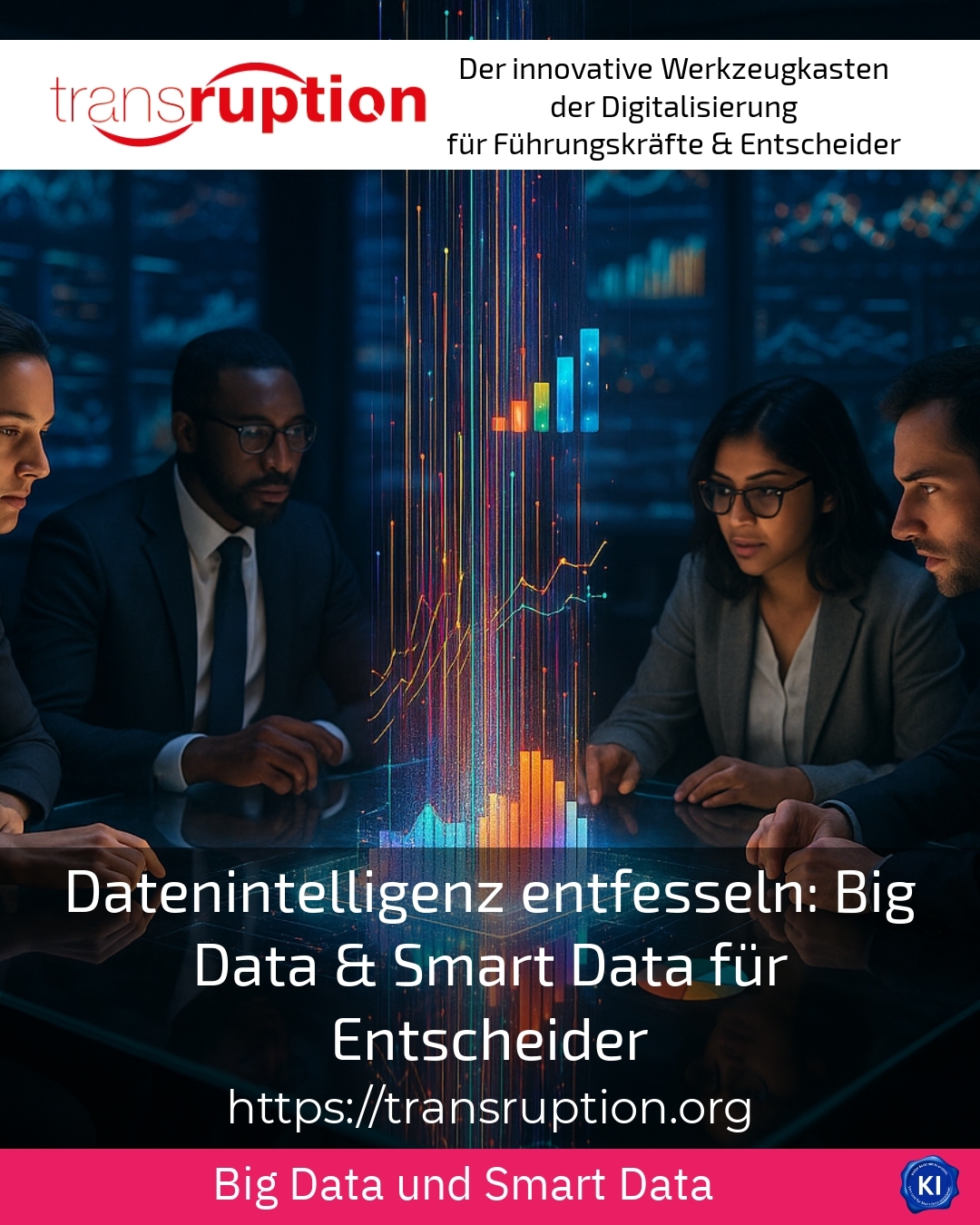
In a world increasingly dominated by data, data intelligence plays a central role for decision-makers. It enables companies to extract meaningful insights from vast amounts of data and make informed decisions. Big Data and Smart Data are two key concepts frequently discussed in this context. While Big Data focuses on the quantity of data, Smart Data aims to increase the quality and relevance of information in order to derive useful insights[1][2].
Big Data: The Challenge of Large Data Volumes
Big Data describes large, often unstructured datasets, characterised by their volume, variety, and velocity. These data originate from various sources, such as transactional data in the financial sector or sensor data from Industry 4.0[1][11]. The challenge, however, is that Big Data is often not directly usable, as it first needs to be processed to provide usable information[5].
One example of this is the automotive industry, which relies heavily on vehicle data. For this purpose, companies must analyse data from vehicle systems and sensors to support predictive maintenance and identify failures early on[1].
Smart Data: The Key to Valuable Insights
Smart Data, on the other hand, are high-quality, context-rich, and actionable insights extracted from Big Data. This data is targeted and assists companies in practical and valuable use for informed decision-making[3][4]. For example, companies can develop targeted marketing campaigns by analysing relevant data on purchasing behaviour or customer preferences[2].
Another example is healthcare, where Smart Data is used to develop more personalised treatment approaches. By analysing patient records and laboratory results, doctors can design better treatment plans and reduce costs[1].
Application of Smart Data in practice
Smart Data find widespread application across various industries to optimise business processes and gain competitive advantages. In manufacturing, sensors are used to monitor machine conditions and prevent breakdowns through predictive maintenance[7]. In marketing, Smart Data enables the development of personalised advertising campaigns tailored to specific customer needs[8].
BEST PRACTICE at the customer (name hidden due to NDA contract) is to use Smart Data to improve customer loyalty. By analysing customer data, companies can develop personalised offers that better meet customer needs and increase loyalty.
Data Intelligence: The Enabler of Informed Decisions
By combining Big Data and Smart Data, companies can optimally leverage data intelligence. This connects the volume of data with the added value of smart information to provide decision-makers with a supportive foundation for well-informed decisions [1]. Companies thus benefit from more efficient business processes, improved marketing strategies, and increased efficiency through the targeted use of data [8].
My analysis
Data intelligence is crucial for companies looking to remain competitive in a data-driven market. By strategically utilising big data and transforming it into smart data, businesses can make informed decisions and distinguish themselves from the competition. The future of data analysis lies in the ability to convert complex datasets into actionable insights, thereby making business processes more efficient.
Further links from the text above:
For more information on data intelligence and the use of big data and smart data for businesses, please visit the following sources:
Data intelligence: big data and smart data for decision-makers
Big data vs. smart data: is more always better?
Smart data: How intelligent data is shaping our future
For more information and if you have any questions, please contact Contact us or read more blog posts on the topic TRANSRUPTION here.











 Deutsch
  English (UK)