
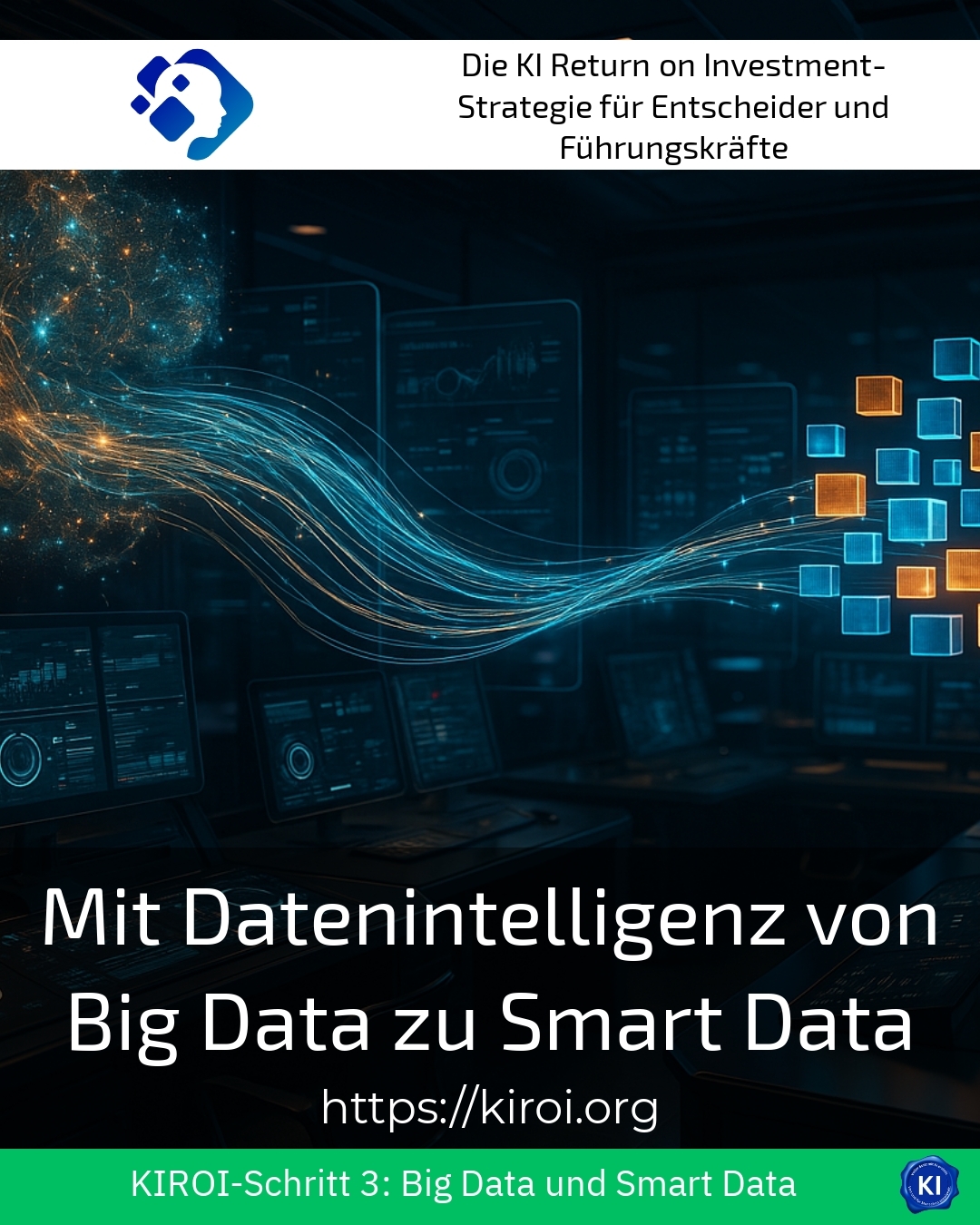
Imagine your company is sitting on a vast treasure trove of data and doesn't even know it. That is precisely what happens every day in countless organisations that collect information but fail to tap into its potential. The way with data intelligence from Big Data to Smart Data describes one of the most exciting transformations of our time. While companies used to take pride in massive amounts of data, pioneers today recognise a fundamental paradigm shift. It is no longer about quantity, but about quality and relevance. This realisation is transforming entire industries and creating new competitive advantages for those who actively shape the change.
Managing the challenge of information overload
Companies currently generate more information than ever before in human history. Sensors in production facilities record measured values every second. Customer interactions leave digital footprints. Supply chains continuously produce movement data. This abundance overwhelms traditional analysis methods and frequently leads to decision paralysis. Many managers report a paradoxical situation. They have access to more information than ever, but feel less well informed. The reason lies in the lack of refinement of the raw data.
This problem is particularly evident in the field of industrial manufacturing. Modern production lines generate millions of data points per day. Machine statuses, quality measurements and process parameters are documented comprehensively. Yet only a few companies use this information for predictive maintenance. The situation is similar in retail, where point-of-sale systems and loyalty cards collect extensive transaction data. The combination of this information with weather data, local events and economic indicators is often neglected. Huge potential is also lying dormant in healthcare within electronic health records and research databases.
Best practice with a AIROI customer
A medium-sized engineering company approached us with a typical challenge. Over the years, the organisation had made considerable investments in sensor technology and data acquisition systems. However, it lacked a clear strategy for utilising this collected information. As part of our transruptions coaching accompaniment, we jointly developed a structured approach to data refinement. First, we identified the mission-critical questions that actually needed to be answered. Subsequently, we filtered out precisely those data points from the flood of information that were relevant to these questions. The result was impressive because the analysis teams could suddenly work with focused data sets. Decision-making accelerated considerably and the quality of forecasts improved measurably. This project is an exemplary illustration of how change with data intelligence from Big Data to Smart Data can practically succeed.
Use intelligent algorithms as enablers
The transformation of raw data into actionable insights requires powerful technological tools. Machine learning and Artificial intelligence play a central role in this. These technologies can recognise patterns that remain hidden to the human eye. They identify correlations in complex data sets and generate recommendations for action. The aim here is not to replace human expertise. Rather, intelligent systems support professionals in their work and provide valuable impetus.
In the logistics sector, algorithms are already optimising route planning in real time. They take traffic conditions, weather conditions and delivery priorities into account simultaneously. Financial service providers rely on automated anomaly detection for fraud prevention. Every transaction is checked for unusual patterns in fractions of a second. In the energy sector, intelligent systems enable the balance between generation and consumption. They forecast demand and control decentralised energy sources accordingly. These examples illustrate the transformative potential of modern analytical methods.
Clients frequently report initial concerns about automated decision support systems. The worry about loss of control is understandable and should be taken seriously. Therefore, we recommend a step-by-step approach that keeps people at the centre. Algorithms provide recommendations and analyses, but people make the final decisions. This division of labour has proven effective in practice and builds trust.
Data quality as a foundation for smart data
The validity of any analysis depends on the quality of the underlying information. Flawed or incomplete input data inevitably leads to misguided conclusions. Therefore, every transformation project must begin with a thorough stocktake. Which data sources exist and how reliable are they? How up-to-date is the information and how consistent is its collection? These questions form the foundation for all further steps.
For example, the telecommunications sector struggles with fragmented customer data from various systems. Legacy systems, new installations and acquired business units often maintain their own databases. Harmonising these sources requires considerable effort, but it is worth it. In the pharmaceutical sector, regulatory requirements present additional complexity. Research data must be documented in a traceable and audit-proof manner. Insurance companies, in turn, juggle heterogeneous claims reports and contract documents. The standardization of this information forms the prerequisite for precise risk models.
With data intelligence from Big Data to Smart Data through cultural change
Technology alone is not enough for a successful transformation. At least equally important is the cultural shift within the organisation. Employees must understand why data-driven decisions offer benefits. Leaders should act as role models and embody analytical approaches. Silo mentalities between departments must be overcome to let information flow freely. These soft factors often decide the success or failure of transformation projects.
Our transruption coaching support addresses precisely this dimension. We assist organisations in developing a data-savvy corporate culture. In doing so, we take into account the specific circumstances of each sector and company. In retail, for example, branch managers must recognise the value of central analyses. In manufacturing companies, the challenge is to get foremen and technicians enthusiastic about new tools. In the service sector, the focus is on linking customer service and data analysis.
Best practice with a AIROI customer
An internationally operating retail group faced the challenge of engaging its decentralised organisation in data-driven decision-making processes. Over the years, the national subsidiaries had developed their own analysis methods and reporting structures. This heterogeneity prevented comparability and considerably hampered strategic management. As part of our support, we facilitated a comprehensive change process that involved all relevant stakeholders. First, we conducted interviews with managers from various countries and functional areas. We then jointly developed a standardised KPI framework that took local idiosyncrasies into account. Training programmes imparted not only technical skills, but also an understanding of the added value of standardised analyses. After about a year, those involved reported a noticeably improved quality of decision-making. For the first time, the group was able to identify cross-border trends and systematically transfer best practices. This example impressively demonstrates how cultural transformation and technical innovation must go hand in hand.
Observing data protection and ethics as guardrails
The intensive use of information raises important ethical and legal questions. Data protection regulations set strict limits on the processing of personal data. Companies must ensure transparency regarding the collection, storage and use of information. Data subjects have rights of access and erasure that must be respected. These requirements are not an obstacle, but rather build trust among customers and employees.
Particularly strict regulations apply to the handling of patient data in the healthcare sector. Hospitals and medical practices must implement pseudonymisation and encryption consistently. Banks are subject to extensive regulatory reporting obligations and auditing requirements. Their analysis systems must be traceable and auditable. The public sector also faces special challenges. Administrations hold sensitive citizen data that requires the highest level of protection. Balancing analytical capabilities with data minimisation requires careful consideration.
Approach the practical implementation step by step
The path to a data-driven organisation begins with small, manageable steps. Pilot projects in selected areas allow for learning experiences without excessive risk. Successes in these projects build acceptance and enthusiasm for further initiatives. The gradual scaling of proven approaches minimises bad investments and accelerates the learning process. In doing so, organisations should use agile methods and react quickly to insights.
Car manufacturers often begin by analysing quality data from manufacturing [1]. Initial successes in defect prevention motivate expansion to further production areas. Media companies often start with the personalisation of content recommendations for digital channels. The measurable improvements in user engagement and dwell time convince sceptics. Local authorities pilot smart city applications initially in individual districts before planning city-wide rollouts. This incremental approach has proven successful across industries [2].
The Trial with data intelligence from Big Data to Smart Data is not a one-off project task. Rather, it represents a continuous journey that never truly ends. Technologies evolve and open up new possibilities. Business models change and require different analytical focuses. Regulatory frameworks shift and demand adjustments. Successful organisations therefore establish permanent improvement processes for their data utilisation [3].
My AIROI Analysis
The transformation of unstructured information into actionable insights is one of the decisive success factors of our time. Organisations that actively shape this change secure sustainable competitive advantages. It repeatedly becomes apparent that technology is only part of the solution. At least as important are cultural changes, clear governance structures and continuous learning. Our experience from numerous projects confirms this holistic approach. Companies should start with specific business questions, not with technical capabilities. Refining raw data into actionable information requires specialist expertise and domain knowledge. Algorithms can assist, but they do not replace a deep understanding of business processes. The ethical and legal dimensions must never be neglected. Trustworthy handling of data creates acceptance among customers, employees and business partners. We recommend a pragmatic, step-by-step approach with quick wins. Manageable pilot projects enable important learning experiences with limited risk. The subsequent scaling of successful concepts accelerates the organisation-wide transformation. Leaders should act as role models and live out data-driven decision-making. This is the only way to create a corporate culture that values and promotes analytical approaches. The journey with data intelligence from Big Data to Smart Data has no defined end. It requires permanent adaptation to new technologies, changing markets and evolving requirements.
Further links from the text above:
[1] Bitkom – Digital transformation of SMEs
[2] McKinsey Digital Insights
[3] Gartner – Data and Analytics Research
For more information and if you have any questions, please contact Contact us or read more blog posts on the topic Artificial intelligence here.









 Deutsch
  English (UK)