
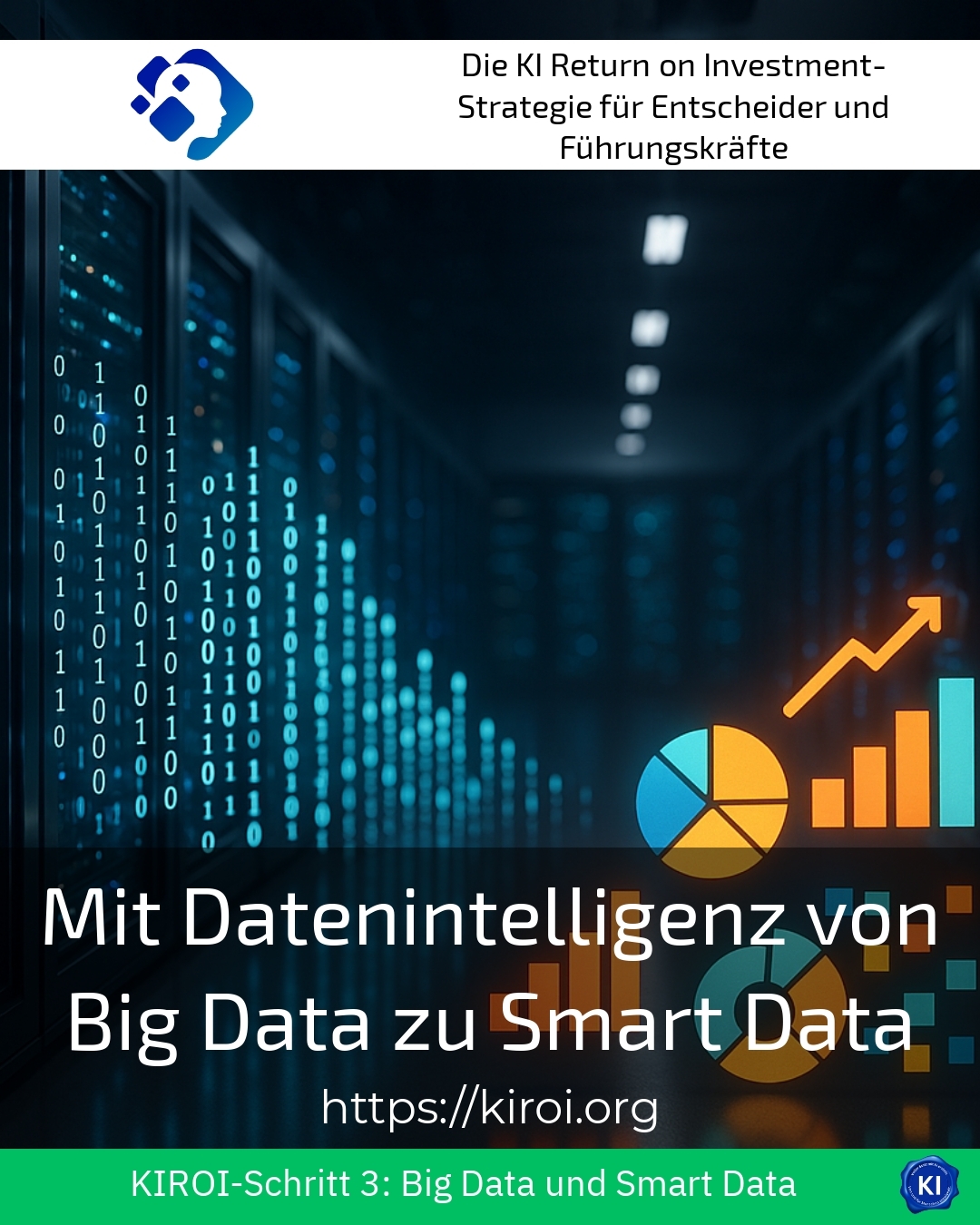
Imagine your company collects millions of data points every day, yet only a fraction of them lead to real insights. This is precisely where the transformative change begins that presents organisations worldwide with new challenges. Moving from big data to smart data using data intelligence describes a process that requires far more than technical upgrading. It is about a fundamental shift in perspective in the way we evaluate and utilise information. This article shows you concrete ways in which you can generate real added value from the flood of data.
The challenge of the modern information landscape
Businesses today generate more data than ever before in the history of commerce. Servers store customer interactions, sensors capture production data, and digital channels log every movement. Yet this sheer mass of information fundamentally overwhelms traditional analysis methods. Executives frequently report feeling like they are drowning in numbers, while simultaneously lacking the tools to derive wise decisions from them.
For example, a medium-sized machine builder collected all production data from its production lines over years. The volume of data grew exponentially, but no one was able to derive optimisation potential from it. Only through targeted filtering and contextualisation did actionable insights emerge. A logistics company that possessed millions of route data experienced a similar situation. The sheer volume of data did not help because relevant patterns were lost in the noise. A financial services provider, in turn, had extensive customer profiles, but could not use them for personalised offers.
Best practice with a AIROI customer
An internationally active automotive supplier approached us with a specific problem that many companies will recognise in a similar form. Over a period of five years, the company had collected all manufacturing quality data and stored it in a central data warehouse. The volume of data amounted to several petabytes, yet the quality assurance department was unable to derive any usable forecasts for potential sources of error from it. Together with the transruptions coaching team, we first developed a prioritisation matrix for the various data streams. In collaboration with the specialist departments, we identified those parameters that actually influence product quality. We then implemented a multi-stage filtering system that weeded out irrelevant information and highlighted relevant correlations. The result was impressive, as the error rate fell by over twenty percent within six months. The employees reported a significantly improved basis for decision-making in their daily work.
Transforming from big data to smart data with data intelligence
The transition from pure data collection to intelligent data utilisation demands strategic thinking. First of all, companies need to define which questions they actually want to answer. Only then is it possible to determine which data are relevant for this. For many organisations, this prioritisation already poses a considerable challenge. This is because the clear link between business objectives and data capture is often lacking.
A retail company, for instance, recorded every single point-of-sale transaction down to the finest detail. Yet the real question was which product combinations customers bought particularly frequently. A fraction of the collected data was entirely sufficient for this question. An energy supplier, in turn, wanted to be able to predict its customers' consumption more precisely. The solution lay not in more data, but in the intelligent linking of existing information with external weather data [1]. A pharmaceutical company applied the same logic to clinical studies. Instead of recording every conceivable biomarker, they concentrated on those with proven relevance.
Quality over quantity as a guiding principle
The temptation is strong to collect more and more data in the hope of better insights. However, this approach frequently leads to a dead end because complexity grows faster than usefulness. Instead, modern concepts help companies to concentrate on the essentials. The art lies in targeted omission and the courageous focus on relevant connections.
A telecommunications provider reduced its customer data analysis to fifteen core parameters and thereby achieved better predictions regarding customer retention. An insurance company got rid of historical claims data older than seven years and significantly improved its risk models as a result. An online retailer dispensed with the detailed collection of scrolling behaviour and instead concentrated on completed purchases and abandoned shopping carts. All these examples show that less can indeed be more.
Contextualisation as the key to understanding
Data without context remain meaningless series of numbers that no one can interpret. Only embedding them into a broader context turns them into actionable knowledge. This process of contextualisation requires both technical tools and human expertise. Algorithms can recognise patterns, but humans must interpret these patterns and translate them into actions.
A hospital used this insight to link patient data with treatment outcomes and develop personalised therapy recommendations [2]. A municipal utility contextualised consumption data with demographic information and was thus able to offer targeted energy consultations. A travel company combined booking data with weather forecasts and local events to provide better recommendations. In all three cases, contextualisation transformed raw data into valuable insights.
Best practice with a AIROI customer
A leading food manufacturer approached us with a specific challenge that is typical for many companies in the sector. The company had extensive data from production, logistics and sales, but was unable to link them together in a meaningful way. The individual departments were working in data silos, which made holistic optimisation impossible. As part of the transruption coaching, we first developed a joint data strategy involving all relevant stakeholders. We defined uniform standards for data collection and created interfaces between the various systems. Developing a shared understanding of which data points are relevant for which decisions was particularly important. Employees received training to ensure they could actually make use of the new possibilities. The project spanned nine months and resulted in a significantly improved quality of decision-making at all levels. Production lead times decreased measurably, and customer satisfaction demonstrably increased.
From big data to smart data through collaboration using data intelligence
Transformation rarely succeeds on its own, because different perspectives are required. IT experts understand the technical possibilities, whilst business departments know the operational requirements. Leaders, in turn, must set the strategic direction and provide resources. Sustainable success only arises when these three groups work together effectively.
A chemical company established interdisciplinary teams that accompanied data projects from conception to implementation. A media company brought editors and data scientists to the table to better predict the reach of articles. A construction company connected site managers with analysts to identify project risks early [3]. In all cases, it was shown that the combination of different expertises led to better results than isolated approaches.
Ethical aspects of intelligent data usage
As analytical capabilities increase, so does the responsibility when handling information. Companies must ensure that they use data only for legitimate purposes. Transparency towards customers and employees is becoming increasingly important in this regard. The legal frameworks set limits, but ethical considerations often go beyond them.
A bank consciously dispensed with certain analysis options because they were perceived as too invasive. A retailer openly communicated which data it collected and for what purposes, thereby winning customer trust. A technology company established an ethics committee that reviews new data usage concepts prior to implementation. These examples show that responsible handling of data can also make good economic sense.
My AIROI Analysis
The journey with data intelligence from big data to smart data represents a key challenge of our time for organisations of all sizes, touching upon both technological and cultural aspects and requiring profound changes. My experience from numerous consultancy projects shows that the success of this transformation depends on several factors, all of which must be considered equally. First, a clear strategic vision is needed to define the added value that data analysis should create for the company. Without this orientation, projects quickly get lost in technical details with no discernible business benefit.
Furthermore, the involvement of all relevant stakeholders is crucial to the success of the project. IT departments must not work in isolation, but must cooperate closely with the business departments. transruptions coaching supports companies precisely at this interface by building bridges between different perspectives. The support encompasses both strategic consulting and practical implementation assistance, with the focus always being on sustainable skills development. Organisations that consistently follow this path frequently report significantly improved decision-making processes and enhanced competitiveness. Experience shows that investment in intelligent data utilisation pays off in the medium to long term, even though the initial effort can be substantial.
Further links from the text above:
[1] Bitkom – Big Data and Analytics Overview
[2] Fraunhofer – Smart Data Research
[3] McKinsey – Data Analytics Insights
For more information and if you have any questions, please contact Contact us or read more blog posts on the topic Artificial intelligence here.









 Deutsch
  English (UK)