
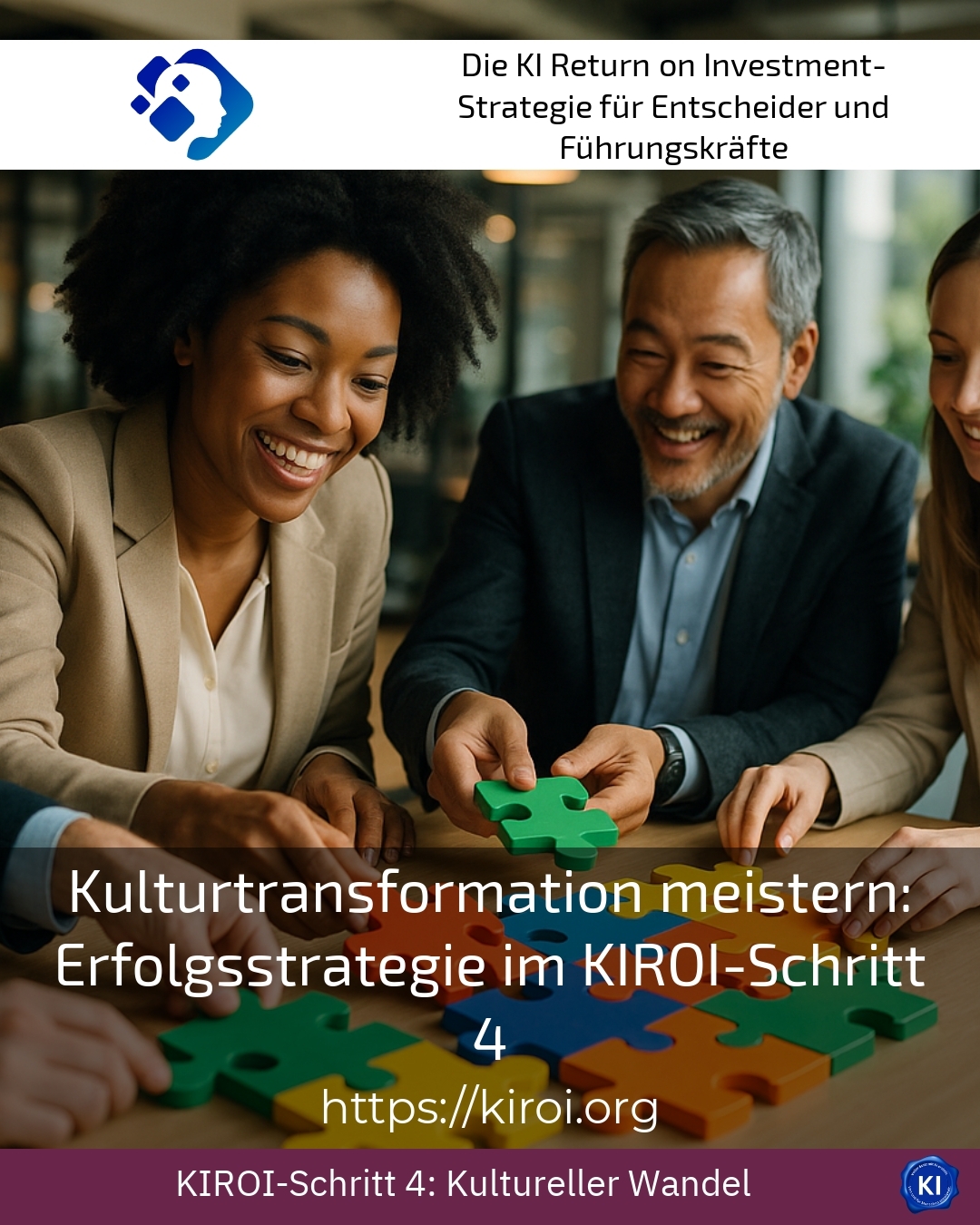
Culture transformation is gaining increasing significance in today's working world. To successfully manage this complex change, it is important to involve leaders as key drivers. Culture transformation is not a one-off project, but a continuous process that unfolds its decisive impact particularly in the fourth step of the AIROI model.
Kulturtransformation: the key role of leaders in AIROI Step 4
The focus of Step 4 in the AIROI model is on the active role of leaders as multipliers of the new corporate culture. They act as role models, embodying the lived values and behaviours, thereby creating a nucleus for cultural change. Cultural transformation can only succeed sustainably if leaders consistently align their behaviour with the new values.
In practice, companies from a wide range of sectors demonstrate how this step is effectively supported. For example, management teams from the IT sector report that regular coaching gives them the confidence to shed old habits and bravely integrate new ones. In the automotive industry, team coaching strengthens a shared understanding of new, agile collaboration. In service companies, on the other hand, continuous reflection on individual leadership styles helps to guide change processes with clear conviction and empathy.
BEST PRACTICE with one customer (name hidden due to NDA contract) A medium-sized technology company used targeted individual coaching and team workshops to support leaders in integrating the desired values into daily decision-making. This resulted in an authentic, collaborative leadership culture that had a positive impact on employee motivation and innovative strength.
Targeted actions for effective culture transformation
To master culture transformation at this stage, the combination of coaching, communication, and leading by example is crucial. Leaders should:
- regularly participate in individual and team coaching sessions to reflect on personal values and blind spots;
- lead by example with new behaviours consistently in daily work;
- foster open exchange with employees that can also productively incorporate resistance;
- systematically design feedback processes to make culture development measurable;
- and communicate the steps of change transparently to strengthen trust and a shared sense of identity.
Examples from the finance industry illustrate how proactive leadership intervention reduces conflict and constructively supports change. In healthcare, regular feedback rounds enable teams to anchor the new culture and align it with patient orientation. In the manufacturing sector, too, it is evident that leaders who actively act as coaches quickly adapt processes and structures to new values.
The challenges and opportunities of cultural transformation
Integrating new ways of thinking and behaving brings with it uncertainties and resistance. Many leaders face the task of preserving what has proven effective while consistently driving necessary innovations. Culture transformation therefore requires a sensitive yet determined approach.
Involving employees is a crucial success factor. Retail companies report that participatory formats and continuous communication increase team acceptance. In the education sector, joint workshops foster a stronger sense of community and greater identification with change. In the energy sector, systematic process adjustments sustainably support cultural change, thus enhancing competitiveness.
Strategies for Sustainable Change
For successful implementation, it is recommended:
- Early involvement of leadership as positive drivers.;
- Clear definition of desired values and behaviours, linked to company objectives;
- Continuous support through coaching and training.;
- Open communication channels to foster trust and empowerment;
- Measurable objectives for evaluating cultural change.
For instance, companies in the technology sector have fostered a positive innovation culture long-term through continuous dialogue. In logistics, regular retrospectives help optimise learning processes and establish new working methods. And in non-profit organisations, the conscious nurturing of shared values supports collaboration across hierarchical levels.
My analysis
Cultural transformation is a challenging task that should be accompanied by targeted leadership and active involvement of all stakeholders. AIROI Step 4 shows how leaders, as catalysts, can crucially contribute to sustainable implementation. Their role as role models, coupled with systematic reflection and communication, creates the foundation for the long-term success of cultural change.
Companies that consciously and systematically shape this process increase their adaptability, innovativeness, and employee motivation. This turns cultural transformation not only into a means of change but into a lasting resource for growth and competitiveness.
Further links from the text above:
AIROI Step 4: Leaders as Impetus Providers
The path to successful cultural transformation
Mastering Cultural Transformation: Opportunities and Challenges
For more information and if you have any questions, please contact Contact us or read more blog posts on the topic Artificial intelligence here.











 Deutsch
  English (UK)