
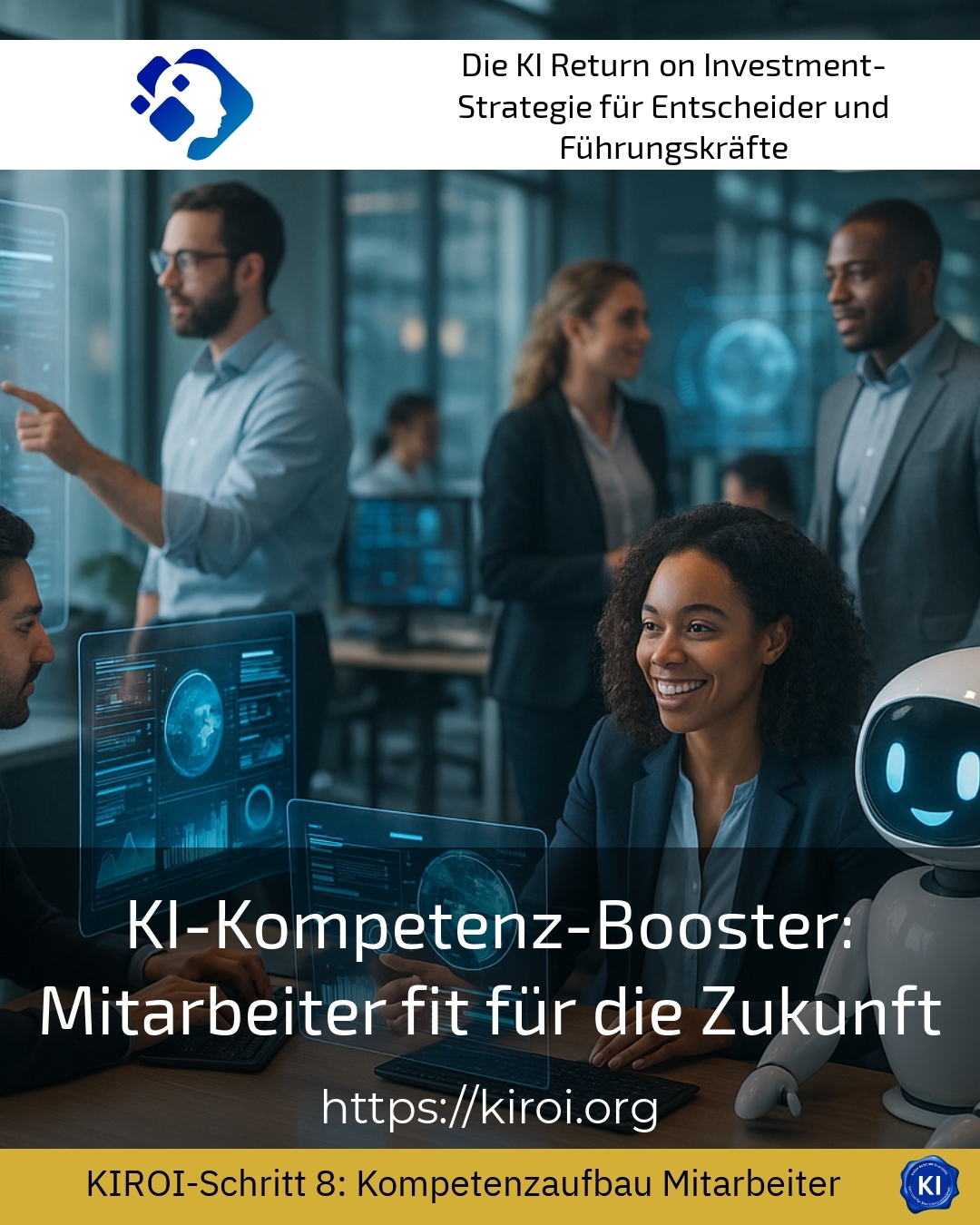
The digital transformation is fundamentally changing our working world. Many companies are facing the challenge of preparing their teams for new technologies. The AI Competence Booster: Getting Staff Ready for the Future accurately describes this need. At the same time, leaders are wondering how to best support their workforce. The answer lies in a systematic approach that combines both technical knowledge and emotional intelligence. In this post, you will learn which concrete steps your company can take. Practical examples play a central role in this. This is how change succeeds in a sustainable and human-centred way.
Why competency development is indispensable today
The speed of technological change often outstrips the adaptability of traditional training programmes. Companies repeatedly bring similar challenges of transruption coaching to us. Leaders find that their teams react uncertainly to new tools. Employees feel overwhelmed and fear being replaced. These anxieties are understandable and deserve sensitive support.
For example, a large retailer found that its sales advisors rejected automated recommendation systems. The staff saw them as a threat to their expertise. A logistics company struggled with the introduction of intelligent route planning. The drivers did not trust the algorithmic suggestions. A medium-sized engineering company also experienced resistance when implementing predictive maintenance systems. The technicians felt their experience was not valued.
These examples clearly show that technical introductions alone are not enough. The human factor determines success or failure. That is why transruptions-Coaching supports organisations in connecting both dimensions. The guidance on projects related to digital change creates trust and acceptance.
The AI Competency Booster as a Strategic Instrument
A systematic approach to competence development begins with an honest assessment of the current situation. Where do individual team members stand today? What skills do they already possess? Where are there gaps that need to be addressed? These questions form the foundation of any sustainable development strategy. The AIROI methodology offers valuable insights for structured analyses here.
An insurance company used this approach to prepare for automated claims processing. Claims handlers learned to identify complex cases that require human expertise. A pharmaceutical company trained its sales representatives to work with data-driven customer analytics. The representatives developed new skills in interpreting behavioural patterns. An energy provider prepared its customer advisors for intelligent chatbot systems. The employees took on the role of an escalation level for challenging enquiries.
Best practice with a AIROI customer
A medium-sized manufacturing company in the automotive supplier sector faced a significant challenge. Management had decided to introduce intelligent quality control systems. These systems were intended to automatically detect and classify errors in components. The long-serving quality inspectors initially reacted with great scepticism to this announcement. Many of them had more than twenty years of professional experience in this field. They feared that their expertise could suddenly become worthless. transruptions-coaching accompanied the company over a period of six months. Together, we developed a programme that retrained the inspectors as system trainers. The experienced employees contributed their knowledge to improve the algorithms. They learned to document error patterns and teach them to the system. This created a completely new appreciation for their expertise. The quality inspectors became indispensable partners in technological development. At the end of the project, the participants reported increased self-confidence. They no longer felt like victims of change, but rather as active shapers of their future.
Practical implementation steps for the AI competency booster
The implementation of an effective development programme requires careful planning. Initially, an analysis of the team's existing competencies is recommended. Subsequently, individual learning paths are defined, taking into account different starting levels. Regular reflection sessions allow for the programme to be adapted to current needs. Mentoring systems promote knowledge exchange between experienced and new employees.
A trading company established so-called learning partnerships between younger and older employees. The younger colleagues brought technical affinity. The older team members shared their knowledge of customer relationships and industry contexts. A financial services provider set up weekly experimentation rooms. There, employees could try out new tools in a protected environment. A healthcare company integrated learning units directly into daily work. Employees received short daily prompts to develop their skills further.
Emotional intelligence as a key competence of the future
Technical knowledge alone is not enough to succeed in an automated world of work. Instead, human skills that machines cannot replicate are gaining importance. Empathy, creative problem-solving, and complex communication are becoming key differentiators. This is why transruption coaching places particular emphasis on developing these soft skills.
A telecommunications provider trained its customer service staff in emotional communication. The employees learned to better support frustrated customers. A travel company fostered the creative consulting skills of its employees. These employees developed individual travel concepts that no booking platform can create automatically. An educational institution invested in the coaching skills of its lecturers. The teachers were enabled to support learners more individually.
These developments show that people can remain at the centre. Technology takes over repetitive tasks and creates free space. This free space can be used for value-adding human interactions. The AI competence booster: making employees fit for the future therefore means more than technical training.
Understanding and constructively addressing resistance
Clients often report resistance within their teams. These reactions are natural and deserve respect. Change causes uncertainty, and people need time to adapt. Transruptions coaching helps leaders understand and constructively address these dynamics.
A media company encountered strong reservations about automated text generation. Editors feared a loss of journalistic quality. An architecture firm faced rejection when introducing parametric design tools. Designers felt their creative freedom was threatened. A consultancy struggled with the acceptance of analytics tools among its consultants. Experienced consultants doubted the validity of algorithmic recommendations.
Best practice with a AIROI customer
A large commercial law firm turned to transruptions-Coaching with an urgent request. The partners had decided to introduce intelligent contract analysis software. The associates and paralegals reacted to this decision with considerable uncertainty. They feared that their research work might become redundant. The coaching programme began with in-depth individual discussions to understand the individual concerns. It became apparent that many employees strongly linked their professional identity with research activities. Together, we developed a narrative that highlighted new career perspectives. The employees learned to view the software as a tool for increasing efficiency. They realised that they would now gain more time for complex legal analyses. The freed-up capacity enabled more intensive client discussions and strategic advice. After the programme concluded, the atmosphere within the company had noticeably improved. Employees reported higher job satisfaction and new development opportunities. Staff turnover decreased measurably, and client satisfaction also increased.
Leaders as enablers of change
The role of leaders is changing significantly in the context of technological transformation. They are becoming enablers and supporters of their teams. In doing so, they must themselves develop an open attitude towards new technologies. At the same time, they are expected to provide security and direction. Finding this balance presents many leaders with challenges.
An industrial company specifically invested in the development of its middle management. The team leaders learned to moderate change processes. A retail group trained its branch managers in supporting digital transformations. They became local contact persons for technical questions and emotional support. A technology company established a reverse mentoring programme. Younger employees guided experienced managers in adopting new tools.
Sustainable Anchoring of Learning Cultures
One-off training programmes are not enough to guarantee lasting competence development. Instead, organisations need a culture of continuous learning. This culture is fostered through consistent role-modelling by leadership. Mistakes must be viewed as learning opportunities, not as failures. A willingness to experiment should be rewarded and encouraged.
A software company introduced so-called Failure Fridays. On these days, employees shared their failures and the lessons learned from them. A consumer goods group set up internal innovation labs. Employees could develop and test new ideas there. A service company established a points system for completed learning units. The collected points could be exchanged for additional training budgets.
These approaches show that a learning culture must be actively shaped. It does not arise by itself but requires conscious investment. The AI Competence Booster: Equipping Employees for the Future describes exactly this comprehensive development approach.
My AIROI Analysis
The observations from numerous accompanying projects show a clear pattern. Organisations that involve their employees early on and comprehensively achieve better results. Purely technical implementations without human support fail more often or fall short of their potential. The emotional dimension of change processes is often underestimated.
Approaches that value and expand existing competencies are particularly successful. Employees then don't feel replaced, but rather developed. This attitude generates motivation and commitment to change. Managers play a crucial role as role models and enablers. Their own willingness to learn inspires teams to similar openness.
The AIROI methodology offers a structured framework for these development processes. It combines analytical assessments with practical implementation steps, taking into account both organisational and individual factors. Transruption Coaching supports companies in this multifaceted transformation with experience and empathy.
The future belongs to organisations that connect technological innovation with human development. These companies will be able to attract and retain talent. They will react more flexibly to market changes and achieve sustainable success. The path to get there begins with the first step of conscious skills development.
Further links from the text above:
[1] McKinsey – Reskilling in the Age of AI
[2] World Economic Forum – Future of Work
[3] Harvard Business Review – Artificial Intelligence
[4] Bitkom – Digital Transformation
For more information and if you have any questions, please contact Contact us or read more blog posts on the topic Artificial intelligence here.






 Deutsch
  English (UK)