
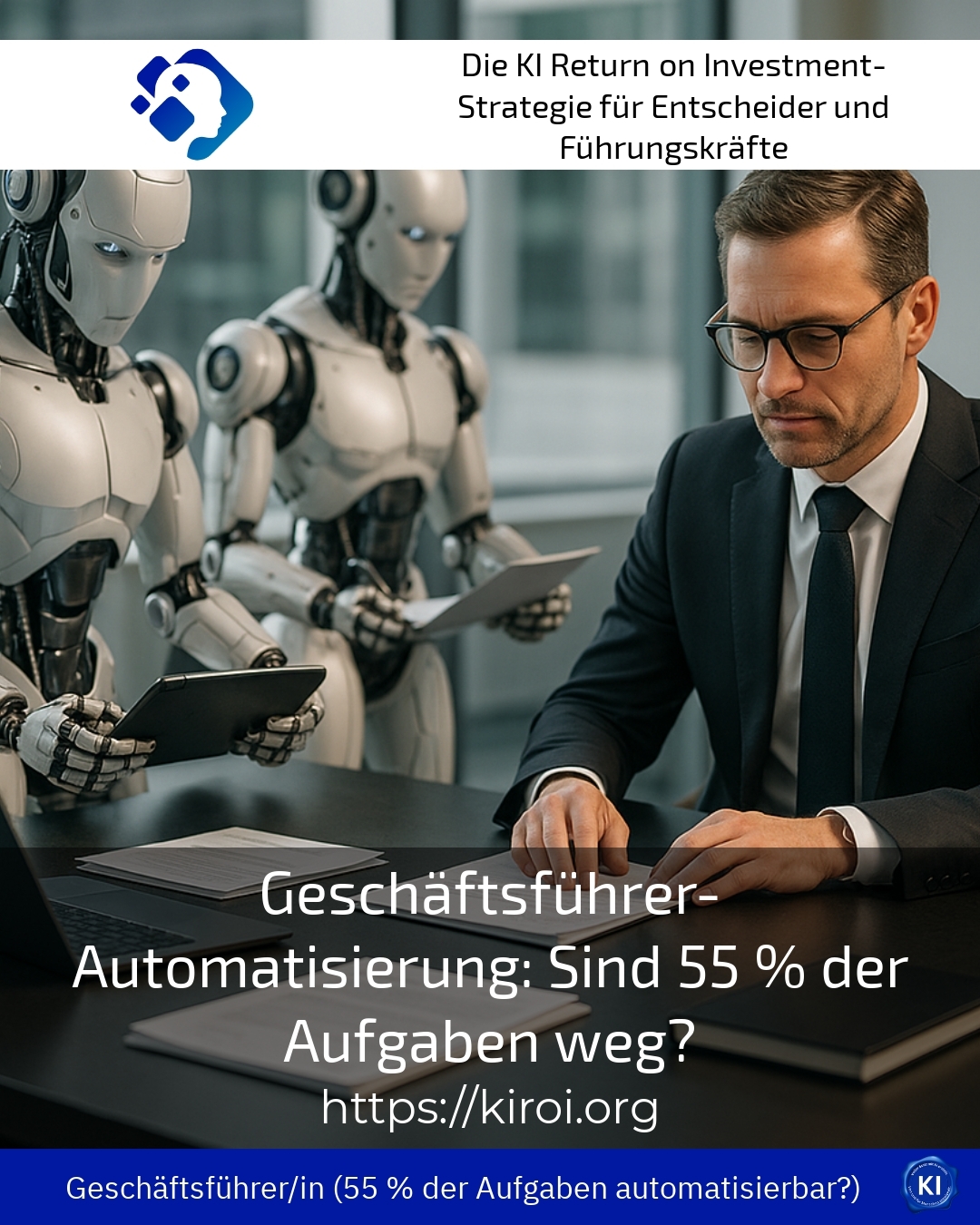
What happens to your position if intelligent systems can take over more than half of your daily work – and why does it affect you? Managing Director Automation Right now, even in top management?
The development is progressing rapidly and fundamentally changing established leadership structures. Analyses show that approximately 55 percent of typical activities in leadership positions could be supported or replaced by modern technologies. This finding is based, among other things, on data from the Job Future Observatory of the Institute for Employment Research [1]. The figures illustrate a change that goes far beyond operational levels.
If you are active in this field, the AIROI-Seminare offer a thorough solution. You can find the current dates here. risawave.org/en/live-events-with-sanjay-sauldie/ [2]. These seminars, lectures, and workshops will help you strategically reorient your leadership role.
Why traditional leadership models are under pressure
The classic responsibilities of a company management include areas such as financial planning, personnel decisions, and strategic direction. Today, intelligent analysis systems already perform the evaluation of complex market data. Furthermore, they generate precise forecasts for business developments. Automated reporting systems generate summaries in seconds that used to take hours. This is not a distant vision of the future; it is a present reality.
A medium-sized company in mechanical engineering, for example, uses algorithmic systems for supplier selection. The software automatically analyzes price histories, delivery times, and quality metrics. Another example can be found in retail, where assortment decisions are based on sales forecasts. In the field of personnel planning, intelligent systems identify qualification gaps and suggest suitable further training. These developments show how Managing Director Automation looks concrete.
The effects do not only affect operational activities. Strategic decisions are increasingly based on machine-processed information. Executives often report that they spend more time interpreting data. The actual decision-making process therefore shifts to a higher level of abstraction.
Best practice with a AIROI customer A company in the logistics industry faced the challenge of adapting its leadership structures. The CEO spent about 15 hours per week analyzing performance metrics. By implementing an intelligent dashboard, this effort was reduced to two hours. The time gained was invested by the leadership team in strategic customer conversations and innovation projects. The AIROI seminar had previously laid the foundations for this transformation. The guidance provided by transruptive coaching helped overcome resistance within the team. Initially, employees were uncertain about the new systems. However, through clear communication and a gradual rollout, acceptance was achieved. Today, the company reports a significantly improved quality of decision-making. The leadership team is focusing on value-adding activities such as relationship building and market development.
Understanding the 55 percent threshold for managing director automation
The stated 55 percent quota of tasks that can be automated requires a nuanced approach. It does not mean that every second leadership position becomes redundant. Rather, it shows which tasks can be supported by technology. The remaining 45 percent encompass core competencies that still require human expertise.
These core competencies include emotional intelligence and interpersonal leadership. Motivating teams requires empathy and a situational sense. Crisis management requires creative problem solving in the face of uncertainty. Negotiations with business partners are based on trust and building relationships. These skills are difficult to replicate through algorithms.
An example from the real estate industry illustrates this. In complex project developments, various stakeholders must be brought together. Investors, authorities, and residents have different expectations. Integrating these perspectives requires diplomatic skill. In healthcare, a similar picture emerges. Clinic managers must balance medical, economic, and ethical aspects. Pure data analysis is not sufficient for such decisions. In manufacturing, on the other hand, long-standing supplier relationships play a central role.
Which areas of responsibility are particularly affected
Automation mainly concerns repetitive and data-based tasks. Financial planning and budgeting are among the areas most affected. Controlling tasks are increasingly being taken over by business intelligence systems. The creation of reports for supervisory bodies is being partially automated. Monitoring compliance requirements uses rule-based systems.
In the area of personnel management, algorithms identify fluctuation risks. They suggest candidates for promotion based on performance data. Scheduling and resource allocation often take place automatically. In communication, systems create drafts for circulars. The analysis of market trends and competitors is also increasingly being carried out automatically.
For example, a trading company uses automated competition monitoring. Price changes by competitors are recorded and analyzed in real time. The management receives summarized recommendations for price adjustments daily. In the restaurant industry, systems optimize purchasing planning based on booking forecasts. The construction industry relies on automated project progress monitoring.
How leadership roles are transforming
The Managing Director Automation it requires a redefinition of leadership. Instead of gathering information, the focus will be on its intelligent interpretation. Instead of monitoring processes, the focus will shift to shaping corporate culture. The role will shift from the operational manager to the strategic visionary.
This transformation does not happen automatically. It requires conscious development and new skills. The AIROI strategy provides a structured framework for this. The seminars provide practical approaches for integrating new technologies. At the same time, they strengthen the human leadership skills.
An example from the media industry illustrates the change. In the past, CEOs spent a lot of time analyzing revenue figures. Today, dashboards perform this task in seconds. The time saved is now used for creative strategy discussions. In the insurance industry, the development is similar. Risk assessments are performed algorithmically, customer relationships remain human. The tourism industry is also undergoing a change. Booking forecasts are automated, while destination development remains a leadership task.
Best practice with a AIROI customer A family business in the food retail sector underwent a comprehensive transformation process. The owner initially had concerns about the increasing technologicalization. Through coaching in transruptive change management, she was able to constructively address these concerns. The AIROI seminar helped her recognize the opportunities for development. Within six months, the company implemented a new inventory management system. This took over much of the management’s previous planning work. The owner used the new freedom to expand into neighboring regions. Today, she operates three additional locations that would not have been possible without the time savings. Employee satisfaction also increased, as more time was available for personal conversations. The example shows how automation can enable growth.
Practical steps for the transition to automated management
Successful handling of these changes begins with an honest assessment of the current situation. Managers should analyze which of their activities can be automated. This analysis forms the basis for a strategic realignment. The next step is targeted competence development.
The AIROI-workshops provide concrete tools for this process. Participants learn to systematically identify automation potential. They develop strategies for integrating new systems. At the same time, they strengthen their human leadership skills.
In banking, for example, executives are increasingly using automated risk analysis. They invest the time gained in advising customers on complex financing. In the energy sector, systems automate grid optimization. Management focuses on policy frameworks and sustainability. The pharmaceutical industry is automating documentation processes. Executives are devoting more time to research strategy.
My AIROI Analysis
The shift towards greater automation at the leadership level is irreversible. This is not a threat, but an opportunity for realignment. The 55 percent figure shows the potential for relief from repetitive tasks. At the same time, it underscores the importance of genuine human leadership skills. Successful adaptation requires proactive action and continuous learning. The AIROI strategy provides a proven framework for this transformation. Leaders who act early become agents of change. They use technology as a tool, not as a substitute. The future belongs to leadership figures who can combine both worlds. Technological expertise and human leadership complement each other ideally. The time for this realignment is now. The tools are available, the paths are known. The decisive factor remains the willingness to change. Those who possess this willingness will emerge strengthened from the transformation.
Further links from the text above:
[1] IAB Job Futuromat
[2] AIROI seminars and live events
For more information and if you have any questions, please contact Contact us or read more blog posts on the topic Artificial intelligence here.







 Deutsch
 English (UK)