
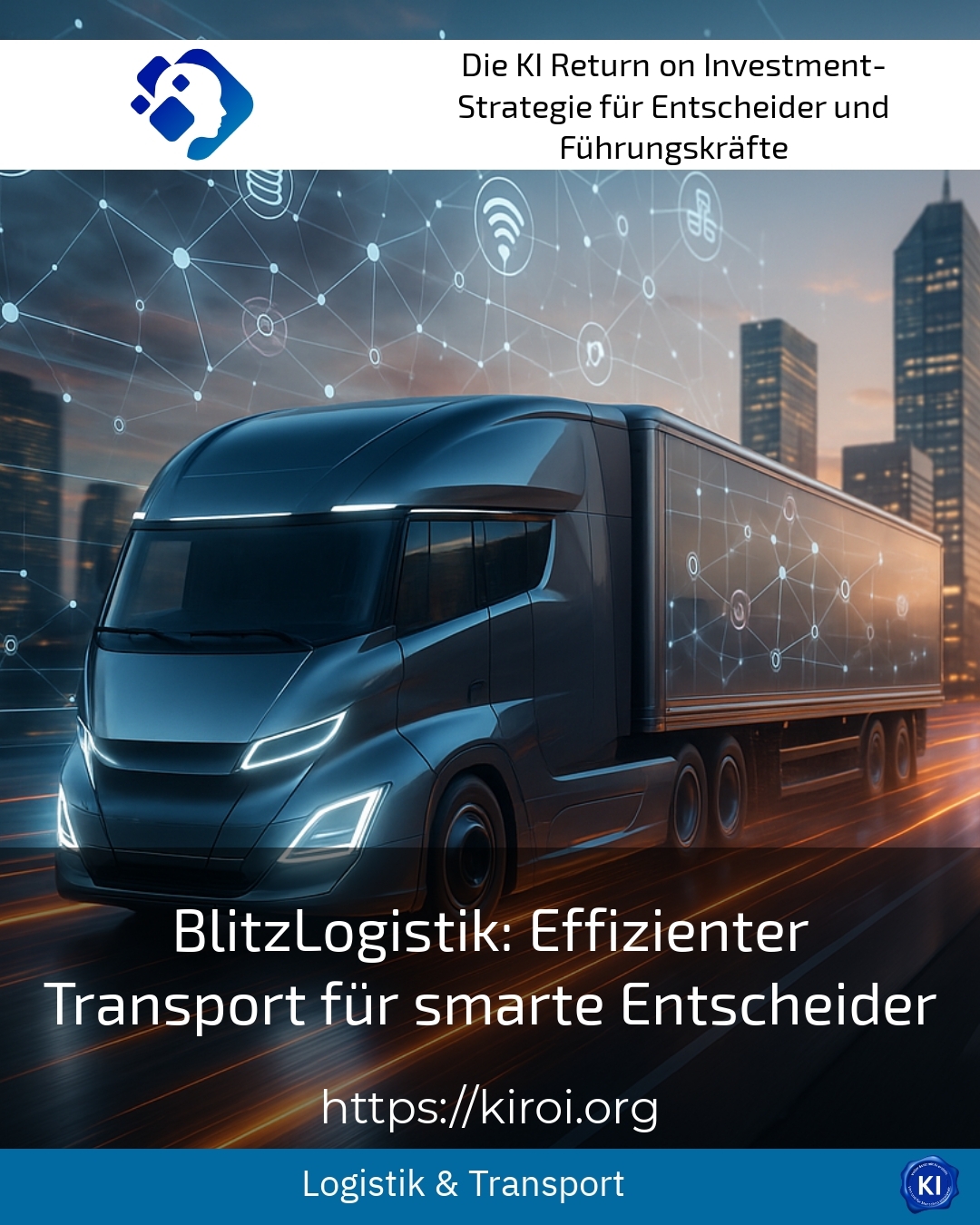
Have you ever wondered why some companies get their goods to the customer within a few hours, while others keep them waiting days for their deliveries? The answer lies in an area that is frequently underestimated, but is crucial for business success. Smart decision-makers have long recognised that the efficient transport of goods is not merely an operational necessity, but offers a strategic competitive advantage. In a world where customers expect instant availability, the speed of goods delivery becomes the decisive differentiating feature. Those who rely on modern solutions here secure an advantage that competitors will find difficult to catch up with.
Why fast transport has become indispensable today
Customer expectations have changed fundamentally over recent years. In the past, buyers accepted delivery times of a week or more. Today, they expect their parcels the next day or even the same evening. This development affects not only the end-consumer market, but is increasingly shaping the business-to-business sector as well. Manufacturing companies need spare parts within a few hours because idle machines cause enormous costs. Retailers expect daily deliveries to keep their inventory to a minimum while still remaining able to deliver at any time. Hospitals depend on fast medicine deliveries because, in the worst case, delays can cost lives.
Digitisation is what made this acceleration possible in the first place. Modern tracking systems enable seamless, real-time parcel tracking. Customers can see precisely on their smartphones where their order currently is. Algorithms calculate optimal routes while taking traffic conditions, weather and vehicle capacity into account. Artificial intelligence forecasts demand and enables predictive dispatching. These technologies create transparency and efficiency in equal measure.
An automotive supplier from southern Germany illustrates this development impressively. The company supplies several production plants daily with just-in-sequence components. Any delay of more than an hour would bring the assembly line to a standstill. Therefore, the supplier relies on fully digitalised route planning that immediately detects deviations and calculates alternative routes. A food retailer, on the other hand, uses temperature-monitored transport with GPS tracking. This ensures that fresh goods arrive at the customer's premises at the optimum temperature. A pharmaceutical company, in turn, relies on specialised express couriers that deliver life-saving medicines to clinics within hours.
The role of artificial intelligence in modern freight transport
Artificial intelligence is revolutionising the way companies plan and control their logistics. Machine learning analyses historical data and recognises patterns that remain hidden from human planners. This allows demand peaks to be predicted and capacities to be adjusted accordingly. Predictive analytics warn of potential bottlenecks before they arise. Automated decision-making systems respond in real time to changing conditions and dynamically adjust routes.
These intelligent systems support dispatchers in making complex decisions. They suggest optimal cargo space utilisation and minimise empty runs. They take drivers' hours and rest periods into account, thereby ensuring compliance with statutory regulations. They identify consolidation opportunities and thereby reduce transport costs. At the same time, they improve service quality through more reliable delivery time slots.
For example, a medium-sized mechanical engineering company uses AI-supported route planning for its spare parts service. The system takes into account not only geographical factors, but also the urgency of individual orders and the qualifications of the service technicians. An e-commerce retailer relies on intelligent warehouse management, which automatically redistributes inventory between different locations in order to shorten delivery times. A wholesale builder's merchant uses predictive models to forecast seasonal fluctuations and plan its transport capacities accordingly.
Best practice with a AIROI customer
A leading manufacturer of industrial components faced the challenge of significantly reducing its delivery times without driving up transport costs. The company supplied customers throughout Europe and struggled with unreliable delivery windows that regularly led to complaints. As part of a transruptions coaching project, we jointly analysed the existing processes and identified substantial potential for optimisation. We supported the company in implementing an AI-powered transport management system that brought together real-time data from various sources. The system integrated traffic information, weather data and historical delivery times into its calculations. In addition, we introduced dynamic route planning that automatically clustered orders according to priority and geographical proximity. The results significantly surpassed even the management's most optimistic expectations. The average delivery time was reduced by more than thirty percent, while transport costs per shipment fell by fifteen percent. Customer satisfaction rose measurably and the number of complaints declined significantly. The improved predictability proved to be particularly valuable, enabling the company to make binding delivery commitments to its customers and to keep them.
Sustainability and efficiency as drivers for smart decision-makers
Ecological responsibility and economic efficiency are not mutually exclusive. On the contrary: smart decision-makers recognise that sustainable transport solutions are often also the more cost-effective ones. Optimised routes mean fewer kilometres travelled and therefore lower fuel consumption. Better vehicle utilisation reduces the number of journeys required and cuts CO₂ emissions per transported unit. Alternative drives such as electric or hydrogen vehicles are becoming increasingly economically attractive, particularly in urban delivery traffic.
Regulatory requirements are further reinforcing this trend. Low-emission zones in city centres make it more difficult to drive conventional diesel vehicles. CO₂ levies are making fossil fuels more expensive and alternative powertrains more competitive. Major customers are increasingly demanding evidence of the environmental footprint of their supply chains. Companies that invest proactively in this area secure long-term competitive advantages.
A beverage manufacturer from the Rhineland has switched its entire city delivery fleet to electric vehicles. The higher initial purchase costs are offset by lower operating costs and avoided environmental zone restrictions. A furniture retailer combines rail transport for long distances with electric delivery vehicles for the last mile. A textile logistics provider uses bicycle couriers in inner cities to supply fashion boutiques quickly and emission-free.
Digital transformation as the key to fast supply chains
Connecting all parties involved in a supply chain creates transparency and enables rapid responses to changes. Cloud-based platforms link shippers, freight forwarders, carriers and consignees. Real-time data flows between all partners, creating a shared view of the situation. Deviations are identified immediately and can be communicated proactively. Customers receive automatic notifications regarding the status of their consignments.
This transparency fundamentally transforms collaboration. Trust replaces complex checks and reduces administrative overhead. Automated document processes speed up customs clearance and avoid delays at border crossings. Electronic consignment notes replace paper documents and significantly simplify processing. Blockchain technology ensures the integrity of sensitive data and creates immutable documentation.
For example, a chemical company uses a digital platform to seamlessly document hazardous goods transport and be able to respond to authorities' enquiries at any time. An electronics retailer has completely digitalised its returns logistics and is able to put returned goods back on sale within hours. A food corporation monitors the cold chain of its fresh products using IoT sensors and can intervene immediately if there are any temperature deviations.
Strategic partnerships for maximum flexibility
No company can handle all transport requirements on its own. Smart decision-makers therefore rely on a network of specialised partners who bring different competencies to the table. Standard shipments go via cost-efficient parcel services. Bulky goods are transported by specialist pallet freight forwarders. Express shipments are handled by flexible courier services with guaranteed transit times. International transports are coordinated by experienced freight forwarders with a global network.
Selecting the right partners requires careful analysis and ongoing assessment. Service quality and reliability often carry more weight than price alone. Transparent communication and a rapid response to problems are essential. Technological compatibility enables seamless integration into existing systems. Shared values regarding sustainability and social responsibility strengthen the partnership in the long term.
A cosmetics manufacturer works with a network of more than twenty different logistics partners. Each partner caters to specific requirements such as temperature-controlled transport, dangerous goods or international customs clearance. A industrial equipment supplier uses specialist heavy-haulage companies for machine transport, whilst spare parts are dispatched via express networks. A fashion retailer combines large-volume seasonal shipments with flexible top-up deliveries during the season.
Best practice with a AIROI customer
An internationally active medical technology manufacturer was looking for ways to improve its ability to deliver in crisis situations. Experiences during global supply chain disruptions had shown how vulnerable the company was. As part of our support, we jointly developed a multi-layered resilience strategy that took various scenarios into account. We identified critical transport routes and worked out alternative options for each of these paths. The company diversified its logistics partners and built relationships with regional freight forwarders in various markets. In addition, we implemented an early warning system that detects potential disruptions based on various indicators. The new strategy was tested in a pilot project for a particularly critical product line. When a transport strike actually blocked an important route, the company was able to switch to alternative partners within a few hours. The ability to deliver was guaranteed throughout, while competitors struggled with considerable delays. Management reported significantly increased planning certainty and an improved relationship with key customers who greatly appreciated the reliability.
Future trends for smart decision-makers in transport
Developments in the transport sector are progressing rapidly. Autonomous vehicles promise more efficient and safer transport, even if nationwide deployment will still take some time. In future, drones could deliver urgent parcels to hard-to-reach areas or revolutionise the last mile in urban spaces. Experts are discussing Hyperloop systems as an alternative for long-distance transport between major cities.
More short-term relevance attaches to developments in data usage and process automation. Digital twins create virtual representations of complex supply chains and enable the simulation of various scenarios. Robotic process automation takes on repetitive administrative tasks, freeing up employees for value-adding activities. Augmented reality assists warehouse staff with order picking and significantly reduces error rates.
A logistics service provider is already testing autonomous lorries on a defined route between two plants. A pharmaceutical wholesaler is trialling drone deliveries to remote medical practices. A port operator is using digital twins to optimise container handling and minimise waiting times.
My AIROI Analysis
Observations from numerous projects clearly show that companies can achieve significant competitive advantages with modern transport solutions. Clients frequently report initial scepticism regarding the investment required, which quickly turns into enthusiasm after implementation. The combination of intelligent technology and strategic partner selection regularly proves to be successful. It is evident that the most expensive solutions do not necessarily deliver the best results, but rather the approaches tailored precisely to the respective requirements.
Particularly remarkable is the interaction between efficiency and sustainability. Companies that optimise their transport operations not only reduce costs, but simultaneously make a contribution to environmental protection. This double dividend makes investments in modern logistics solutions particularly attractive. Smart decision-makers recognise this potential and systematically exploit it [1]. Guidance through such transformation projects repeatedly demonstrates that the human factor remains crucial [2]. Technology alone does not solve problems if employees are not brought along and processes are not adapted. Transruption coaching can provide valuable impetus here in order to overcome resistance and anchor changes sustainably [3]. The future belongs to companies that use technology intelligently without forgetting the people who operate and further develop these systems.
Further links from the text above:
[1] German Logistics Association – Publications on logistics trends
[2] Fraunhofer SCS – Supply Chain Services Research
[3] AIROI Blog – Artificial Intelligence in Practice
For more information and if you have any questions, please contact Contact us or read more blog posts on the topic Artificial intelligence here.









 Deutsch
 English (UK)