
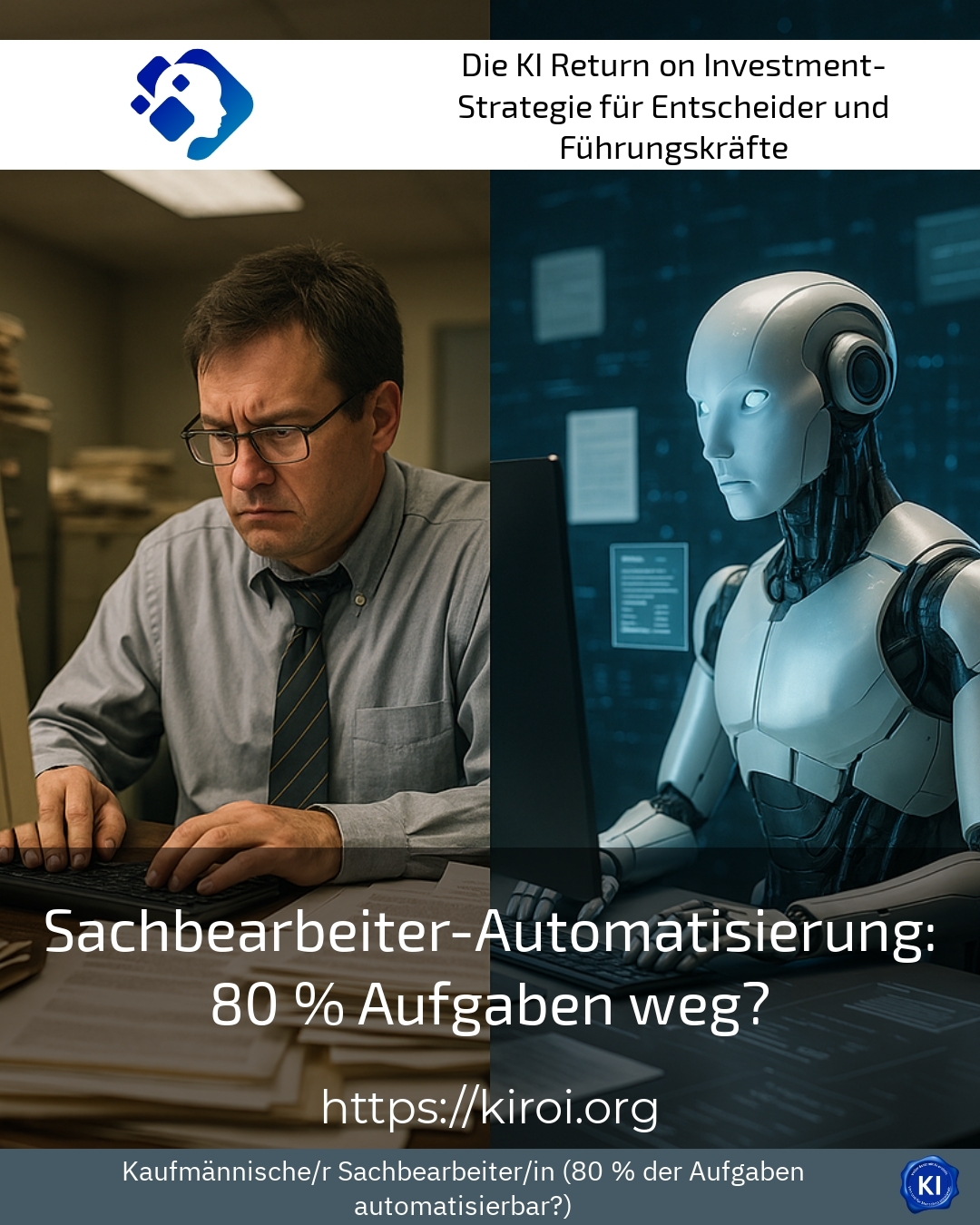
Will eight out of ten tasks in your everyday office life soon be done by machines, and do you already need to prepare for a completely transformed working world that is arriving faster than most realise? This question is currently occupying countless professionals in the administrative sector, because the admin automation is progressing at breathtaking speed and fundamentally changing how office work is organised and carried out. What was considered a secure permanent job only yesterday is today being put to the test by intelligent algorithms that can handle routine tasks in a fraction of a second for which humans would need hours or even days.
The findings on this topic are based, amongst other things, on the analyses of Job-Futuromats of the Institute for Employment Research [1]. This platform impressively demonstrates which professional activities can already be replaced by technological solutions today. If you yourself work in this field and are wondering how you can actively shape your professional future, the AIROI seminars an excellent opportunity for further development. The current dates can be found on the RisaWave website [2], where Sanjay Sauldie regularly offers lectures, workshops, and seminars on strategic realignment in the digital age.
The silent revolution in the corporate offices
In countless companies, a profound transformation is currently taking place which often occurs unnoticed by the general public and yet brings far-reaching consequences for millions of employees. Intelligent software solutions are increasingly taking over tasks traditionally performed by human professionals in the administrative sector. For example, modern systems process incoming invoices fully automatically, check them for plausibility and forward them to the relevant approval departments. Customer enquiries are answered by chat-based assistants that are available around the clock and often respond more quickly and precisely than human employees. Data entry into complex enterprise systems is now carried out by robots that can extract information from a wide variety of sources and transfer it into the correct fields without error.
This development is particularly impressive in the field of document processing. Modern systems automatically recognise contract contents, categorise them according to predefined criteria and archive them in digital filing systems. Scheduling for appointments and meetings is handled by intelligent assistants that reconcile calendars and find optimal time slots. The creation of standardised reports and evaluations is also increasingly in the hands of algorithmic helpers. These examples make it clear that the admin automation no longer represents a distant vision of the future, but is already a lived reality in many organisations today.
Best practice with a AIROI customer
A medium-sized company in the service sector was faced with the challenge of fundamentally modernising its administrative processes, as the existing procedures had become too slow and prone to errors. The management recognised at an early stage that simply introducing new technology without strategic guidance would be doomed to failure, which is why they opted for comprehensive consultancy as part of the AIROI strategy. Together with the consultancy team, those responsible first analysed all recurring administrative tasks and identified more than thirty processes that were suitable for automation. However, rather than making staff redundant, the company developed an innovative concept to redeploy the affected staff, who now act as process facilitators and quality assurance specialists. The former office staff underwent intensive training and now support the automated systems with human expertise and critical judgement. After twelve months, the company was able to reduce the processing time for standard procedures by sixty per cent, whilst at the same time staff satisfaction rose significantly as repetitive tasks were eliminated and more challenging tasks were introduced. Clients frequently report similar experiences, in which the right strategic support made the decisive difference between a successful transformation and a chaotic transition.
Which activities are particularly affected?
The analysis of various job profiles clearly shows that certain areas of responsibility are more affected by the technological transformation than others, which brings both risks and opportunities for those concerned. Repetitive tasks with clearly defined rules and predictable procedures are at the top of the automation candidates. The entry of master data in customer management systems can now be automated almost completely, as can the maintenance of article databases or the updating of price lists. The monitoring of incoming payments and the automatic sending of reminders have also long functioned without human intervention. In correspondence, intelligent systems take over the creation of standardised reply letters, the processing of holiday requests and the management of absence notifications.
Interestingly, the wave of automation is now also extending to more complex tasks. The review of insurance applications for completeness and plausibility is carried out by algorithms that detect inconsistencies more reliably than human reviewers. Contract documents are automatically examined for critical clauses and flagged accordingly. Even the preparation of decision-making templates for management is increasingly being taken over by systems that compile relevant data and present it clearly. This development makes it clear that the admin automation does not stop at simple routine activities, but increasingly encompasses more demanding areas.
Concrete impacts in daily work
The practical impacts of this development can be seen daily in the offices and administrations of the country, where employees are confronted with changing requirements and new ways of working. A classic example is found in the processing of incoming mail: whereas previously employees opened letters, recorded their contents and forwarded them to the responsible departments, today a scanner handles the digitalisation, text recognition handles the content capture and a workflow system handles the automatic distribution. Another example concerns expense claims, where intelligent apps capture receipts via smartphone, automatically categorise them and calculate the reimbursement amount, while approval takes place digitally via predefined authorisation levels. Much has also changed in the area of personnel administration, as the drawing up of employment contracts, the maintenance of personnel files and the management of training records largely run automatically.
For the staff concerned, this means a fundamental shift in the focus of their work. Instead of entering data manually, they monitor the results of automated processes. Instead of drafting standard correspondence, they deal with special cases and exceptions. Communication with customers and business partners on complex matters is becoming increasingly important, whilst simple enquiries are handled by chatbots. This transformation requires new skills and a willingness to engage in continuous professional development, which can be supported by targeted training programmes such as the AIROI seminars.
Strategies for successful adaptation to clerical automation
In view of these profound changes, the urgent question arises as to how administrative professionals can optimally prepare for the future without losing touch or being overtaken by technological development. The first and most important step is to soberly analyse one's own situation and understand which of one's tasks can already be automated today or could be automated in the near future. This self-analysis makes it possible to purposefully build up skills that will also be in demand in an automated working world. These are, in particular, abilities such as critical thinking, creative problem-solving, emotional intelligence and the ability to communicate effectively in complex situations.
Another important aspect concerns understanding the technologies used. Those who understand how automated systems work are better able to interpret their results and react more quickly in the event of errors. The ability to work alongside intelligent assistants and make the most of their strengths is becoming a key competence in the modern workplace. Furthermore, specialisation in specific subject areas is becoming increasingly important, because whilst generalists can be replaced by broadly applicable automation solutions, experts with in-depth specialist knowledge remain indispensable. The AIROI strategy offers valuable insights here for strategically shaping one’s own position in the changing labour market.
Best practice with a AIROI customer
A long-standing administrative employee in a large organisation was faced with the announcement that large parts of her previous duties were to be taken over by new software systems, which initially triggered great uncertainty and anxiety about the future. However, during a AIROI workshop, she realised that her years of experience and deep understanding of company processes represented a unique value that could not easily be replaced by technology. With professional guidance, she developed a new profile as a process expert and link between the technical systems and the human users who needed support with problems and special cases. She completed targeted further training in the area of process optimisation and learned to understand the new technological possibilities as tools that enrich her work instead of making her redundant. Today, she is responsible for the continuous improvement of automated processes and advises management on the introduction of further digitalisation projects. Her story impressively demonstrates that the right attitude and a strategic approach can make the difference between being a victim and a shaper of change, with external guidance often providing crucial impetus for this transformation.
The human component remains indispensable
Despite all technological advances, there are numerous areas in which human skills remain irreplaceable and will presumably stay that way for the foreseeable future, which opens up an important perspective for the professionals concerned. The handling of complex customer queries that require empathy and situational judgement remains a domain of human expertise. When business partners are upset or difficult negotiations lie ahead, algorithms cannot muster the necessary interpersonal sensitivity. The resolution of unusual problems for which no standardised procedures exist requires creative thinking and the ability to draw meaningful conclusions from limited information. Strategic planning and the development of new business ideas also remain human tasks, as does the ethical evaluation of decisions and their societal consequences.
As a result, a new working model is emerging in many organisations, where humans and automated systems work in close cooperation, making the most of their respective strengths. Technology takes over the repetitive, time-consuming tasks, whilst human employees can concentrate on demanding, value-adding activities. This development can well be understood as an opportunity, as it enables a release from dull routine work in favour of more meaningful and fulfilling tasks. The AIROI workshops and lectures support professionals in recognising these opportunities and actively making use of them.
My AIROI Analysis
The comprehensive consideration of current developments in the field of admin automation presents a nuanced picture that gives cause neither for blind panic nor for careless ignorance, but rather invites a sober assessment and proactive preparation. The technological transformation of administrative tasks is not a passing fad, but a fundamental shift that will permanently change the working world and is already well underway. At the same time, experience from numerous consulting projects and workshops shows that this shift does not by any means have to spell the end of meaningful employment if it is properly understood and actively shaped.
The crucial question is not whether automation will come, but how individuals and organisations prepare for it and what role they want to play in the automated world of work. Those who invest in their own ongoing development early on, build new skills and view technological changes as an opportunity can emerge strengthened from this process of transformation. The AIROI strategy offers a structured framework and practical tools for this, to successfully navigate one's own path through the change. It is not about fighting against technology, but growing with it and purposely bringing out one's uniquely human strengths. The future belongs to those who view change as a task to be shaped and actively get involved, rather than passively waiting for what comes their way.
Further links from the text above:
[2] AIROI seminars and live events with Sanjay Sauldie
For more information and if you have any questions, please contact Contact us or read more blog posts on the topic Artificial intelligence here.









 Deutsch
  English (UK)