
Have you ever wondered why some leaders effortlessly share their knowledge while others, despite enormous expertise, generate little resonance? The crucial difference often lies not in the content itself, but in the way knowledge is structured, prepared, and communicated. AIROI Knowledge Boost: How Leaders Share Knowledge Effectively describes a systematic approach that closes this gap. Leadership in companies faces the challenge of communicating complex insights in a way that they actually reach their intended audience and have a lasting impact. The choice of the right channels as well as emotional appeal play a central role in this process. In this article, you will learn how modern knowledge transfer strategies work and which concrete methods have proven themselves in practice.
Warum traditionelle Wissensvermittlung ihre Grenzen erreicht
The classic view of knowledge transfer is based on a simple sender-receiver model. A manager possesses information and passes it on. However, this linear view is too narrow. Today, employees are confronted with a flood of information. They consciously and unconsciously filter what appears relevant. As a result, many well-intentioned knowledge initiatives go unused. For example, a production manager can document detailed process optimizations. However, without an appealing presentation, these documents remain unread. Similarly, sales managers who compile best practices. The files disappear in digital archives. Human resources managers are also familiar with this phenomenon from onboarding processes. New team members receive extensive manuals that are rarely thoroughly reviewed.
The causes of this inefficiency are manifold. Time constraints play a significant role. In addition, the emotional connection to the content is often lacking. People learn better when they can establish a personal connection. Furthermore, interactive elements are often lacking. Passive consumption of information rarely leads to deep understanding. Another factor is the lack of contextualization. Knowledge appears abstract when it is not linked to concrete application situations. Purchasing managers often report on this problem. They share negotiation strategies, but these are not implemented. In quality management, a similar situation is evident. Detailed inspection protocols exist, but their implementation varies significantly.
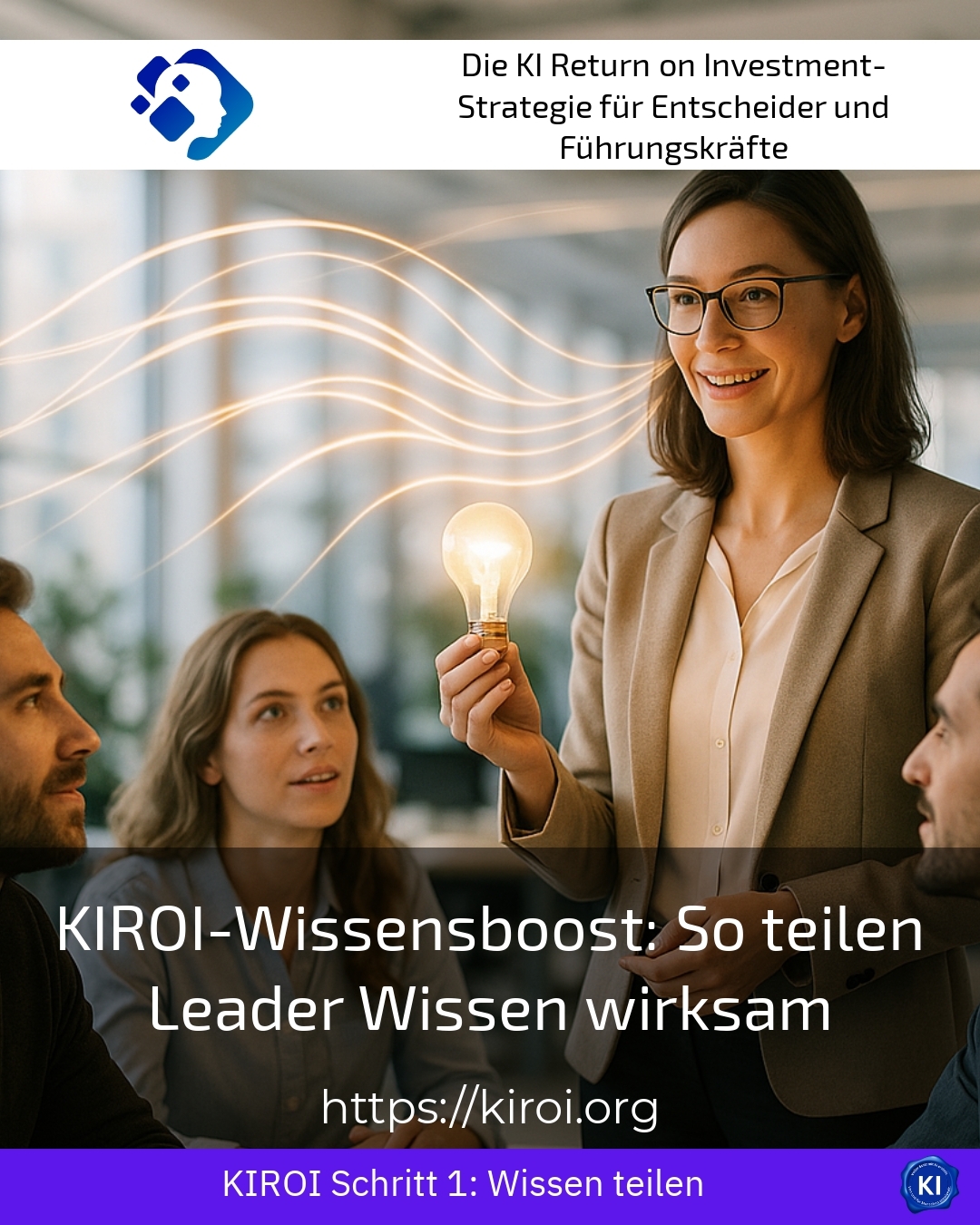
AIROI-Knowledge boost: This is how leaders effectively share knowledge through storytelling
One of the most effective methods of knowledge dissemination is narrative framing. Stories activate other brain regions than mere facts. They generate emotional engagement and remain longer in memory. Leaders who package their insights in stories achieve demonstrably better results. For example, a logistics manager can tell a story about a critical delivery delay. He describes the challenge, the solution, and the outcome. This narrative conveys technical knowledge much more effectively than a checklist. Similarly, this works in customer service. A team leader describes a particularly difficult case. She explains which communication techniques led to success. This story inspires and also continues to develop.
Storytelling can be applied to various formats. Short video messages are excellent for quick insights. Longer podcast episodes provide deeper insights. Written case studies also hold their own. What matters is the personal touch. Leaders should bring their own experiences. They can also talk about mistakes and learning processes. This authenticity creates trust and increases engagement. In finance, controllers are increasingly using this technique. They tell stories about complex budget negotiations. In marketing, campaign managers share their insights from failed and successful projects.
Best practice with a AIROI customer
A medium-sized company in the mechanical engineering sector faced a particular challenge in the area of internal knowledge dissemination. The experienced management team had built up enormous tacit knowledge over decades. At the same time, a generational change was looming, and it seemed that this knowledge was about to be lost. As part of a transruptive coaching process, the company developed a structured mentoring program with narrative elements. The senior leaders were supported in capturing their experiences in the form of short video stories. Each story addressed a specific challenge from the working day. The recordings were deliberately kept authentic, without elaborate production. Within six months, an internal knowledge library with over fifty stories was created. The response exceeded all expectations significantly. New employees reported a faster onboarding process. They felt better prepared for typical situations. Even experienced team members used the library regularly to refresh their knowledge. The project impressively demonstrated how effective knowledge dissemination can be achieved. The key was the combination of personal storytelling and simple technical implementation.
Digital tools as amplifiers for knowledge transfer
Modern technologies offer numerous opportunities to support knowledge dissemination. Collaboration platforms enable the exchange across locations. Learning management systems structure content and track progress. Artificial intelligence can even suggest personalized learning paths. Nevertheless, technology is only a tool. It does not replace the human component. Leaders must continue to provide context. They interpret information and provide guidance. For example, an IT manager can build a technical knowledge wiki. Without regular maintenance and updates, it quickly becomes outdated. A research leader might use digital lab books. The entries become valuable only through explanatory comments.
Choosing the right tools depends on various factors. Company culture plays an important role. The technical affinity of the workforce also influences the decision. Smaller teams often benefit from simple solutions. Large organizations require scalable systems. Retail managers increasingly rely on mobile learning formats. Short microlearning units fit into the hectic workday. In the consulting industry, detailed webinars work better. Employees expect in-depth analyses there. In the trades, video tutorials for practical instructions work well. The visual demonstration effectively bridges explanatory gaps.
Interactive formats for deepening knowledge
Passive consumption rarely leads to sustainable learning. Interactive elements significantly increase the depth of processing. Discussion rounds enable the exchange of different perspectives. Practical exercises solidify theoretical knowledge through application. Quiz formats can also stimulate reflection in a playful way. Management teams should therefore regularly plan interactive formats. A project manager can conduct weekly lessons-learned sessions. The team jointly analyzes completed project phases. A sales manager organizes role-playing sessions for sales negotiations. The simulation prepares for real-life situations. In healthcare, department managers use case discussions for further training. The joint analysis promotes critical thinking.
Formats that appeal to different learning styles are particularly effective. Visual learners benefit from diagrams and infographics. Auditory learners prefer podcasts and lectures. Kinesthetic learners need practical exercises. A mix of different elements appeals to most people. The AIROI Knowledge Boost: How Leaders Share Knowledge Effectively This diversity is systematically taken into account. In the banking sector, executives experiment with gamification elements. Compliance training is boosted by playful competitions. In the pharmaceutical industry, scientists combine presentations with laboratory exercises. This combination of theory and practice significantly enhances the learning effect.
Best practice with a AIROI customer
A service company with several hundred employees was looking for new ways to exchange knowledge internally. The previous training formats did not achieve the desired effect. Many participants found the events to be too theoretical and devoid of practical application. As part of a transruptive coaching process, the management team developed a new concept. At the heart of this were so-called knowledge circles, which took place regularly in small groups. Each knowledge circle focused on a specific topic from the workplace. The moderator was a different management member who brought special expertise in that area. The meetings followed a structured process with an introductory presentation, discussion, and practical exercises. After each knowledge circle, the participants documented their most important insights in a shared digital notebook. This documentation became a valuable resource for later reference. The executives reported on significantly higher participation compared to previous formats. The employees particularly appreciated the direct practical relevance and the opportunity to exchange ideas with colleagues from other departments. The project illustrates how well-thought-out formats can significantly improve knowledge transfer.
The importance of trust and psychological safety
Knowledge transfer is only possible in an environment that fosters openness. Employees must feel safe to ask questions. They must also be able to admit when they do not understand something. This psychological safety is a leadership responsibility. Leaders significantly shape the team culture through their behavior. A department head who openly addresses their own mistakes signals a willingness to learn. A team leader who answers questions with respect encourages curiosity. In contrast, a climate of evaluation stifles any exchange of knowledge. Employees then withhold information out of fear of being ostracized.
Concrete measures can strengthen psychological safety. Regular feedback sessions create trust. Anonymous question-and-answer opportunities reduce the barrier. The physical layout of the workplace also influences the exchange of ideas. Open meeting areas encourage informal conversations. In the technology sector, executives establish so-called Failure Fridays [1]. On these days, failed projects are analyzed without assigning blame. In the creative industry, agencies hold regular retrospectives. The team jointly reflects on processes and results. In the manufacturing sector, shift leaders promote direct exchange at the machine. These spontaneous conversations often convey more than formal training.
Leaders as role models in knowledge transfer
The credibility of knowledge initiatives depends heavily on the behavior of leadership. Leaders must lead by example; what they expect from others. When they themselves continuously learn, it inspires the team. When they generously share knowledge, an open-minded culture is created. A CEO who regularly shares book recommendations stimulates further learning. A department manager who makes her conference notes available demonstrates transparency. The AIROI Knowledge Boost: How Leaders Share Knowledge Effectively This exemplary function is particularly emphasized by this.
There are many practical implementation possibilities. Managers can send weekly newsletters with insights. They can record short video updates on current developments. Personal office hours also provide an opportunity for knowledge exchange. In the education sector, school principals conduct open visits to classrooms with subsequent feedback. In the restaurant industry, chefs conduct regular tastings with explanations. In event management, project managers share their event documentation with the entire team. These continuous small impulses often have a more lasting effect than large one-time measures.
Knowledge transfer across generations
The demographic development presents many organizations with special challenges. Experienced employees are retiring. Their tacit knowledge is in danger of being lost. At the same time, younger generations bring new perspectives and technological knowledge. The combination of these different knowledge bases requires conscious design. Mentoring programs can foster the exchange between generations. Both parties benefit from each other. The experienced mentor shares his practical knowledge. The mentee brings fresh ideas and digital skills.
Different approaches are evident in various industries. In the trades, master craftsmen establish tandem models with apprentices. The practical collaboration enables immediate knowledge transfer. In law firms, partners work closely with entry-level professionals. The joint case handling effectively imparts experience. In healthcare, institutions organize mentorships between established staff and newcomers. This personal support significantly accelerates the onboarding process. In engineering, experienced professionals document their solutions in structured knowledge databases. This documentation secures critical know-how for the future.
Best practice with a AIROI customer
A traditional family business in the food industry was preparing for a comprehensive generational change. Several long-standing executives were approaching retirement, and their wealth of experience needed to be preserved. The company embarked on a systematic knowledge acquisition project with the support of transruptive coaching. In structured interviews, the departing executives shared their critical decisions in their careers. They described both successful and failed initiatives and the lessons learned from them. The interviews were recorded and transcribed, with particular attention paid to preserving context and nuance. Additionally, thematically organized knowledge cards were created that visually represented key insights. The subsequent executives received structured access to this material during the transition phase. They were able to ask questions and have in-depth discussions before their predecessors left the company. This approach significantly minimized the loss of knowledge and at the same time created valuable historical documentation of the company’s history. The new management team still speaks today about the helpful impulses from this project.
My AIROI Analysis
The ability to effectively share knowledge is increasingly becoming a core competency of modern leadership. In a work environment characterized by constant change and increasing complexity, individualists can no longer succeed. Successful organizations are characterized by collective intelligence based on functionally efficient knowledge transfer. AIROI Knowledge Boost: How Leaders Share Knowledge Effectively offers a structured framework for this, which takes into account and integrates various dimensions.
The presented examples from different industries show that more effective knowledge transfer is not a question of resources. Rather, the right attitude and thoughtful formats are crucial. Leaders who generously share knowledge not only strengthen their teams, but also their own position. They are perceived as competent and trustworthy, which increases their effectiveness within the organization. Therefore, the investment in knowledge transfer pays off many times over.
The importance of the human component in all knowledge processes should be emphasized. Technology can support and enhance knowledge processes, but it does not replace personal interaction. The emotional connection between the source of knowledge and the recipient remains central to successful transfer. Leaders who embrace this insight achieve more sustainable results than those that rely solely on digital solutions. The combination of both approaches promises the greatest success.
In conclusion, it can be concluded that knowledge transfer is a continuous task that requires conscious design. It is not enough to build a system once and then hope for automatic effects. Leaders must regularly reflect, adapt, and innovate. This active design distinguishes successful knowledge cultures from stagnating organizations. The impulses presented here can serve as a starting point for their own experiments and developments.
Further links from the text above:
[1] Harvard Business Review: A Good Leader Embraces Failure
For more information and if you have any questions, please contact Contact us or read more blog posts on the topic Artificial intelligence here.








 Deutsch
 English (UK)