
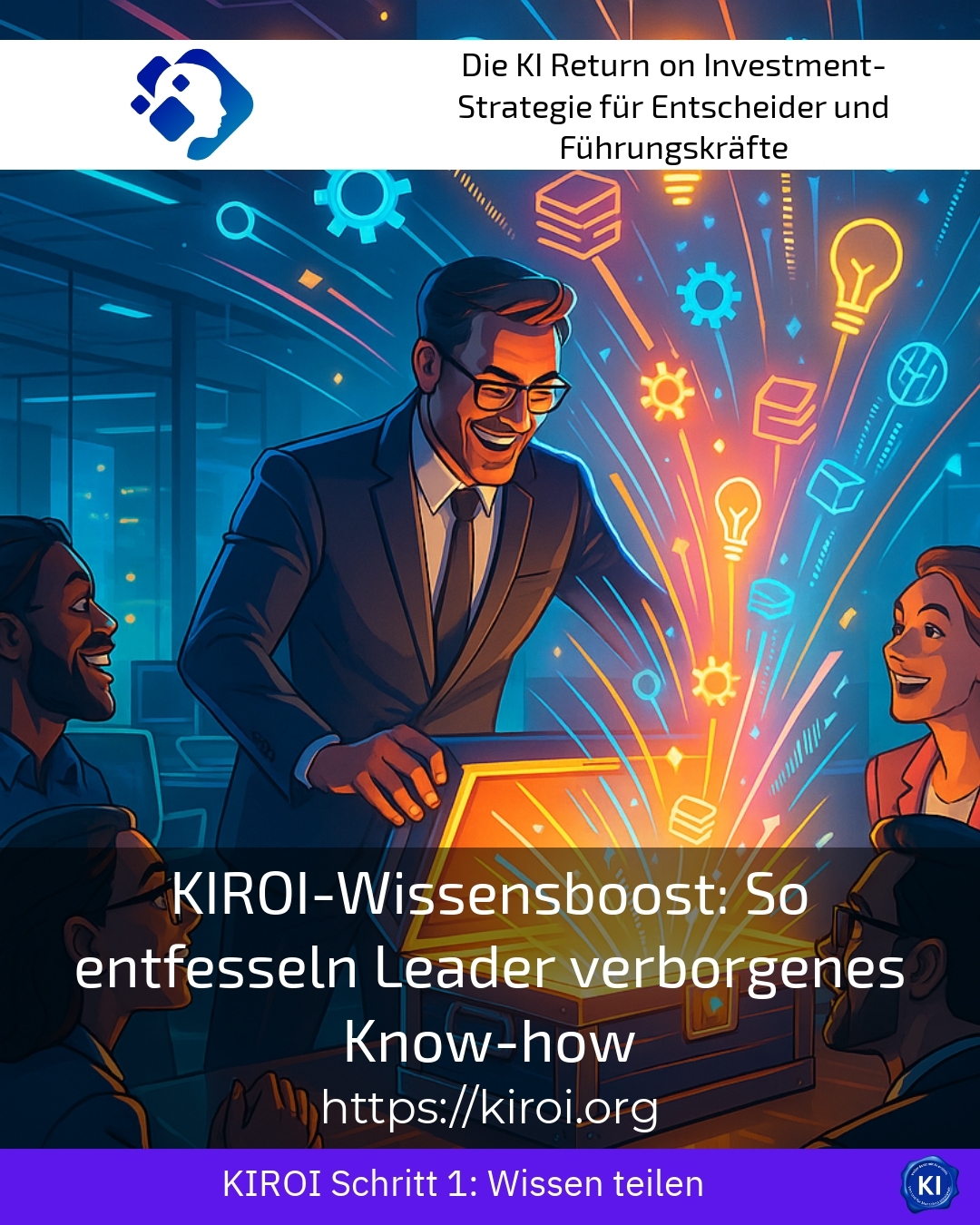
Imagine that within your company there lies a massive treasure that no one has ever lifted simply because no one knew where it was buried. Countless organisations experience this exact situation day in, day out, and it is not a matter of forgotten machinery or unused office space, but rather the most valuable asset of all: the knowledge of your employees. The AIROI Knowledge Boost offers leaders a systematic approach to finally make this hidden know-how visible and deploy it strategically. But how do you get people to actually share their expert knowledge instead of hoarding it? And why do so many well-meaning initiatives fail within the first few weeks? In this article, you will discover which levers really work and how you, as a leader, can establish a culture of open exchange.
Why hidden knowledge slows down businesses
In almost every organisation, knowledge islands exist that operate in isolation from one another. An experienced engineer knows every trick to maintain a complicated machine, but he has never documented this knowledge. A sales representative has maintained excellent customer relationships for years, yet her methods remain invisible to colleagues. An IT specialist has long since developed solutions to problems that other teams are still struggling to find. These knowledge silos do not arise out of ill intent, but rather from a lack of time, missing structures and sometimes even unconscious fear of being replaceable.
The consequences of this fragmentation of knowledge often only become apparent after a delay, but then with full force. When a key person leaves the company, an entire universe of experiential knowledge frequently disappears. New employees have to repeat mistakes that could easily have been avoided. Projects are delayed because no one knows that another department has already overcome similar challenges. For example, a manufacturing company lost valuable production time for months because the specialist knowledge of a retired technician had not been recorded anywhere. A logistics service provider had to hire costly consultants, even though the required know-how was certainly present internally. And a medium-sized mechanical engineering firm completely redeveloped a solution that a colleague in another branch had already perfected years ago.
The AIROI Knowledge Boost: A Compass for Managers
Leaders face the demanding task of building a bridge between individual expertise and collective benefit. The AIROI Knowledge Boost supports them by providing a clear framework for knowledge transfer and development. This approach does not start with technology or processes, but with the people themselves. After all, knowledge cannot simply be skimmed off like cream from milk. It must be shared voluntarily, and for this, employees need trust, time and recognition.
Leaders who successfully shape this change see themselves as enablers rather than controllers. They create spaces for exchange, both physical and digital. They actively ask for experiences and insights instead of merely demanding results. In a chemical company, the production management established regular knowledge circles where shift workers could present their ideas for optimisation. An automotive supplier introduced so-called lessons learned sessions, in which insights were systematically documented after each project. And a pharmaceutical corporation set up internal expert directories so that employees could quickly find the right contact person for specific questions.
Psychological Safety as a Foundation
Without psychological safety, every knowledge initiative remains an empty promise. People only share their knowledge willingly when they do not have to fear negative consequences. They need to be able to trust that mistakes will not be punished and that their contribution is valued. In many organisations, however, a culture of caution prevails, in which employees prefer to remain silent rather than make themselves vulnerable.
Transruptions-Coaching supports leaders in building an atmosphere of trust. Clients frequently report that even small behavioural changes have a major impact. For example, the head of department at an energy utility began talking openly about his own uncertainties in meetings. A plant manager at a steel producer publicly thanked employees who pointed out problems. And a divisional head at a telecommunications company established the rule that in project meetings, the youngest team members should always speak first.
Best practice with a AIROI customer A medium-sized company in the field of industrial automation faced a critical challenge because several experienced technicians were due to retire within a short space of time, and their extensive experiential knowledge had not been documented anywhere. As part of a transruptional coaching project, we developed a mentoring programme together with the management team in which each departing expert worked intensively with a successor over a period of six months. This involved not only technical knowledge, but also relational knowledge regarding customers and suppliers, as well as the unwritten rules of the corporate culture. The managers received impulses on how to support this process in an appreciative manner without the experienced employees feeling exploited. We established joint reflection sessions in which mentors and mentees exchanged their experiences. In addition, the mentees documented their most important insights in an internal wiki that remained accessible for future generations. Following the completion of the project, both the departing experts and their successors reported a significantly higher level of satisfaction. The management team noted that critical processes could be continued seamlessly and that no significant loss of knowledge had occurred.
Practical methods for unleashing knowledge
Knowledge can be captured, shared and developed in a variety of ways. Leaders have the task of selecting the appropriate methods for their specific situation and implementing them consistently. Not every technique is suitable for every team, which is why a willingness to experiment and adapt is required.
A proven method is so-called storytelling sessions, in which employees report on particularly challenging or educational situations [1]. These stories convey not only facts, but also emotions and contextual knowledge. A construction company used such sessions to share experiences from complex major projects within the team. A food manufacturer collected stories about successful process improvements and made them accessible on the intranet. And a textile manufacturer regularly invited experienced production employees to talk about their experiences in troubleshooting.
AIROI Knowledge Boost through structured knowledge maps
Knowledge maps help to make existing expertise within the company visible [2]. These visual representations show at a glance which competencies are available where and where gaps might exist. The AIROI Knowledge Boost use such maps as a basis for targeted development measures.
An electronics manufacturer created a detailed skills matrix for its development department and in doing so discovered unexpected talents. A logistics company mapped the knowledge of its warehouse managers and discovered that certain optimisation techniques were only known at a few locations. And a packaging manufacturer used knowledge maps to identify critical dependencies on individual experts at an early stage and take targeted counter-measures.
Establish Communities of Practice
Communities of Practice are informal networks of people who share a common interest or field of expertise [3]. These communities promote the spontaneous exchange of knowledge across departmental boundaries. Leaders can initiate such communities, but should not regulate them too heavily.
A metal processing company established a community for welding experts who met monthly to exchange experiences. A plastics manufacturer set up a quality circle community in which employees from various plants discussed their improvement ideas. And a plant manufacturer created a digital community for project managers in which they shared best practices and lessons learned.
Best practice with a AIROI customer An internationally active specialty chemicals manufacturer wanted to strengthen the innovative power of its research departments while avoiding duplication of work between different sites. transruptions coaching supported managers in establishing a cross-site Community of Practice for process developers. First, together with the participants, we identified the relevant subject areas and potential attendees. We then developed a format for regular virtual meetings in which one site at a time presented a current project or an interesting finding. The managers learned how to facilitate these meetings without dominating the discussion. They also received impulses on how to create incentives for active participation, for example through recognition in employee appraisals or through small budgets for cross-site projects. After a year, the participants reported numerous concrete improvements that had arisen from the exchange. Several research projects were able to be accelerated because similar challenges had already been solved at other sites. The executive board estimated the saved development costs to be a six-figure sum.
Technology as an enabler, not a solution
Digital tools can significantly facilitate knowledge transfer, but they never replace the human element. Many companies invest in expensive knowledge management systems which then gather dust unused. The reason for this is usually that the cultural and organisational prerequisites have not been created.
A mechanical engineering company introduced a modern wiki system that no one populated because the employees were not given the time to do so. An electronics corporation implemented a sophisticated expert database, but no one maintained it because there was no incentive to do so. And an aerospace supplier purchased an AI-backed knowledge platform, which nevertheless failed due to resistance from the workforce because it was introduced without involving those affected.
Successful digitalisation projects in knowledge management therefore always start with the people and their needs. A tool manufacturer first asked its employees what information they would like and how they would prefer to access it. A paper manufacturer tested various platforms in small pilot groups before making a company-wide decision. And a beverage manufacturer trained its managers intensively in how they could motivate their teams to actively use digital knowledge tools.
The role of the leader as a knowledge multiplier
Through their own behaviour, managers largely shape whether knowledge sharing in their organisation thrives or withers. They are role models, and employees watch closely whether their leaders share knowledge themselves or hoard it. The AIROI Knowledge Boost therefore places a strong emphasis on the personal development of leaders.
Effective knowledge management means first of all communicating transparently oneself and actively passing on one's own insights. A production manager at a furniture manufacturer began sending weekly round robins with his most important learnings. A plant manager at a cosmetics manufacturer set up open office hours where employees at all levels could ask questions. And a divisional head at a semiconductor manufacturer documented his decision-making processes in detail so that successors could understand why certain paths had been taken.
Furthermore, effective knowledge leaders promote networking within their teams and beyond. They bring together people who can learn from one another. They identify hidden experts and give them platforms to make their contribution. They regularly ask what knowledge is missing and where support is needed.
My AIROI Analysis
Following my intensive work on the topic of knowledge transfer in organisations, I am convinced that the decisive success factor lies neither in technology nor in processes, but in the attitude of managers. Knowledge is not a commodity that can simply be moved from A to B. It is a living treasure that can grow when it is shared and that withers when it remains locked away. Leaders who understand this create environments in which people are happy to give their best.
The AIROI Knowledge Boost provides a valuable framework for this transformation, but it won't happen by itself. Companies must be prepared to invest time and resources and to weather setbacks. Not every initiative will bear fruit immediately, and some employees will initially resist the change. This is where the importance of patient and persistent leadership becomes apparent.
Transruption coaching can guide leaders in mastering this demanding journey. Clients frequently report that simply reflecting on their own knowledge patterns provides valuable insights. In my experience, the combination of a structured approach and individual guidance has proven to be particularly effective. Those who have the courage to unleash hidden know-how are rewarded with a vibrant, learning organisation that remains capable of action even in turbulent times.
Further links from the text above:
[1] Harvard Business Review – Knowledge Management
[2] McKinsey – Unlocking the Potential of Knowledge Management
[3] APQC – Knowledge Management Resources
For more information and if you have any questions, please contact Contact us or read more blog posts on the topic Artificial intelligence here.







 Deutsch
 English (UK)