
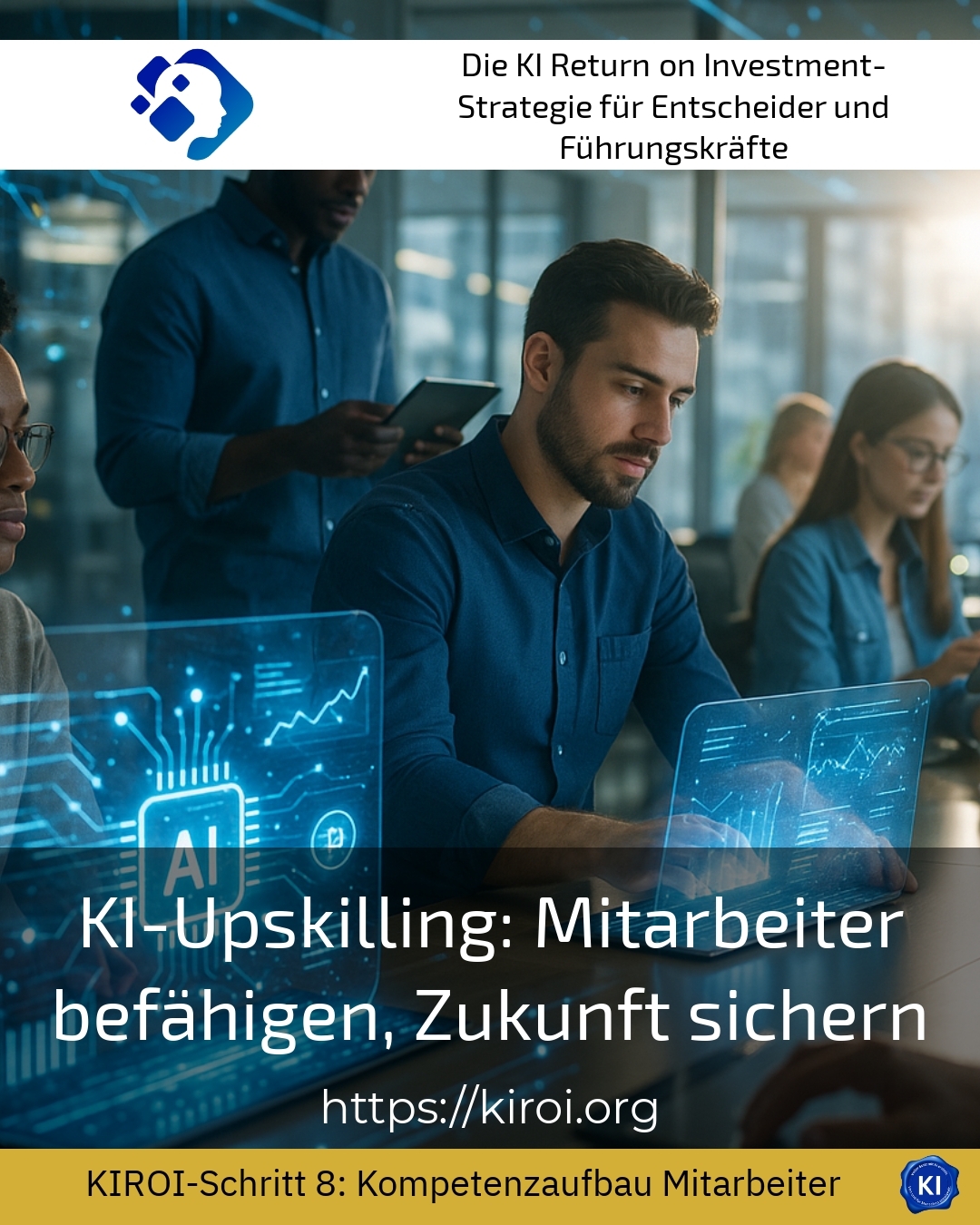
Will your company still be competitive in five years if your workforce is not developing the skills for tomorrow today?
This question is currently occupying leaders and decision-makers in almost all sectors of the economy, because the technological transformation is progressing at a pace that is presenting many organisations with significant challenges. AI Upskilling has become a central concept that encompasses far more than mere training measures or isolated workshops. Rather, it is about a fundamental realignment of skills development that puts people at the centre while simultaneously unlocking the potential of intelligent technologies. Clients often report that they were initially unsure where to even begin. The complexity of the topic can seem overwhelming. This is precisely where professional guidance comes in, providing orientation and creating structures.
Why traditional further education is no longer sufficient
The classical approaches of corporate training are increasingly reaching their limits. While previously one seminar a year was enough to keep employees up to date, today the technological landscape changes fundamentally within a few months. In the financial sector, for example, algorithms now use complex patterns for fraud detection, which places entirely new demands on the analytical skills of employees [1]. Banks and insurance companies face the challenge of qualifying their teams so that they can not only operate these systems, but also critically question them.
A similar dynamic can be seen in healthcare. Radiologists are increasingly working alongside intelligent image recognition systems. This collaboration requires a deep understanding of both the medical and the technological side. Clinics that invested early in relevant training programmes report significantly higher diagnostic accuracy and more satisfied staff. In the logistics sector, too, predictive systems are fundamentally transforming warehousing and route planning. Dispatchers have to learn how to work with recommendation systems and make sense of their suggestions.
Best practice with a AIROI customer
A medium-sized logistics company with around 800 employees faced the challenge of preparing its dispatch department for working with a new intelligent route planning system. The management team had initially planned to conduct merely a technical briefing, but quickly realised that this would not be sufficient. As part of transruption coaching, we jointly developed a multi-stage qualification concept that addressed technical as well as methodological and communicative competencies. The employees not only learned how to operate the system, but also developed an understanding of the underlying logic and limitations of the technology. The support provided to managers, who had to learn how to lead their teams through this transformation, was particularly valuable. After six months, remarkable results were evident: acceptance of the new system stood at over 85 per cent, and route planning efficiency improved by more than 20 per cent. The decisive factor was that employees perceived the system as support rather than a threat, because they understood how it worked and were able to actively help shape it.
AI upskilling as a strategic competitive advantage
Companies that systematically invest in the skills development of their workforce gain a significant competitive advantage. This is not only due to improved productivity, but also to increased innovative capacity and staff retention. In the retail sector, for example, forward-thinking companies use intelligent systems for demand forecasting and personalised customer engagement. Employees who understand how these systems work can make significantly better decisions in their day-to-day business [2].
The manufacturing industry also provides clear examples of the importance of systematic upskilling. Production staff now work with predictive maintenance systems. These systems analyse machine data and detect potential failures before they occur. To be able to use this information effectively, employees need a basic understanding of data analysis and statistical relationships. Mechanical engineering companies that have established corresponding training programmes report significantly reduced downtime and higher plant availability.
The shift is also clearly visible in the management consultancy sector. Consultants are increasingly using intelligent analysis tools to evaluate large volumes of data. The ability to use these tools competently and to critically evaluate their results is becoming the decisive differentiating factor. Consultancy firms are therefore investing heavily in the further qualification of their employees.
Practical approaches to successful AI upskilling
The successful implementation of qualification programmes requires an approach that is both structured and flexible. First of all, it is essential to assess the workforce's current level of competence. Building on this, tailored development paths can be defined. In this regard, combining various learning formats has proven effective. Online courses impart basic theoretical knowledge. Practical workshops enable the learning of specific applications. And coaching sessions accompany individual development.
In the banking sector, for example, the concept of „AI Champions“ has become established. Selected employees receive intensive training and subsequently act as internal multipliers. They support their colleagues in their daily work and ensure continuous knowledge transfer. This approach has proved particularly effective because it integrates qualification into the daily workflow. Insurance companies use similar concepts to prepare their claims handlers for working with automated claims assessment systems. Human resources development in hospitals is increasingly relying on simulation training, where medical staff can practice using diagnostic support systems.
Best practice with a AIROI customer
An insurance group with several thousand office-based employees approached us with the challenge of preparing their workforce for the introduction of an intelligent claims assessment system. Previous experience with technological change had shown that purely technical system training did not lead to sustainable adoption. As part of transruptions coaching, we first developed a differentiated competency model that took various roles and requirement profiles into account. On this basis, target group-specific learning paths were created, which included digital self-learning modules as well as face-to-face workshops and individual coaching. The involvement of managers, who played a crucial role as change agents, was particularly important. They learned to address resistance constructively and to guide their teams through the change process. Another success factor was the establishment of a continuous feedback process, which made it possible to adapt the programme on an ongoing basis to actual needs. The feedback from participants was overwhelmingly positive, and the introduction of the new system ran much more smoothly than in comparable projects in the past.
The human dimension of transformation
Whilst maintaining a strong focus on technological aspects, the human dimension must not be neglected. Many employees view technological transformation with uncertainty or even fear. These concerns must be taken seriously and actively addressed. Clients frequently report that it was precisely the emotional accompaniment of the change process that proved crucial to its success. Here, transruption coaching can provide valuable momentum as professional guidance.
In the media sector, for example, journalists are faced with the question of how to deal with text-generating systems. These tools can support certain tasks, but do not replace journalistic expertise and judgement. Editorial teams that communicate openly about these issues create trust and acceptance [3]. Similar challenges are evident in the legal sector, where intelligent systems are increasingly being used for document analysis and research. Law firms must train their employees so that they experience these tools as an asset to their work.
In human resources, intelligent systems are transforming recruitment and employee development. HR professionals must learn to critically question these systems and recognise potential biases. Responsibility for fair and transparent processes remains with humans. This requires both a technical understanding and the ability to engage in ethical reflection.
Sustainable integration of AI upskilling into corporate culture
One-off qualification measures are not enough to ensure long-term success. Rather, continuous learning must become an integral part of corporate culture. This requires appropriate structures and resources. In the technology sector, many companies have already established internal academies that provide regularly updated learning opportunities. These facilities create spaces for experimentation and the exchange of experiences.
Pharmaceutical companies use similar approaches to prepare their researchers for working with intelligent analysis systems. Drug discovery benefits enormously from systems that can analyse molecular relationships and make predictions. To unlock this potential, scientists need the appropriate competencies. Energy suppliers face the challenge of preparing their employees to work with intelligent grid control systems. The complexity of the energy transition requires new skills in data analysis and systems thinking.
An interesting dynamic can be seen in the education sector itself. Teachers must learn to use intelligent learning support systems effectively while at the same time strengthening pedagogical relationship-building. Schools and universities that create appropriate training programmes are preparing their educators for the education of the future [4].
My AIROI Analysis
The systematic enablement of employees to work with intelligent technologies is no longer an optional extra, but a strategic necessity for any forward-looking business. My experience from numerous accompanying projects shows that success depends decisively on a holistic approach that equally considers technical, methodological and emotional aspects. Organisations that invest early in corresponding programmes secure significant competitive advantages.
I find the involvement of managers, who play a key role as role models and enablers, to be particularly important. Not only must they possess the relevant skills themselves, but they also need to be able to guide their teams through change processes. Ultimately, technological transformation is a human challenge that deserves professional support. transruptions coaching can offer valuable assistance here by structuring and accompanying individual and organisational development processes.
The industry examples make it clear that no economic sector is exempt from this development. Whether financial services, healthcare, manufacturing or media – intelligent systems are fundamentally transforming the world of work everywhere. Companies that qualify their employees for this future are investing in their sustainable competitiveness. The question is no longer whether AI Upskilling is necessary, but how it can best be implemented. Professional guidance helps to set the right priorities and make optimal use of the available resources.
Further links from the text above:
[1] McKinsey – The State of AI
[2] World Economic Forum – Future of Jobs Report
[3] Bitkom – Artificial Intelligence in Companies
[4] OECD – Skills Beyond School
For more information and if you have any questions, please contact Contact us or read more blog posts on the topic Artificial intelligence here.








 Deutsch
  English (UK)