
Will your teams still be competitive in a few years when intelligent systems are already revolutionising entire work processes today?
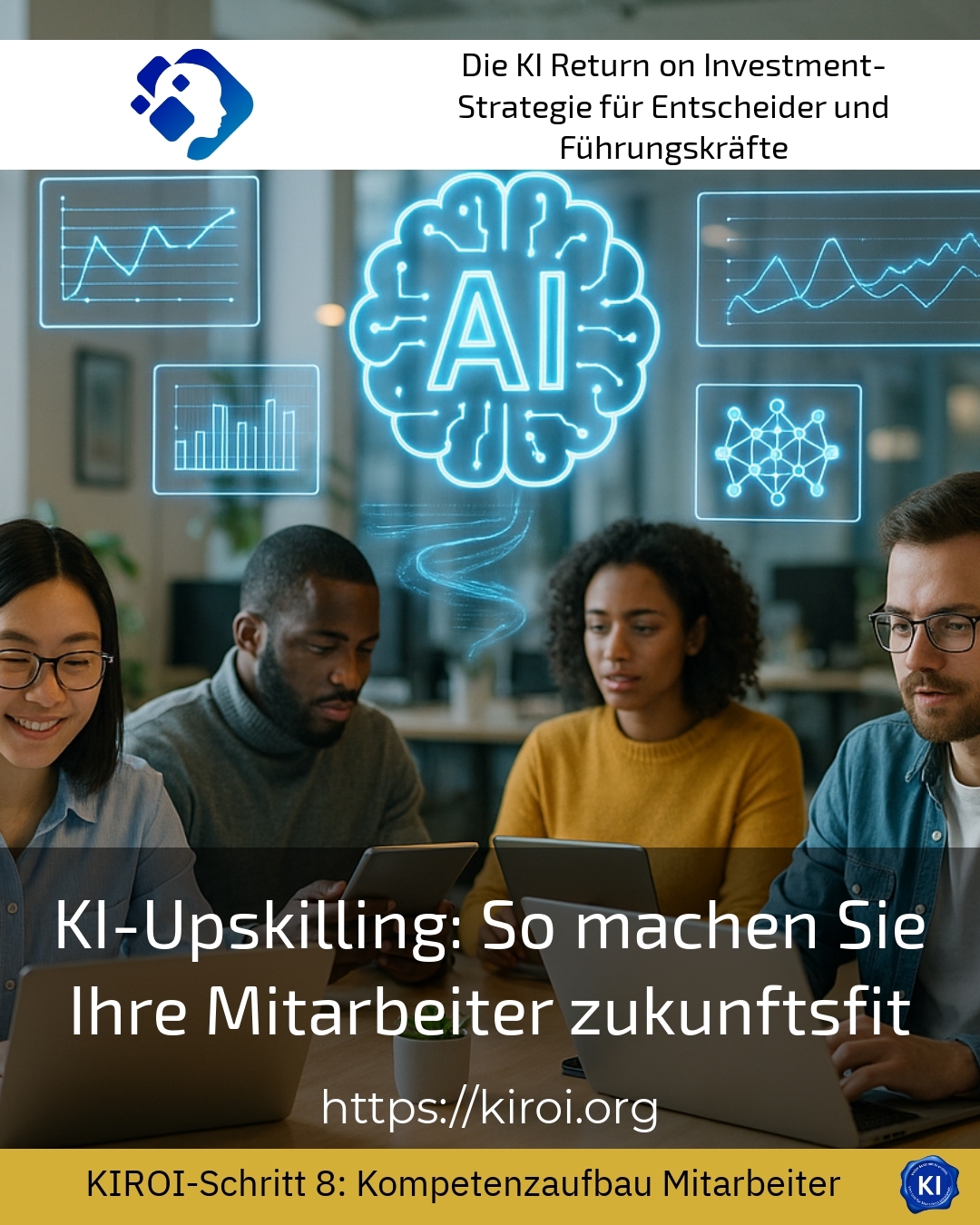
This question is currently occupying leaders in almost all industry sectors. The digital transformation is advancing at an enormous speed. Companies are facing the challenge of preparing their workforce for completely new demands. AI Upskilling has established itself as a crucial success factor in the process. Anyone who wants to make their employees future-proof must act today. The skills gap between what teams can achieve today and what will be demanded tomorrow is widening continuously. At the same time, this development offers enormous opportunities for organisations that proactively invest in the further development of their workforce.
Why traditional further education is no longer enough
Traditional approaches to staff development are reaching their limits. One-off seminars or sporadic training courses are no longer sufficient. The speed of change has reached a level that makes continuous learning essential. Companies frequently report that employees quickly relapse into old patterns after traditional training. This is because isolated learning units rarely bring about lasting behavioural changes.
For example, an engineering company found that after a two-day workshop, production planners showed hardly any change in their way of working. Engineers in the automotive sector experienced something similar when introducing new simulation systems. Specialists in the chemical industry also reported feeling overwhelmed when integrating intelligent analysis tools. These examples clearly show that a fundamentally different approach has become necessary.
Transruptions-Coaching supports companies precisely with these challenges. It is not about providing one-off impulses. Rather, the focus is on the long-term support of transformation projects. Leaders and teams receive continuous assistance with the implementation of new ways of working.
AI upskilling as a strategic competitive advantage
Organisations that systematically invest in the skills development of their workforce gain measurable advantages. They can react more quickly to market changes. Their innovation cycles are noticeably shortened. Employee retention increases because people are given development prospects. At the same time, recruitment costs for external specialists fall.
In the aviation industry, maintenance teams have significantly increased their efficiency through targeted skills development. Logistics companies report optimised route planning following corresponding qualification measures. Energy suppliers utilise their employees' expanded know-how for more precise network analyses. These developments illustrate the enormous potential of structured further training initiatives.
Best practice with a AIROI customer
A medium-sized enterprise in the plant engineering sector approached us with a complex challenge. The executive board had recognised that the technical teams urgently needed new skills. At the same time, there was great uncertainty as to what such a qualification programme should look like. Initially, the employees showed considerable resistance to change. Together, we developed a multi-stage support concept that combined individual learning paths with team workshops. The involvement of managers as active learning facilitators was particularly important. After six months of intensive collaboration, impressive results were achieved. Project lead times fell by almost a quarter. The error rate in technical documentation was significantly reduced. Above all, however, the teams developed a new openness to continuous improvement. The management reported a noticeably altered corporate culture that regards innovation and learning as natural elements of everyday work.
Developing individual learning paths
Every employee brings different prerequisites. Some already have a basic understanding of technology. Others first need an introduction to basic concepts. An effective AI Upskilling- Programme takes these differences into account systematically. It begins with a careful inventory of existing competencies.
Sales representatives in mechanical engineering require different skills to development engineers. Quality managers in the pharmaceutical industry have specific requirements for their competency profile. Project managers in construction, in turn, need to set different priorities. This differentiation is crucial for the success of any training programme.
Transruptions-Coaching supports companies in developing tailored learning architectures. The support encompasses both strategic planning and operational implementation. Leaders receive insights on how they can best develop their teams. This holistic approach differs fundamentally from standardised training offerings.
The role of leaders in the AI upskilling process
Managers and team leaders play a key role in the skills development of their staff. They must lead by example and demonstrate a willingness to learn themselves. At the same time, they create the framework conditions that make sustainable learning possible in the first place. Without active support from management, most qualification initiatives fail.
In the steel industry, production managers have started introducing regular learning circles in their departments. Department heads in insurance companies are experimenting with new formats for knowledge sharing. Managing directors of craft businesses report positive experiences with mentoring programmes. These examples show that managers have a variety of ways to actively shape a learning culture.
Often, leaders come to us with the desire to overcome their own uncertainty when dealing with new technologies. They seek guidance in a time of rapid change. Transruption coaching provides precisely this support, enabling leaders to competently guide their teams through transformation processes.
Learning culture as the foundation for future viability
A genuine learning culture does not arise through top-down orders. It develops organically when certain conditions are created. Psychological safety is among the most important factors. Employees must be allowed to view mistakes as learning opportunities. They need time and space for experiments.
Technology companies have had positive experiences with so-called innovation times. Employees are regularly given the opportunity for self-directed learning. Manufacturing plants are setting up learning workshops where teams can test new methods. Service companies are establishing communities of practice for continuous knowledge exchange. These measures create the foundation for sustainable skills development.
Best practice with a AIROI customer
A family-owned business in the precision manufacturing sector was facing a unique challenge. The workforce was already relatively old on average and sceptical about new technologies. Management feared that important experiential knowledge could be lost if younger, digitally savvy employees were hired. Together, we developed an intergenerational learning concept that involved both sides. The experienced specialists acted as mentors for process knowledge, while younger colleagues imparted digital skills. This mutual cross-pollination led to surprising synergies. The older employees lost their apprehension about using new tools. At the same time, the younger colleagues gained a deep understanding of proven manufacturing methods. As a result, the company was able to increase its innovative capacity without losing valuable experiential knowledge. To this day, management reports a significantly improved collaboration between the generations.
Practical steps for implementation
The implementation of a AI Upskillingprogrammes requires careful planning. First, an inventory of current competencies within the company is recommended. Building on this, qualification needs can be systematically identified. Prioritisation should be aligned with strategic corporate goals.
Logistics companies often start by qualifying their dispatchers for data-driven decision-making processes. Financial service providers focus on automating repetitive analysis processes. Retail companies concentrate on personalised customer interaction. These industry-specific approaches significantly increase employee acceptance.
Guidance by experienced coaches can significantly accelerate the implementation process. External perspectives help to overcome operational blindness. At the same time, companies benefit from tried-and-tested methods and tools. Transruption coaching does not prescribe ready-made solutions. Instead, teams are empowered to independently develop suitable approaches.
Measurability and continuous improvement
The success of training measures should be reviewed regularly. Various key figures and indicators are suitable for this. Productivity metrics can provide information on practical gains in competence. Employee surveys capture subjective learning progress and satisfaction.
Pharmaceutical companies measure the success of their programmes using shortened development cycles. Automotive suppliers monitor defect rates in quality-relevant processes. Energy suppliers analyse efficiency gains in grid optimisations. These concrete metrics enable a fact-based evaluation of investments in competency development [1].
The insights gained are incorporated into the further development of the programmes. This creates a continuous improvement cycle that constantly optimises the qualification measures [2]. This iterative approach meets the demands of a constantly changing working environment.
Overcoming obstacles and using resistance
Change processes regularly encounter resistance. That is normal and should not be interpreted as failure. Resistance often contains valuable information about legitimate concerns. They offer an opportunity to improve and adapt programmes.
Employees in the manufacturing industry frequently express concerns about their jobs. Administrative clerks fear the loss of their expertise. Customer advisors in retail wonder whether personal service is still needed. Taking these fears seriously is one of the most important tasks in change management.
Clients frequently report that open communication about the consequences of change significantly increases acceptance. When people understand how their role will evolve, they are better able to embrace change. Transruption coaching therefore places great emphasis on transparent communication throughout the entire transformation process [3].
My AIROI Analysis
The systematic qualification of employees for working with intelligent systems is one of the most important investments that companies can make today. Technological development does not wait for hesitant decision-makers. Those who fail to develop their workforce today will face significant competitive disadvantages tomorrow. At the same time, AI Upskilling huge opportunities for organisations that act proactively.
From my consultancy practice, I know that successful training programmes share certain characteristics. They are long-term and not designed as one-off measures. They take individual requirements into account and create tailored learning paths. They actively involve managers as learning facilitators. They establish a culture that views mistakes as learning opportunities.
The greatest challenge is often not technical issues. Rather, it is cultural and organisational factors that determine success or failure. People must understand why changes are necessary. They need reassurance that their expertise will still be needed in the future. They need time and space to develop new competencies. All of this requires a rethink at all levels of the organisation.
The companies I’ve had the privilege of supporting have undergone impressive developments. They have not only built new competencies, but have also strengthened their overall capacity for innovation. Investing in people pays off in the long run. And that is precisely the real message: technology alone does not create a sustainable competitive advantage. It is always the people who make the difference.
Further links from the text above:
[1] McKinsey: Successful Transformations Are Built on Learning
[2] World Economic Forum: Future of Jobs and Skills Development
[3] Harvard Business Review: Insights on Change Management
For more information and if you have any questions, please contact Contact us or read more blog posts on the topic Artificial intelligence here.







 Deutsch
 English (UK)