
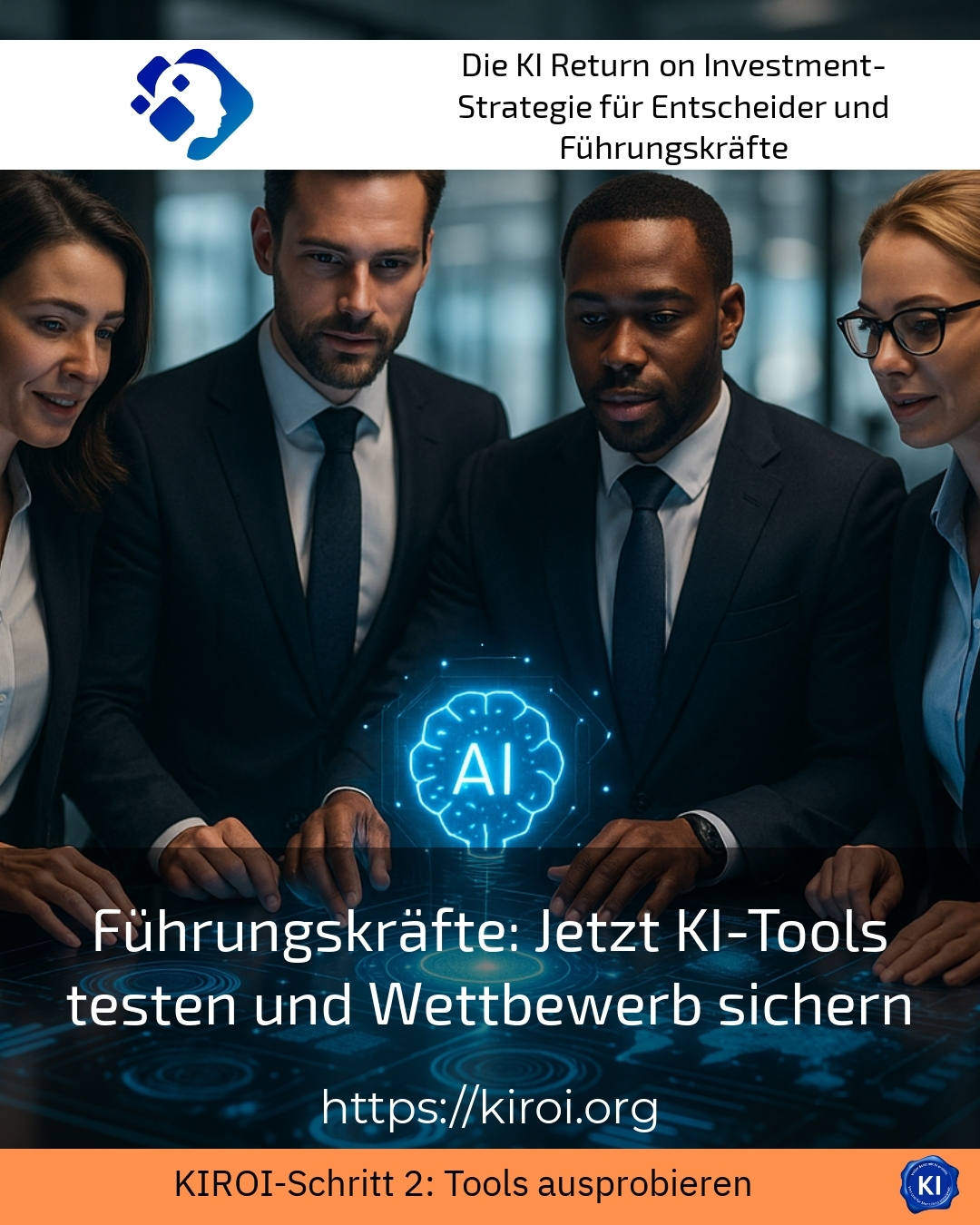
Have you ever wondered why some companies seem to effortlessly reach the top of their industry, while others, despite comparable resources and capabilities, continuously lose ground and wonder what they are actually doing wrong? The answer frequently lies in the willingness of Leaders: Test AI tools now and secure your competitive edge to grasp as a strategic priority and act accordingly. In an economic world transforming at breakneck speed, the ability to adapt digitally determines the success or failure of entire organisations. Those who hesitate today will find tomorrow that their competitors have long since forged ahead and captured market shares that can scarcely be won back.
Why leaders must make testing AI tools and securing a competitive edge their top priority
The current situation in German companies reveals a remarkable paradox that presents many decision-makers with significant challenges. On the one hand, almost all leaders recognise the transformative power of intelligent systems and speak of the need to engage with these technologies. On the other hand, however, an astonishing number of organisations remain stuck in a sort of observation mode from which they find it difficult to break out.
In the manufacturing industry, for example, pioneers are already deploying predictive maintenance systems that can predict machine failures before they occur. A medium-sized mechanical engineering company reduced its unplanned downtime by a remarkable forty percent. The cost savings amounted to several hundred thousand euros annually. At the same time, customer satisfaction improved significantly due to more reliable delivery dates.
In healthcare, intelligent diagnostic systems support doctors in the early detection of diseases. Radiologists frequently report a significant reduction in workload during image analysis. The technology by no means replaces human judgement. Rather, it serves as a valuable second opinion.
Retail companies, in turn, use intelligent systems for personalised customer engagement. Conversion rates increase because offers are better tailored to individual needs. One online retailer recorded a threefold increase in its repeat purchase rate. This demonstrates the enormous potential of data-driven decisions.
Best practice with a AIROI customer
A long-established family business in the manufacturing sector faced the challenge of optimising its production planning. The management had realised that the previous manual planning processes were no longer up to date. As part of the transruptions coaching support, we jointly developed a strategy for the phased implementation of intelligent planning systems. First, we analysed the existing processes and identified the areas that offered the greatest potential for optimisation. We then carried out pilot projects in selected production lines. The employees were involved in the transformation process right from the start. This proved crucial for the acceptance of the new technologies. After six months, the company was able to improve its planning accuracy by more than thirty per cent. Lead times were noticeably reduced. At the same time, employee satisfaction increased because repetitive tasks were reduced and more time remained for value-adding duties. Today, the management reports a fundamentally changed understanding of data-driven decision-making throughout the company.
The strategic dimension of technology adoption
When we talk about the introduction of intelligent systems, it is long no longer just about technical implementations or the acquisition of new software, but rather about a fundamental realignment of the entire corporate culture and the way in which decisions are made. Managers must understand that they themselves act as role models and signal through their own behaviour how seriously the digital transformation is taken.
In the logistics sector, intelligent route planning systems optimise thousands of deliveries every day. One parcel delivery service was able to reduce its fuel consumption by fifteen percent. At the same time, first-attempt delivery rates improved significantly. The drivers benefit from less stress thanks to better planning.
Financial service providers are relying on automated risk analyses when granting credit. Processing times for loan applications are shortening considerably. Customers receive faster responses to their enquiries. At the same time, default rates are falling due to more precise credit assessments.
In the energy supply sector, smart grids enable a more efficient load distribution. Power suppliers can better anticipate and respond to demand peaks. Renewable energy sources can be integrated into the grid more optimally. Security of supply increases whilst resource consumption decreases.
Leaders: Test AI tools now and secure a competitive advantage through cultural change
The cultural aspect of digital transformation is frequently underestimated, even though it is at least as important for long-term success as the technical implementation itself. Employees must understand why changes are necessary and what personal benefits they will gain from them. Without this groundwork of persuasion, even the most sophisticated technical solutions will fail due to a lack of acceptance and commitment from the workforce.
In the insurance industry, intelligent systems significantly assist with claims processing [1]. Handlers can concentrate on complex cases. Standard cases are processed more quickly and consistently. Customers benefit from shorter waiting times for settlement.
Pharmaceutical companies use intelligent analytics for drug development. Clinical trials can be planned and evaluated more efficiently. Potential side effects can be identified earlier. Development times for new active ingredients could potentially be shortened by years.
Telecommunications providers are improving their customer service through intelligent assistance systems. Waiting times in call centres are falling noticeably. Routine enquiries are answered automatically. Service staff can devote themselves to more complex matters.
Best practice with a AIROI customer
A management consultancy firm was looking for ways to streamline its internal processes while simultaneously improving the quality of its analyses. The challenge was that the consultants were spending a great deal of time on data research and preparation instead of focusing on their actual core competence. As part of our transruptions coaching support, we first developed an understanding of the team's specific requirements and workflows. Together, we identified areas where intelligent support systems could offer the greatest added value. We accompanied the introduction of a system for automated data research and preparation. The consultants received training to be able to use the new tools effectively. Following implementation, the employees reported significantly higher job satisfaction. They were able to devote more time to creative and strategic tasks. The quality of client advisory services improved measurably. The company was able to expand its service portfolio and tap into new client segments. The investment paid for itself within a few months.
Practical steps for successful implementation
The question of how Leaders: Test AI tools now and secure your competitive edge cannot be answered with a simple formula, as every company brings its own distinct characteristics, strengths and challenges that must be taken into account. Nevertheless, there are proven approaches that have proved successful in numerous projects and can serve as a guide.
The first step is to carry out an honest stocktake. Where is the company currently positioned? Which processes could benefit from intelligent support? The answers to these questions form the foundation for all further considerations.
In the construction industry, for example, intelligent systems support project planning and monitoring [2]. Clients receive more precise cost estimates. Schedule overruns are identified earlier. Communication between all project participants improves significantly.
In the food industry, intelligent systems are optimising quality control. Defective products are being detected more reliably. The traceability of ingredients is being improved. Consumers benefit from higher safety standards.
Automotive suppliers are relying on intelligent production control. Just-in-time delivery is becoming more precise. Inventory levels can be reduced. Capital tie-up decreases while delivery reliability simultaneously increases.
The importance of pilot projects and a phased approach
Experience suggests it is advisable to begin with manageable pilot projects rather than immediately aiming for a company-wide transformation. This approach makes it possible to gain experience and learn from mistakes. The risk remains controllable. Successes in pilot projects also create the necessary buy-in for larger initiatives.
The media industry is fundamentally transforming through intelligent recommendation systems. Users receive personalised content suggestions. The dwell time on platforms is measurably increasing. Advertisers benefit from more precise targeting.
Real estate companies use intelligent analysis systems for market valuations. Property valuations are becoming more accurate and transparent. Investment decisions are based on more solid data foundations. Risks are easier to assess.
In tourism, smart systems significantly improve the customer experience. Travellers receive tailored recommendations. Hotels can optimise their occupancy rates. The entire industry is becoming more efficient and customer-oriented.
Best practice with a AIROI customer
A medium-sized trading company was faced with the challenge of optimising its warehousing while simultaneously increasing customer satisfaction. The previous forecasting models for inventory proved to be increasingly unreliable, leading to overstocks of some items and bottlenecks with others. As part of the transruptions coaching support, we initially worked on developing a shared understanding of the underlying challenges. We analysed the existing data sources and identified potential for improvement in data quality. Subsequently, we accompanied the introduction of an intelligent inventory management system. The system now takes seasonal fluctuations, weather influences and market trends into account in its forecasts. Employees were intensively trained and involved in the implementation process. Following the introduction, the company reduced its inventory levels by twenty percent. At the same time, the number of delivery bottlenecks dropped drastically. Customer satisfaction rose measurably. The capital freed up could be invested in other growth areas. Today, the management regards the project as a milestone in the company's development.
My AIROI Analysis
In my estimation, we are in a phase where the course is being set for the coming years and in which those companies that act decisively now can build an advantage that will be difficult for laggards to catch up with. The technology is by now mature enough to offer genuine added value. At the same time, it is not yet so widespread that it no longer represents a differentiating advantage.
Frequently, clients report initial concerns that proved to be unfounded over the course of the collaboration. The worry that intelligent systems could destroy jobs often gives way to the realization that they can actually enhance and enrich work. Employees who were initially sceptical become enthusiastic ambassadors for the new technologies.
Transruption coaching guides companies in shaping their own transformation journey. It is not about selling off-the-shelf solutions. Rather, we support them in asking the right questions and finding suitable answers. Every company must walk its own path. We provide impetus and accompany the implementation [3].
The key takeaway from numerous projects is this: the right time to act is now. Waiting may seem more convenient in the short term. In the long term, however, it leads to missed opportunities and competitors pulling ahead. Leaders bear the responsibility of making their organisations fit for the future. This responsibility requires courage and determination.
Further links from the text above:
[1] Bitkom: Artificial Intelligence in the Economy
[2] Plattform Lernende Systeme: Application examples
[3] AIROI-Blog: Strategies for digital transformation
For more information and if you have any questions, please contact Contact us or read more blog posts on the topic Artificial intelligence here.









 Deutsch
 English (UK)