
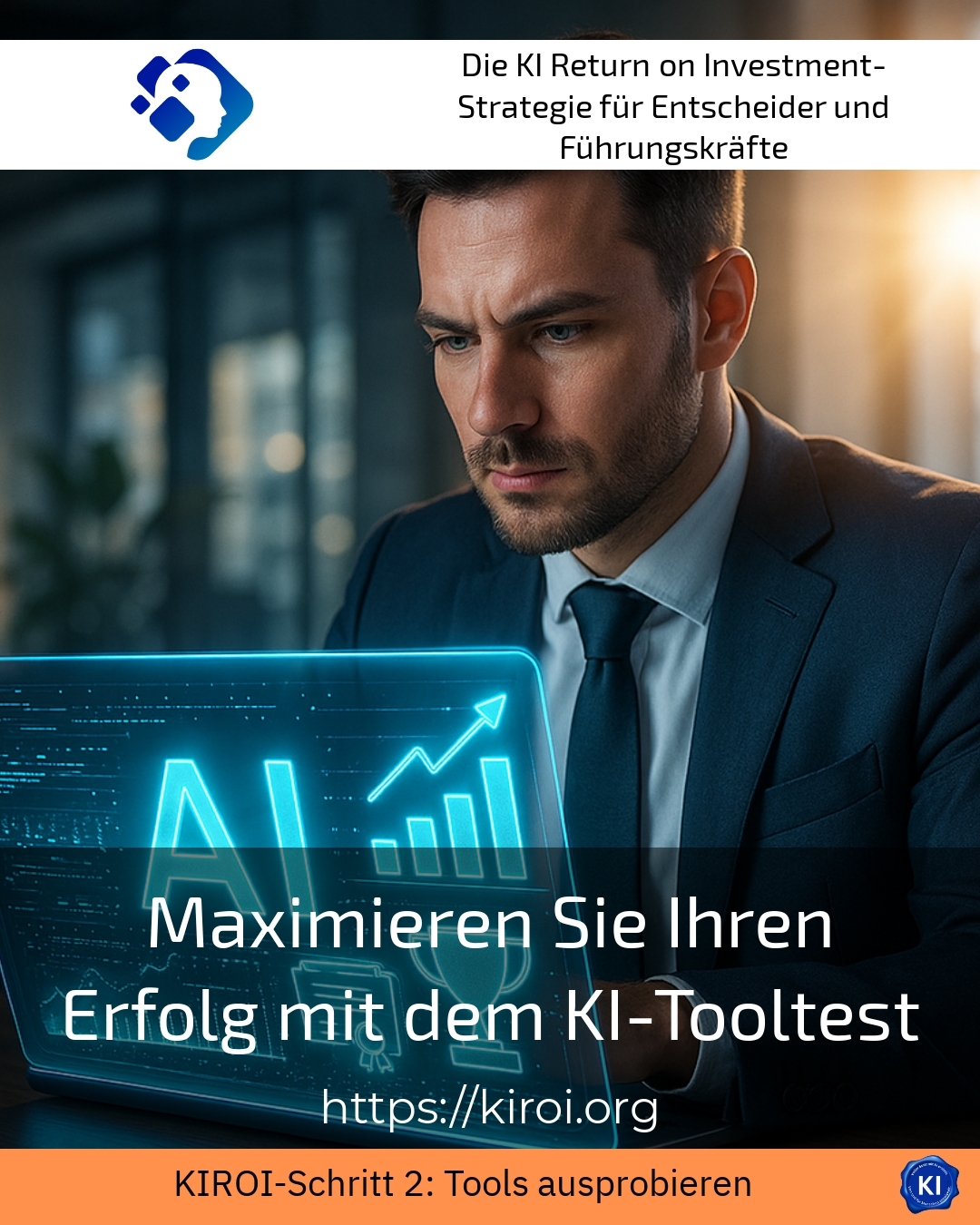
Imagine being able to review every single process in your company for future-proofing. That is precisely what a systematic approach enables you to do, which we call AI Tool Test describe. Digital transformation is fundamentally and sustainably changing industries. Companies that fail to act today will lose their market position tomorrow. This is not about the blind implementation of new technologies. Rather, a well-thought-out analysis is at the heart of it. This analysis shows you which tools actually suit your business model. Clients frequently report being overwhelmed by the options available on the market. The AI tool test provides valuable orientation and structure here.
The strategic importance of systematic technology assessment
Businesses today face an unprecedented challenge. The number of available digital tools is growing exponentially. At the same time, the pressure to make fast and well-founded decisions is increasing. A structured evaluation methodology helps you to keep track. It also helps you to avoid making bad decisions, which often prove costly. In the manufacturing industry, for example, many operations rely on predictive maintenance systems. These systems analyse machine data in real time and forecast potential breakdowns. A medium-sized automotive supplier was thus able to reduce its unscheduled downtimes by remarkable percentages [1]. In retail, on the other hand, intelligent inventory management systems are revolutionising warehousing. Large retail chains are already using this technology successfully to optimise their logistics. Furthermore, financial service providers rely on automated risk assessments for credit decisions.
However, choosing the right tool requires more than superficial research. It demands an in-depth analysis of your specific corporate requirements. Factors such as integratability, scalability and user-friendliness play a central role here. Furthermore, many companies underestimate the necessary change-management effort. Employees must understand and accept new systems before they can generate added value. transruptions coaching supports you comprehensively and sustainably with precisely such projects. It provides impetus for staff development and supports cultural change within the company.
Best practice with a AIROI customer
A traditional mechanical engineering company from Southern Germany was faced with a milestone decision. The management team wanted to automate and modernise quality control. Initially, the company tested three different image recognition systems in parallel during a pilot phase. This structured approach enabled a direct comparison under real production conditions. The results sustainably surprised the entire project team. The supposedly cheapest system proved to be unreliable under changing lighting conditions. The most expensive system, on the other hand, delivered excellent results, but significantly exceeded the available budget. Ultimately, the mid-range solution offered the optimal balance of precision, costs and implementation effort. Through the systematic evaluation, the company saved considerable resources. Furthermore, it avoided a misdirected investment that could have jeopardised the entire digitalisation process. Transruptions coaching accompanied this process from the initial requirements analysis to the final implementation. The employees in quality assurance received intensive training and quickly understood the added value of the new system. Today, the automated quality control runs stably and reliably in three-shift operation.
The AI tool test as a basis for sustainable decisions
A sound technology assessment follows clear methodological principles. First, you precisely define your concrete requirements and expectations. Subsequently, you systematically research available solutions on the market. This is followed by practical testing in a controlled test environment. Finally, you evaluate the results against objective criteria and make your decision. This process may seem time-consuming, but it pays off in the long run. In the healthcare sector, hospitals use this methodology when selecting diagnostic support systems [2]. These systems analyse medical imaging and assist doctors with diagnosis. A major university hospital conducted a six-month comparative test of various providers. The results showed clear differences in recognition accuracy and user-friendliness. In the insurance industry, on the other hand, intelligent systems automate claims processing. Claims handlers can thus focus on complex cases and provide better customer service. Logistics companies use similar approaches to optimise their route planning and reduce fuel costs.
Practical application areas and industry-specific examples
The potential applications of intelligent systems extend across almost all economic sectors. In customer service, chatbots and virtual assistants are revolutionising communication. Telecommunications providers report significantly reduced waiting times for customer enquiries. At the same time, customer satisfaction is increasing due to faster and more precise responses. In marketing, personalised recommendation systems enable highly targeted customer approaches. Streaming services as well as e-commerce platforms successfully utilise this technology [3]. Personalisation demonstrably leads to higher conversion rates and customer loyalty. Intelligent systems are also finding increasing application in human resources. Applicant tracking systems support recruiters in the pre-selection of suitable candidates. They analyse CVs and match qualifications with job profiles. It is important to emphasise that these systems merely support human decision-making. The final hiring decision continues to be made by the responsible HR manager.
Agricultural businesses use intelligent systems for precision farming. Drones analyse fields and identify areas with nutrient deficiencies or pest infestations. Irrigation systems respond automatically to soil moisture and weather data. Winegrowers use similar technologies to optimise their harvest times. In the energy sector, smart grids control the distribution of renewable energy [4]. They balance fluctuations in wind and solar energy and stabilise the power supply. These examples impressively illustrate the breadth of possible applications.
Best practice with a AIROI customer
A medium-sized advertising agency wanted to make its content creation more efficient and accelerate it. The creative team felt overwhelmed by administrative tasks and uninspired. Management decided to carry out a structured AI tool test of various text generation systems. Over a period of three months, employees intensively tested five different providers. They carefully evaluated text quality, adaptability to the brand style and integration options. The results were insightful and partly surprising for the entire team. While some systems delivered quick results, the style seemed impersonal and interchangeable. Other systems required intensive familiarisation, but then delivered high-quality drafts as a basis for their work. The agency ultimately chose a solution that fitted well into their workflow. Today, the copywriters are very happy to use the system for initial drafts and ideation. Creative work remains entirely in human hands and is even enriched. The transruptions coaching supported the rollout and helped to overcome initial resistance within the team. The employees understood that the system complements their work rather than replacing it.
Challenges and success factors when testing AI tools
The implementation of new technologies brings typical challenges with it. Data protection and data security are at the very top of the list. Companies must ensure that sensitive information remains protected. The General Data Protection Regulation sets out clear requirements here for all parties involved. Another critical factor is data quality in existing systems. Intelligent systems can only work as well as the data they receive. Many companies significantly underestimate the effort required for data cleansing and structuring. In the banking sector, for example, institutions invest considerable resources in data quality projects [5]. Only after successful data cleansing do analytical systems deliver reliable results. Pharmaceutical companies are also familiar with this challenge when evaluating clinical trials. The integration of new systems into existing IT landscapes likewise requires careful planning. Interfaces must be defined, tested and documented.
Human factors and change management
Technology alone does not guarantee success in digitalisation projects. The human factor often determines success or failure. Employees must understand and accept the purpose of the change. They need sufficient time and support for familiarisation. Managers play a central role as role models and communicators. They must take fears seriously and communicate transparently about changes. In retail, this becomes clearly evident when introducing intelligent checkout systems. Checkout staff need training and support during the transition phase. The same applies to clerical workers in insurance companies when automated processes are introduced. Transruption coaching provides valuable impulses here and accompanies the change process. It supports managers in guiding their teams through the change. In manufacturing companies, factory workers initially view cooperation with collaborative robots with scepticism. However, after proper introduction and training, many report a relieving effect.
Company culture plays a crucial role in success. Organisations with an open culture regarding mistakes experiment more boldly and learn faster. Hierarchical structures, on the other hand, can slow down innovation processes. Agile working methods promote the acceptance of new technologies and accelerate adaptation. This is particularly evident in the start-up environment and is worthy of emulation. Established companies can learn from this willingness to experiment and benefit from it.
Future prospects and strategic direction
Technological development is advancing unstoppably. What seems innovative today is already standard tomorrow. Companies must therefore continuously evaluate and adapt their technology landscape. Regular AI tool testing is becoming an integral part of strategic planning. It enables the early identification of new opportunities and risks in the market. In the automotive sector, manufacturers are preparing for autonomous driving. They are testing various sensor systems, algorithms and safety concepts in parallel [6]. The aerospace industry uses simulations for aircraft development and training. Architects visualise buildings in virtual reality long before the first spade goes in the ground. These industries show how strategic technology assessment creates and secures competitive advantages.
Sustainability is increasingly gaining importance as an evaluation criterion. Companies examine the energy consumption and environmental impact of technological solutions. Data centres for data-intensive applications consume significant resources and need to be optimised. Efficient algorithms can significantly reduce energy demand and contribute to the carbon footprint. In transport, intelligent systems optimise routes and measurably reduce emissions. Building technology uses sensors and controls for energy-efficient heating and cooling. These aspects are increasingly being incorporated into the evaluation criteria of modern companies.
My AIROI Analysis
Following intensive engagement with the topic of systematic technology assessment, I draw the following conclusions. The structured approach to technological decisions is not a luxury, but a necessity. Companies that implement new tools haphazardly waste resources and demotivate employees. The AI tool test provides a methodological framework for well-founded decisions. It balances technical, economic and human factors equally. I was particularly impressed by the range of application fields across various industries. From agriculture to the financial sector, businesses benefit from systematic evaluation. The success stories demonstrate that careful preparation prevents misdirected investment and promotes acceptance. At the same time, it becomes clear that technology alone does not solve problems. The human factor remains central to any transformation process and must not be neglected. transruptions coaching offers valuable guidance here for projects surrounding digital transformation. It supports companies in deploying technology meaningfully and bringing employees along. My recommendation is therefore: invest time in systematic assessment before you invest. Professionally accompany your teams through change processes and build trust. Utilise the expertise of experienced partners and benefit from their industry knowledge. In this way, you maximise your chances of success and actively shape the digital future.
Further links from the text above:
[1] McKinsey – Predictive Maintenance Insights
[2] Healthcare IT News – AI in Healthcare
[3] Harvard Business Review – Artificial Intelligence
[4] IEA – Digitalisation in Energy
[5] Bank for International Settlements – Fintech
[6] SAE International – Automated Driving Standards
For more information and if you have any questions, please contact Contact us or read more blog posts on the topic Artificial intelligence here.






 Deutsch
  English (UK)