
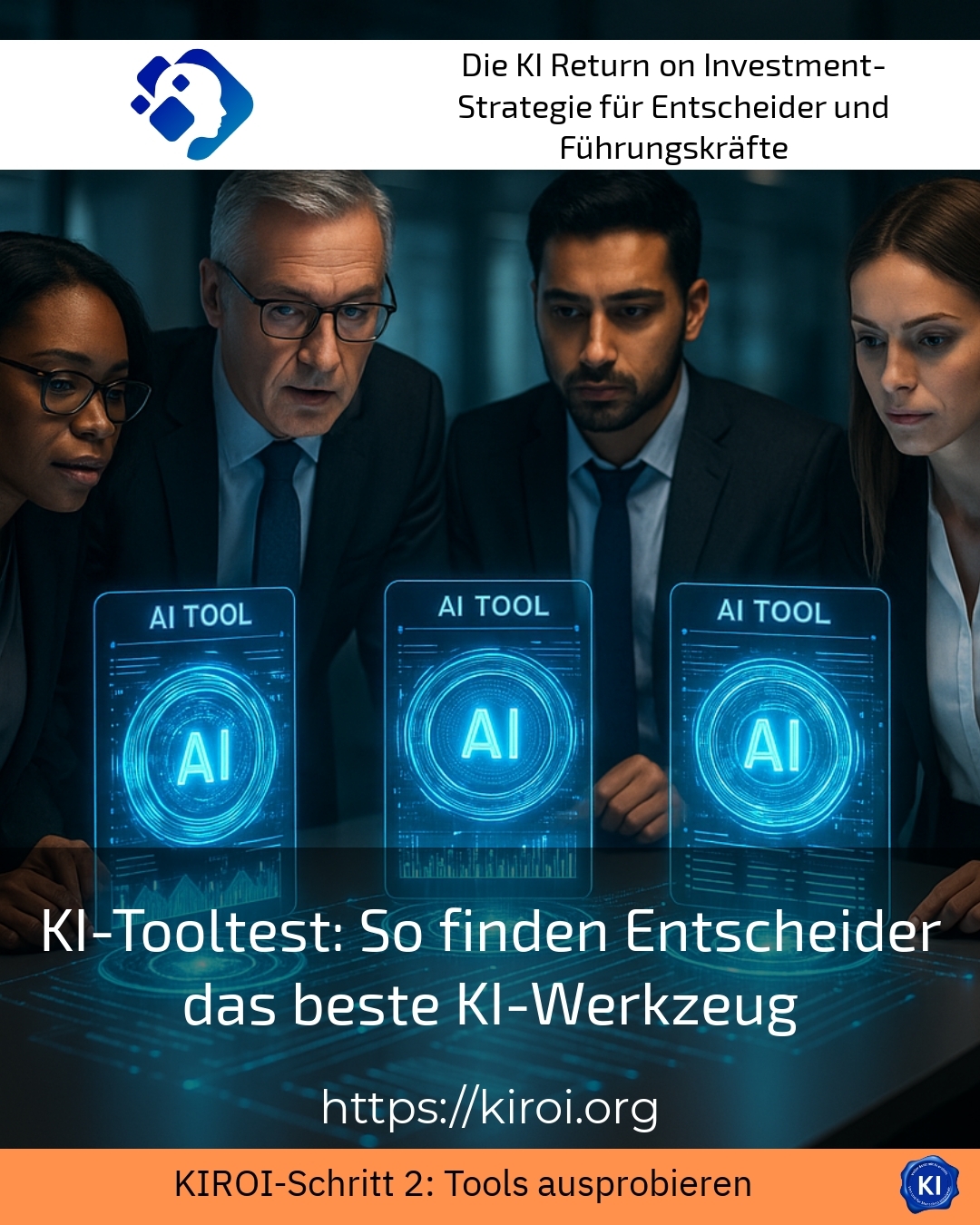
In a world permeated by algorithmic systems, leaders face a crucial challenge. They must select the right solution from an almost overwhelming array of digital tools. The AI Tool Test develops into an indispensable compass. It helps decision-makers make informed judgments. This is no longer just about technical specifications. Instead, strategic fit, ethical aspects and long-term scalability count. Those who implement the wrong systems today will lose touch with dynamic markets tomorrow.
Warum ein strukturierter KI-Tooltest unverzichtbar geworden ist
Choosing algorithmic solutions today requires more than superficial research. Decision-makers need systematic evaluation methods. They must be able to assess various dimensions simultaneously. These include scope of functionality, integration capability, and data protection compliance [1]. Executives often report feeling overwhelmed by the diversity of offerings. A structured approach provides clarity and guidance here.
The complexity of modern systems makes thorough testing essential. Superficial comparisons often lead to costly wrong decisions. Therefore, a multi-stage approach is recommended. First, teams precisely define their specific requirements. Next, they create evaluation matrices with weighted criteria. This methodology sustainably supports objective decision-making.
The added value of structured evaluation is particularly evident in the field of management consulting. Consultants use automated analysis tools for market research and competitive analyses. Others rely on systems for process optimisation at client sites. Still others focus on predictive models for strategic planning. Each use case requires specific functionalities and interfaces.
The most important criteria when testing AI tools for consulting firms
Consulting firms have specific requirements for digital tools. Confidentiality is of paramount importance when working with client data. At the same time, systems must be flexibly adaptable to different industries. Scalability also plays a central role. Projects vary greatly in scope and complexity.
Another critical criterion concerns the traceability of results. Consultants must be able to transparently justify recommendations to their clients. Black-box systems are therefore only suitable to a limited extent for sensitive analyses. Explainable AI approaches are therefore gaining increasing importance [2]. They make it possible to present decision pathways in an understandable way.
Integration into existing workflows also deserves special attention. Consultants often work with various document formats and data sources. An ideal tool connects seamlessly with common platforms. It supports collaborative work in distributed teams. Furthermore, it should offer intuitive user interfaces for different skill levels.
Best practice with a KIROI customer
A medium-sized strategy consultancy faced the challenge of accelerating its market analysis processes. Over a three-month period, the team systematically evaluated a total of seven different analysis platforms. To do this, the individuals responsible first developed a comprehensive catalogue of criteria with fifteen weighted evaluation dimensions. The consultants tested each system under controlled conditions using real project scenarios. The ability to process unstructured data from various sources was particularly important. One system impressed with its excellent text analysis capabilities, but showed weaknesses in numerical evaluations. Another offered extensive visualisation functions but left questions regarding data security unanswered. Through this structured approach, the team ultimately identified a solution that optimally met eighty percent of the requirements. KIROI's transruption support provided methodological impetus throughout the entire evaluation process. Following implementation, analysis times were reduced by an average of forty percent. At the same time, the quality of actionable recommendations increased measurably. Client satisfaction improved significantly in subsequent surveys.
Practical steps for conducting a meaningful AI tool test
The evaluation process ideally begins with a thorough needs analysis. Teams should document and prioritise specific use cases. What tasks are to be automated or supported? What quality standards must the results meet? These questions form the foundation for all subsequent steps.
The next step would be to create a longlist of potential solutions. Industry reports and specialist publications provide valuable guidance [3]. Exchanging ideas with other consulting firms can also offer helpful insights. It's important not to rule out any options too quickly. Sometimes seemingly outsider options surprise with innovative approaches.
Shortlisting is based on defined exclusion criteria. For example, a lack of compliance certifications can lead to immediate exclusion. The same applies to insufficient data protection measures. Cost factors also play a role in the pre-selection. Three to five candidates are suitable for intensive practical tests.
Typical application scenarios in the consulting industry
Strategy consultants often use intelligent systems for extensive market analyses. They automatically scan thousands of documents for relevant trends. This saves considerable time compared to manual research. At the same time, the risk of overlooking important information is reduced.
In the field of organisational development, tools support process analysis. They automatically identify inefficiencies in complex workflows. This allows consultants to gain an overview of optimisation potential more quickly. Visualising process landscapes becomes much clearer with the right tools.
Financial advisors rely on predictive models for risk assessments. These systems analyse historical data and recognise patterns. They can signal potential risks early on. However, they never replace the expert judgement of experienced professionals. They serve as support, not a substitute for human expertise.
Best practice with a KIROI customer
A consultancy firm specialising in restructuring was looking for a system for automated document analysis. The consultants regularly had to work through extensive contract documents and financial reports. The manual effort amounted to an average of twenty hours per project. As part of a structured evaluation process, the team tested four different solutions. Each system was given identical test documents for processing. The results were assessed based on accuracy, completeness, and processing time. One system reliably recognised key clauses but had difficulties with handwritten notes. Another processed all document types but occasionally delivered imprecise summaries. The transruption support helped the team find the right balance between functionality and reliability. The chosen solution reduced the analysis effort to an average of six hours per project. The consultants invested the time saved in higher-quality client discussions. The return on investment fully amortised the acquisition costs within eight months.
Avoiding pitfalls in AI tool testing
Many decision-makers underestimate the time required for thorough evaluations. Superficial tests often lead to later disappointments. Therefore, teams should allocate sufficient resources for the process. Two to three months seem appropriate for comprehensive assessments.
Another common mistake is to focus on current features. However, markets and requirements are constantly evolving. Decision-makers should therefore also consider the vendors' development roadmaps. Regular updates and active further development signal future viability.
The inclusion of all relevant stakeholders deserves special attention. IT departments have different priorities than business units. Compliance officers focus on regulatory aspects. Only when all perspectives are incorporated can viable decisions be made. Workshops with mixed teams promote this holistic view.
The neglect of training needs represents another typical pitfall. Even the best tool only proves effective if employees can use it competently. Training concepts should therefore already be considered during the selection process. Providers with comprehensive training offers deserve appropriate bonus points.
The role of pilot projects in the evaluation process
Pilot projects enable testing under realistic conditions. They reveal strengths and weaknesses that remain hidden in demos. Ideally, teams select a representative project with manageable risk. The results provide valuable insights for the final decision.
During the pilot phase, teams should systematically document feedback. Which functions prove particularly useful in everyday practice? Where do unexpected obstacles arise? These findings will be incorporated into the final evaluation. They form an objective basis for the purchasing decision.
Measuring concrete key figures enhances the significance of pilot projects. Time savings, error rates, and user satisfaction are suitable indicators. Before-and-after comparisons make the added value tangible. They also facilitate internal communication with management and shareholders.
Best practice with a KIROI customer
An internationally active management consultancy evaluated systems for automated presentation creation. The consultants spent considerable time preparing analysis results in slide form. Management hoped for a significant increase in efficiency through intelligent tools. The project team first precisely defined typical presentation formats and quality standards. Subsequently, six experienced consultants tested three different solutions in parallel. Each consultant created identical presentations both manually and with tool support. The results were assessed blindly by partners, without knowledge of the creation method. Surprisingly, one of the cheaper systems achieved the highest quality ratings. The transruption support provided by KIROI helped interpret the partly contradictory results. After implementation, the average time required for standard presentations decreased by fifty-five percent. The saved time is now used by consultants for more creative and strategic tasks. Clients benefit from faster project outcomes without any loss of quality.
My KIROI Analysis
The systematic evaluation of algorithmic tools is developing into a crucial competitive factor. Consultancy firms that professionally manage this process gain sustainable advantages. They make informed decisions and avoid costly failures. The time invested pays off manifold.
My analysis shows that successful evaluations combine several elements. Structured methodology forms the indispensable foundation. Practical pilot projects provide realistic insights. The involvement of all stakeholders ensures acceptance and the feasibility of the decision.
The AI Tool Test requires time, resources, and expertise. Many companies initially underestimate this effort. However, the examples show that careful evaluation is worthwhile. Poor decisions often incur significantly higher costs than thorough preparation.
The transruption support assists decision-makers in this complex process. It provides methodological impulses and helps interpret results. Clients often report valuable changes in perspective through external support. The objective outside view optimally complements internal expertise.
Finally, I would like to emphasise that no tool solves all challenges. Intelligent systems support human expertise but do not replace it. The best technology only has an impact when people use it competently. This balance between automation and expertise remains crucial.
Further links from the text above:
[1] Gartner: AI Tools Glossary and Evaluation Framework
[2] IBM: Explainable AI – Fundamentals and Applications
[3] McKinsey: QuantumBlack AI Insights and Industry Analysis
For more information and if you have any questions, please contact Contact us or read more blog posts on the topic Artificial intelligence here.











 Deutsch
  English (UK)