
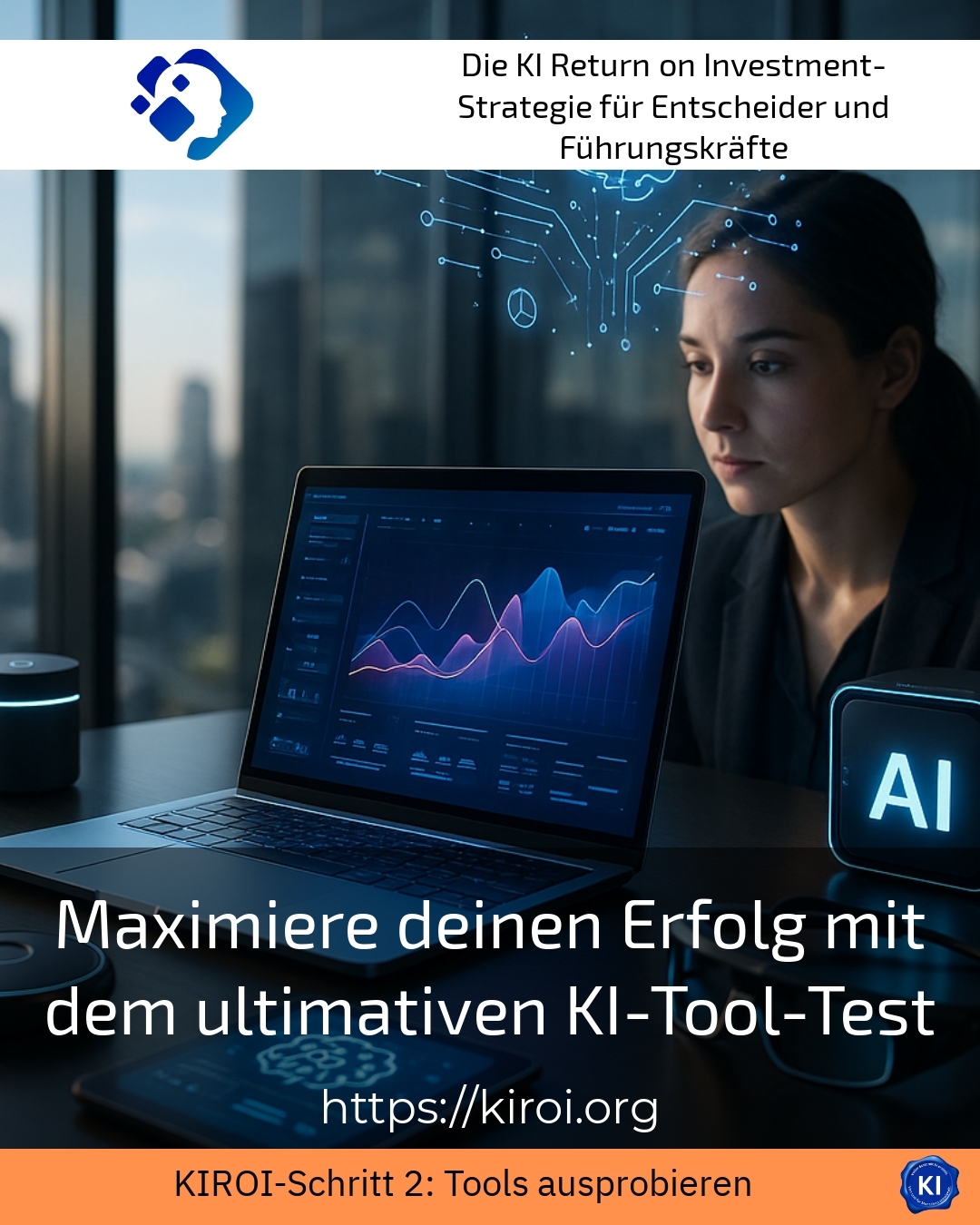
Have you ever wondered why some companies seem to master digital transformation effortlessly, while others mark time despite enormous investments and increasingly lose their competitiveness? The answer often lies in the systematic approach with which organisations select and implement their digital tools, because the ultimate AI tool test is a major factor in determining whether technological investments actually bear fruit or merely remain costly experiments. At a time when artificial intelligence is permeating almost every business sector, the ability to soundly evaluate and strategically integrate these technologies is becoming the decisive differentiator between flourishing and stagnating companies.
The fundamental importance of structured evaluation processes
The landscape of intelligent applications is growing exponentially. New solutions for a wide range of business areas are emerging daily. Companies face the challenge of selecting the right tools from this abundance. In doing so, clients frequently report feeling overwhelmed and disoriented. A structured approach helps to gain clarity and make informed decisions.
In the financial services sector, for example, institutions are increasingly relying on automated credit assessment systems that analyse application data in a matter of seconds and provide risk assessments, whereby the integration of such systems requires a thorough preliminary review in order to meet regulatory requirements and ethical standards alike. Insurance companies, in turn, are implementing claims assessment algorithms that evaluate photographs of accident damage and generate cost estimates, which drastically reduces processing times while simultaneously increasing customer satisfaction. In the field of wealth management, too, robo-advisors are gaining in importance, generating personalised investment recommendations on the basis of individual risk profiles and market analyses.
Best practice with a AIROI customer
A medium-sized financial advisory firm faced the challenge of optimising its customer service without losing the personal touch that had characterised the company for decades. As part of transruption coaching, we accompanied the management team in the systematically evaluating various customer service assistants, jointly developing criteria that took both technical performance and cultural fit into account. The process included testing phases lasting several weeks, in which employees from various departments documented their experiences and contributed suggestions for improvement. The involvement of long-standing customer advisors proved particularly valuable, as their practical knowledge helped to identify unrealistic promises made by providers. Ultimately, the company opted for a hybrid solution combining automated pre-qualification with personal advice. Implementation took place gradually over six months, which allowed for adjustments to be made. Meanwhile, both employees and customers report noticeably improved interactions, and the efficiency gains have enabled the recruitment of additional advisors for complex financial topics.
Criteria for the ultimate AI tool test in practice
The selection of suitable criteria forms the foundation of any successful technology assessment. This is not just about technical specifications. Strategic fit, scalability and integration capability play equally important roles. Companies frequently neglect the aspect of user-friendliness. Yet it is precisely this that determines actual acceptance in everyday working life.
In healthcare, for instance, diagnostic support systems must not only deliver precise results, but also be seamlessly integrable into existing hospital information systems, as doctors and nursing staff have no time for cumbersome system switches and patient safety is the top priority [1]. Radiology departments are increasingly relying on image analysis algorithms that flag anomalies in CT and MRI scans. Care facilities, in turn, are experimenting with monitoring systems that continuously monitor vital signs and automatically raise the alarm in the event of anomalies. These applications demand the highest level of reliability and transparency in their decision-making bases.
Transruption coaching helps organisations to structure these multi-layered demands and set priorities, always focusing on long-term strategic alignment rather than short-term efficiency gains that might come at the expense of employee satisfaction or service quality.
Understanding technical evaluation criteria
The technical evaluation encompasses several dimensions simultaneously. Accuracy and reliability naturally come first. However, processing speed and resource requirements also deserve attention. Added to this are questions of data security and data protection. These aspects are steadily growing in importance in view of increasing regulation.
In retail, these requirements are particularly evident in personalised recommendation systems, which analyse purchase histories and generate individual product suggestions, whereby the balance between personalisation and privacy must be carefully struck so as not to jeopardise customer trust. Inventory management systems forecast demand fluctuations and optimise stock levels. Pricing algorithms dynamically adjust prices to market conditions. Chatbots answer customer enquiries around the clock in natural language.
Maximise your success through systematic implementation support
Choosing a suitable tool is merely the first step. The real challenge lies in successful implementation. Many projects do not fail because of the technology itself; they fail due to a lack of preparation and support. That is why the implementation phase deserves particular attention and care.
Best practice with a AIROI customer
A logistics company with multiple sites wanted to optimise its route planning using intelligent algorithms after rising fuel costs and growing competitive pressure severely squeezed its margins. The initial enthusiasm for the technology quickly gave way to disillusionment when the first pilot tests fell well short of expectations. As part of our support, we worked with the project team to identify several causes for the difficulties, including inadequate data quality, a lack of training for dispatchers and unrealistic timeframes for the transition. We developed a revised implementation plan that provided sufficient time for data cleaning and staff qualification. The active involvement of the experienced dispatchers, whose practical knowledge helped to tailor the algorithms to real-world conditions, was particularly important. After six months of intensive work, there was a clear improvement in results. Fuel savings now exceed the original projections, and staff appreciate the relief from routine tasks. This example illustrates how important realistic expectations and patient support are.
Similar patterns can be observed in the manufacturing industry, where predictive maintenance systems – designed to forecast machine failures and minimise unplanned downtime – only realise their full potential following careful calibration and integration with existing production control systems [2]. Quality control systems use image processing to detect product defects. Production planning algorithms optimise machine utilisation and material flow. Energy management systems identify potential savings in real time.
Embedding the ultimate AI tool test within the organisation
Successful technology adoption requires organisational embedding. Isolated pilot projects rarely lead to sustainable success. Instead, company-wide structures and processes are needed. These create the framework for continuous learning and improvement. They also facilitate the transfer of knowledge between departments.
In the education sector, institutions are experimenting with adaptive learning systems that automatically adjust teaching content to individual learning progress and generate personalised exercises, which relieves the burden on teachers while supporting pupils according to their strengths and weaknesses. Administrative systems automate administrative processes ranging from enrolment to the creation of certificates. Analytical tools identify students with an increased need for support at an early stage. Plagiarism detection software helps to ensure academic integrity.
Ethical Dimensions and Social Responsibility
The implementation of intelligent systems inevitably raises ethical questions. Transparency and explainability are becoming increasingly important. Companies bear responsibility for the impact of their use of technology. This responsibility extends to employees, customers and society as a whole. A conscious approach to these issues strengthens the trust of all those involved.
In human resources, for example, application screening systems that analyse CVs and shortlist candidates raise fundamental questions about fairness and equal opportunities, which is why companies must carefully assess whether the algorithms they use might reproduce or even reinforce existing biases [3]. Performance management systems measure staff performance using various key performance indicators. Talent development platforms recommend personalised development pathways. Staff survey tools analyse sentiment and identify areas where action is needed.
Best practice with a AIROI customer
An internationally active service company wanted to make its recruitment process more efficient through automated pre-selection, as the HR department could hardly keep up with the growing number of applications. As part of the transruptions coaching, we jointly developed an evaluation framework that explicitly considered ethical aspects alongside efficiency criteria and provided for regular reviews for potential discrimination patterns. It was particularly important to involve the works council from the outset in order to take concerns seriously and develop solutions together. The company opted for a system that offers complete transparency regarding the selection criteria used and ensures that human decision-makers always retain final control. Regular audits by external experts ensure compliance with the defined standards. After one year of operation, the results are positive, with candidate satisfaction having even increased despite the automated elements. The HR department now has more time for value-adding activities such as interviews and onboarding. This example illustrates that technological efficiency and ethical responsibility do not have to be mutually exclusive.
Continuous optimisation and further development
The technology landscape is evolving at a rapid pace. What seems innovative today may already be outdated tomorrow. Companies must therefore establish ongoing evaluation and adaptation processes. These enable them to identify and assess new developments at an early stage. In this way, the organisation remains competitive and forward-looking.
In the property sector, estate agents are increasingly using valuation algorithms that analyse market data and provide realistic price estimates, whilst virtual viewing assistants can guide prospective buyers through properties and answer questions in real time. Facility management systems optimise building operations and energy consumption. Predictive analytics tools forecast market trends and investment opportunities. Document analysis applications significantly speed up contract reviews.
My AIROI Analysis
The systematic evaluation and implementation of intelligent tools is now a key management task that goes far beyond purely technological issues and touches upon fundamental strategic, organisational and ethical dimensions. My experience from numerous consultancy projects clearly shows that the difference between successful and failed technology initiatives rarely lies in the quality of the selected solutions, but rather in the thoroughness of the preparation, the involvement of all stakeholders and the patience shown during implementation. Companies that view the ultimate AI tool assessment as a continuous learning process rather than a one-off selection procedure are significantly better positioned to meet the challenges of the coming years. In this context, it is crucial to combine technological possibilities with human expertise and to ensure that the impact on employees and society is managed responsibly.
transruptions coaching supports organisations in striking this complex balance and achieving sustainable success. We provide impetus for strategic direction and offer support with practical implementation. Clients often report that it is precisely this external perspective that helps them overcome operational blindness. The future belongs to those organisations that see technology as a tool for achieving human goals. These organisations use intelligent systems to ease the workload on staff and empower them. They create added value for customers and contribute to social development. It is precisely this mindset that we wish to promote and spread.
Further links from the text above:
[1] WHO Digital Health Initiative
[2] McKinsey Operations Insights
[3] AlgorithmWatch – Automated Decision-Making Systems
For more information and if you have any questions, please contact Contact us or read more blog posts on the topic Artificial intelligence here.









 Deutsch
 English (UK)