
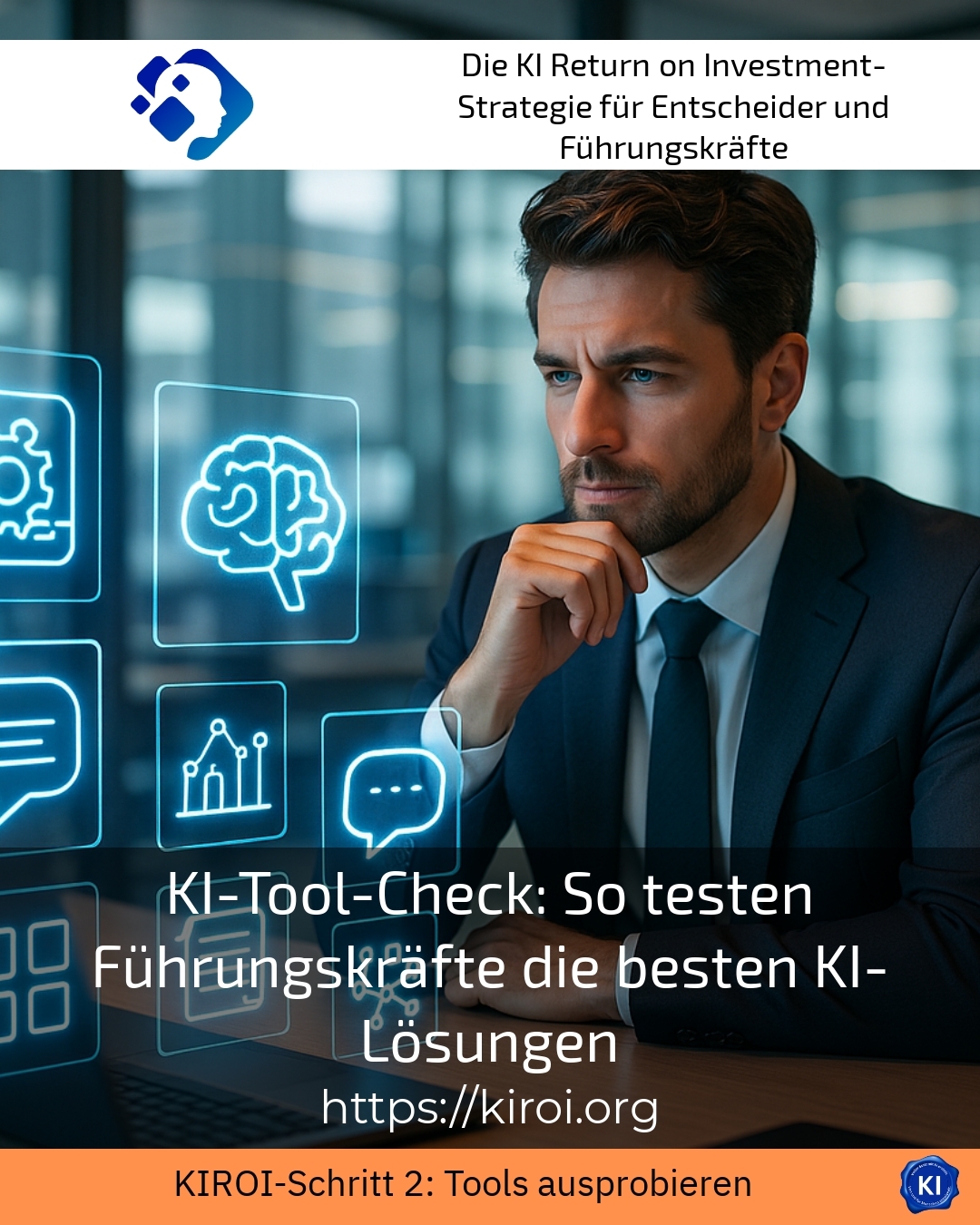
Are you potentially wasting valuable company resources on AI tools that do not match your actual requirements at all? This question is currently occupying numerous decision-makers in leading positions, because the market for intelligent software solutions is growing rapidly and confusingly at the same time. The AI tool check: How leaders test the best AI solutions is thereby developing into an indispensable competence that determines competitive advantages and strategic positioning. Transruption coaching accompanies leaders precisely in such complex evaluation processes and provides important impetus for well-founded technology decisions. Clients frequently report that only a systematic approach brings to light the truly suitable solutions and prevents costly misjudgements.
Why structured evaluation processes have become indispensable
Choosing suitable intelligent systems presents managers with significant challenges because vendor promises often deviate markedly from operational reality. At the same time, modern business models increasingly require automated processes that can hardly be implemented competitively without corresponding technological support. For example, a medium-sized manufacturing company implemented a promising forecasting system without having adequately checked the data quality beforehand, thereby experiencing considerable setbacks in production planning. A retail group, on the other hand, tested various chatbot solutions in parallel and only realised through direct comparison which system actually suited the corporate culture. In addition, a logistics company invested in route optimisation which, following systematic evaluation, proved to be particularly energy-efficient and thus also supported sustainability goals.
The AI tool check: How leaders test the best AI solutions ideally begins with a thorough stock-taking of existing processes and data structures. Many decision-makers underestimate the importance of a clear definition of objectives, which should go far beyond general increases in efficiency. Concrete key performance indicators and measurable results form the foundation for any serious evaluation, because only in this way are objective comparisons between different providers possible.
Best practice with a AIROI customer An internationally active mechanical engineering company faced the challenge of equipping its customer service department with intelligent support without compromising the personal quality of advice. Together with coaching guidance from transruptions, the company developed a multi-stage testing process in which the most frequent customer inquiries were first categorised and prioritised. Subsequently, three different providers were invited to present their solutions in a controlled test environment, using real customer inquiries from the past as test cases. In addition to the pure quality of the responses, the evaluation took into account factors such as the ability to integrate into existing CRM systems, multilingualism and the option for continuous improvement through feedback loops. Following a four-week pilot phase with selected customer groups, it became clear which solution achieved the highest level of acceptance among employees and customers alike. The result was a well-founded decision that contributed sustainably to customer satisfaction and effectively relieved the service staff.
Practical methods for the systematic AI tool check
The development of a company-specific evaluation framework forms the starting point for all further evaluation steps, because standardised checklists rarely reflect the specific requirements of individual organisations. For example, a pharmaceutical company developed a scoring system that placed a particularly heavy weighting on regulatory requirements, thereby minimising compliance risks. An insurance company, on the other hand, focused on the explainability of decisions because customers expect comprehensible justifications in the event of a claim. An energy utility, in turn, prioritised the real-time capability of the tested systems because grid loads have to be forecast down to the second.
Test scenarios and pilot projects as a basis for decision-making during the AI tool check
Pilot projects enable a realistic assessment of performance under real operating conditions without exposing the entire company to risk. A retail group initially tested various inventory management systems in selected branches, thereby gaining valuable insights into regional differences. A bank deliberately conducted its pilot phase in a smaller branch in order to be able to react quickly if problems arose. An automotive supplier specifically created a sandbox environment in which new systems were tested with historical production data before being transferred to the live environment.
Defining meaningful success criteria requires close collaboration between technical experts and the operational departments that will later be working with the systems. Clients frequently report that this cross-departmental coordination in particular is initially perceived as time-consuming, but in the long run more than pays off as time well invested. Transruption coaching helps to bring together the different perspectives and develop common evaluation standards that are accepted by all participants.
Criteria for the evaluation of intelligent systems
Technical performance alone is by no means enough to make an informed decision for or against a particular solution. For example, a telecommunications company found that the technically superior system achieved significantly poorer acceptance rates among employees and was therefore unable to fulfil its potential. A government agency only realised during pilot operations that data protection requirements were much easier to implement with one provider than with another technically comparable system. A media company placed particular value on the creative capabilities of the tested solutions and developed its own quality criteria for this purpose that went beyond mere efficiency metrics.
Best practice with a AIROI customer A medium-sized technology company was looking for a solution for automated quality control in manufacturing and received promising presentations with impressive detection rates from several suppliers. However, the management team decided not to rely solely on the manufacturers' claims, but rather a structured AI Tool Check to carry out, which took the specific production conditions into account. Together with the transruptions coaching team, test criteria were developed which, in addition to recognition accuracy, also incorporated robustness under changing lighting conditions, ease of maintenance and training effort for the operating personnel. The results showed clear differences between theoretical performance figures and practical performance under real production conditions. Particularly insightful was the observation that a system with a slightly lower base accuracy outperformed competing products after just a few weeks thanks to its better learning capability. This insight would probably have remained hidden without the systematic testing process and would have led to a suboptimal decision.
Integration and scalability as crucial factors
The ability to integrate seamlessly into existing IT landscapes often determines the practical value of a solution, because isolated standalone solutions cause additional manual effort and create sources of error. A healthcare provider experienced that a promising diagnostic system could not be connected to the existing patient administration system and thus lost its added value. A hotel chain, on the other hand, was able to achieve significant increases in revenue through the successful integration of a booking forecasting system into revenue management. A construction company particularly valued the interfaces with CAD systems and BIM platforms because the project-relevant data was already available there.
The scalability of a solution deserves special attention because the initial pilot operation usually accounts for only a fraction of the later data volume and user numbers. Managers should specifically ask for references where similar scaling requirements have been successfully mastered in order to develop realistic expectations. Disruption coaching also supports companies in developing growth scenarios that enable forward-looking technology selection.
Human factors in technology assessment
Acceptance by eventual users ultimately determines whether a technically compelling solution can actually unfold its potential in everyday operations. A financial services provider therefore involved employees from various departments in the selection process at an early stage, thereby achieving a significantly higher adoption rate after implementation. A logistics company trained selected drivers on various systems during the trial phase and systematically gathered their feedback on user-friendliness. An advertising agency had its creatives test several assistance systems in their daily business and documented both the time saved and their subjective satisfaction with the results.
Senior managers must lead by example in such evaluation projects and actively participate in testing phases themselves, as this underscores the seriousness of the endeavour and provides valuable perspectives. Clients frequently report that having their own practical experience with various systems led to surprising insights that pure data analysis could not provide.
Long-term perspectives and supplier relationships
The selection of an intelligent system establishes a longer-term business relationship in most cases, which is why the stability and development direction of the provider should also be factored into the evaluation. For example, a chemical group fundamentally checks the financial strength of potential technology partners in order to minimise the risk of a market exit during ongoing projects. A publisher analysed the innovation speed of various providers and deliberately chose a company with regular feature expansions. An airline placed particular emphasis on the provider's European location in order to be able to meet data protection requirements more easily.
Best practice with a AIROI customer A long-established family-run business in the food industry faced the strategic decision of which technology partner should accompany the digitalisation of its product development. Together with the transruptions coaching team, the management developed a comprehensive catalogue of criteria that, alongside technical aspects, also took into account the cultural fit between the companies. Several potential providers were invited to workshops where, in addition to product demonstrations, informal discussions also took place between the teams. This approach provided insights into the working methods and communication culture of the providers that would not have been revealed through standard tender procedures alone. The final decision fell on a medium-sized specialist which, although not boasting the largest market presence, won them over through its collaborative approach and industry expertise. This choice proved to be sustainably valuable because the provider developed flexible and pragmatic solutions even for unforeseen requirements.
Continuous improvement and measurement of success
The AI tool check: How leaders test the best AI solutions does not end with the implementation decision, but continues with a systematic review that regularly checks whether the expected results are actually occurring. An industrial company established quarterly review meetings to analyse the performance indicators of the introduced systems and compare them with the original projections. A retail organisation developed a dashboard that visualises key success metrics in real time and makes deviations immediately visible. A service corporation introduced biannual user surveys to capture subjective satisfaction with the implemented solutions.
This continuous evaluation creates the basis for subsequent improvements and optimisations, but also for the honest decision to decommission a solution if necessary, should it permanently fail to meet expectations. Transruption coaching supports leaders in making such uncomfortable decisions and in learning from the insights gained for future projects.
My AIROI Analysis
The systematic evaluation of intelligent systems has developed into a core competency of modern corporate management that goes far beyond technical understanding and combines strategic thinking with operational attention to detail. The structured AI tool check: How leaders test the best AI solutions protects organisations against costly bad investments while simultaneously creating the conditions for successful transformation projects [1]. Of particular significance is the recognition that technical performance alone does not represent a sufficient basis for decision-making, but must always be evaluated in the context of the specific corporate culture, existing processes and strategic goals [2]. The practical examples presented in this article illustrate that successful evaluations always integrate multiple perspectives and take into account both quantitative metrics and qualitative assessments. Transruption coaching supports leaders precisely with this multifaceted task and provides valuable impetus for the design of company-specific selection processes [3]. Clients frequently report that it is only through external support that the necessary distance from internal preferences is created, thereby enabling more objective decisions. The time and diligence invested in a thorough evaluation regularly pays off many times over, because it not only improves the immediate system selection, but also fosters organisational learning and strengthens technology expertise within the company. Leaders who take this responsibility seriously and actively engage in evaluation processes thereby create the foundation for sustainable competitive advantages and a future-proof positioning for their organisation.
Further links from the text above:
[1] Bitkom – Artificial Intelligence in Corporate Use
[2] McKinsey – The State of AI
[3] Transruption Coaching – Guidance for Digitalisation Projects
For more information and if you have any questions, please contact Contact us or read more blog posts on the topic Artificial intelligence here.








 Deutsch
  English (UK)