
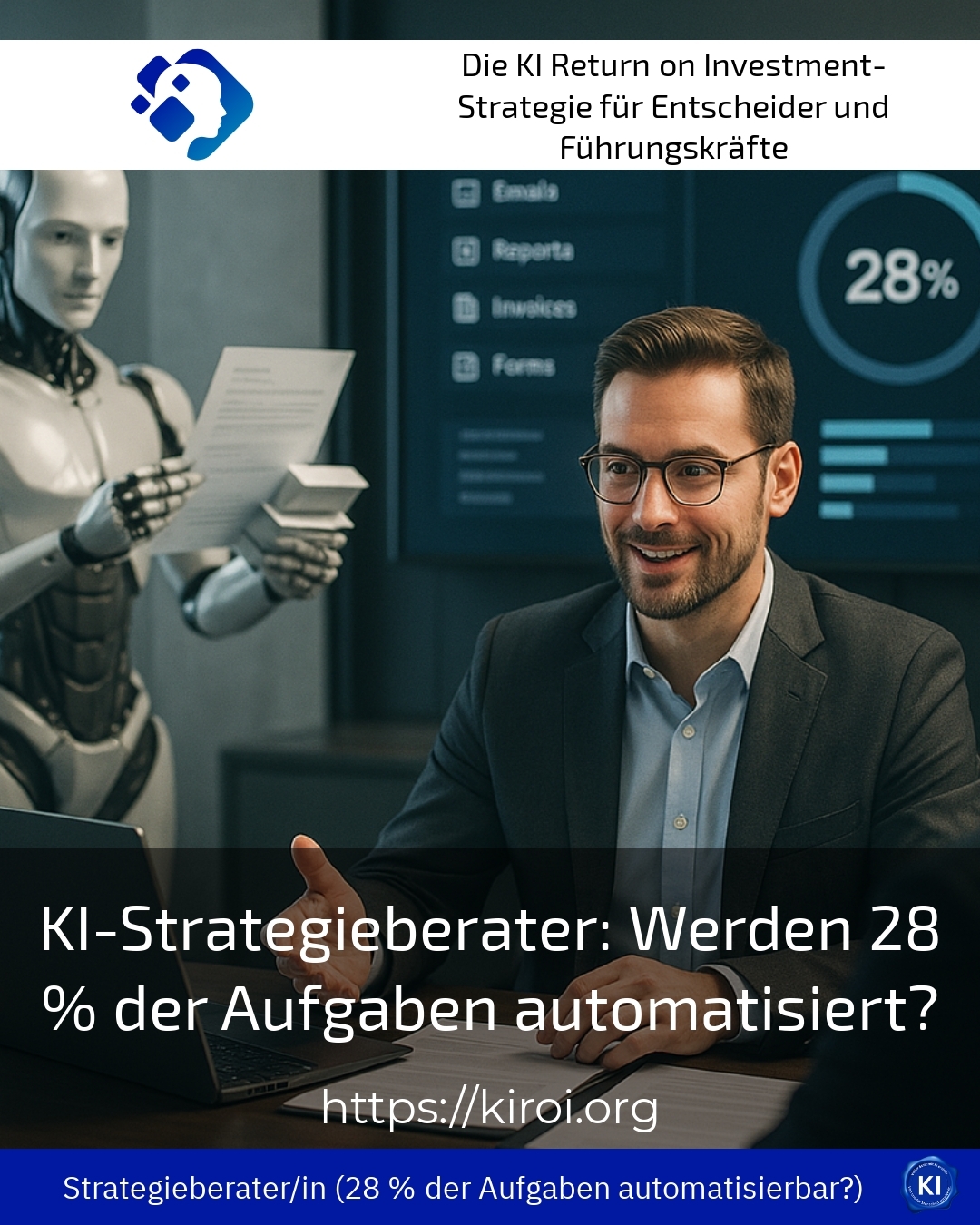
Will your expertise soon become redundant because intelligent systems make strategic decisions faster and more accurately than you do? This question is currently occupying numerous professionals who work in advisory and analytical roles and are increasingly confronted with the transformation of their working environment. The AI strategy consultant is exemplary of an occupational group that, on the one hand, benefits from technological innovations, but on the other hand is also experiencing a significant transformation in its fields of activity. The much-discussed figure of 28 percent of automatable tasks raises fundamental questions that go far beyond mere efficiency gains and touch upon the professional identity of an entire industry.
The basis for this assessment is provided, among other things, by the Job Futuromat of the Institute for Employment Research [1]. This scientifically grounded analysis systematically examines which tasks in various occupational fields could be replaced by modern technologies. If you work in this dynamic field, strategic further training is recommended. The AIROI seminars provide practical knowledge for the successful integration of intelligent systems into your daily work. You can find the current dates on the AIROI seminar page [2]. These events help professionals not only to maintain their position in the changed market environment, but also to actively shape it.
The changing role of the AI strategy consultant in an automated world
The landscape of strategic management consultancy is undergoing fundamental change because data-driven analysis tools are becoming increasingly powerful. Routine tasks such as the processing of market data, the creation of standardised presentations or the execution of competitor analyses can now be taken over by intelligent systems. A AI strategy consultant must therefore redefine its core competencies. The human ability to contextualise complex relationships remains irreplaceable in this regard. For example, an experienced consultant can recognise cultural nuances in international projects that algorithms miss. Similarly, they are able to identify emotional resistance in transformation processes and resolve it constructively. The combination of technological understanding and human intuition creates added value that pure automation cannot offer.
In practice, this development is particularly evident when supporting digitalisation projects. A medium-sized manufacturing company needs more than just a technical analysis of its processes. It needs a partner who understands the concerns of its employees and overcomes resistance. The implementation of new technologies often fails not because of technical hurdles, but due to a lack of acceptance and missing change management skills. This is where human advisory expertise unfolds its full impact. Another example can be found in the financial sector, where intelligent systems assist with risk analysis. However, the final assessment and strategic direction remain with the experienced consultant. This pattern is also apparent in healthcare, where data-driven diagnostic support complements the expertise of specialists rather than replacing it.
Best practice with a AIROI customer
An international consulting firm faced the challenge of future-proofing its services. Management recognised that traditional analytical methods were increasingly being replaced by automated solutions. At the same time, pressure on fees grew as clients demanded cheaper digital alternatives. As part of the AIROI support, the company developed a hybrid strategy that combined technological efficiency with human expertise. The consultants learned to use intelligent tools to amplify their skills rather than viewing them as competition. Data preparation was henceforth automated, which created more time for strategic discussions with clients. Within eighteen months, the firm increased its client retention by forty percent. Employee satisfaction also improved because monotonous tasks were eliminated and more demanding activities came to the fore. This example illustrates how the AIROI strategy helps companies embrace change as an opportunity and actively shape it.
Which tasks can actually be automated
The much-cited 28 per cent of automatable activities are distributed unevenly across various areas of tasks. Particularly affected are repetitive analytical activities that follow standardised patterns. The preparation of market overviews, the evaluation of key performance indicators and the documentation of project progress are among these vulnerable areas. In management consulting, for example, due diligence processes can be partially automated. The review of contractual documents can be accelerated through intelligent text analysis. The preparation of benchmark studies also benefits from automated data collections. An AI strategy consultant must know and understand these developments in order to be able to provide clients with well-founded recommendations. The AIROI seminars impart precisely this knowledge and enable participants to draw the right conclusions for their own positioning.
In contrast, numerous tasks remain firmly in human hands. The moderation of strategy workshops requires empathy and situational awareness. Conducting negotiations in critical business situations demands human presence and powers of persuasion. The development of innovative business models arises from creative dialogue between people. In the technology sector, this is evident when mentoring start-ups. Here, it is not just about numbers and forecasts. It is about trust, motivation and shared visions. The situation is similar in public administration. There, consultants must take political sensitivities into account. They have to mediate between various stakeholder groups and facilitate compromises. The energy sector provides another example. Transformation projects there require intensive stakeholder communication that goes far beyond technical aspects.
The importance of soft skills in the automated advisory world
The more technical tasks are automated, the more valuable human qualities become. This seemingly paradoxical development is significantly shaping the future of the consulting industry. Communication skills, emotional intelligence and ethical judgement are gaining in importance. An experienced consultant can read between the lines and identify unspoken concerns. They sense when a project team is under stress and adapt their approach accordingly. These skills cannot be programmed. In the logistics sector, this becomes apparent during complex optimisation projects. The technical solution is often quickly found. However, implementation fails due to human factors. In the retail sector, consultants experience similar situations. Digitalisation projects require intensive change management. The pharmaceutical industry offers further examples. There, consultants must reconcile regulatory requirements with business objectives.
Best practice with a AIROI customer
A mid-sized mechanical engineering company sought support for the strategic realignment of its service department. The technical possibilities for predictive maintenance and digital customer portals were known and generally available. Nevertheless, implementation had stalled for several months because internal resistance was blocking the project. The long-standing service technicians feared the loss of their expertise and their jobs. The sales team saw digital offerings as a threat to their customer relationships. As part of the AIROI support, these fears were systematically addressed and transformed into constructive energy. The employees received training that showed them how they could use the new tools for their work. The service technicians became experts for complex problem cases that automated systems could not solve. Sales learned to use digital offerings as a door opener for deeper customer relationships. After a year, the service department had become the company's most profitable business division. Customer satisfaction reached record highs, and employee turnover fell significantly.
Strategies for successful positioning through change
The future belongs to those who can combine technological competence with human expertise. AI strategy consultant should understand both worlds and be able to connect them. Continuous professional development plays a central role in this. The AIROI strategy offers a structured framework for this development. Workshops and lectures impart not only theoretical knowledge, but also practical application skills. Specialising in certain industries or subject areas can also be sensible. Generalists increasingly struggle to compete against specialised providers. The automotive industry looks for consultants with deep industry knowledge. The financial sector demands regulatory expertise. Healthcare requires knowledge of specific framework conditions and stakeholders.
Developing a personal brand is also gaining in importance. In a world where standardised services are being automated, the individual perspective counts. A AI strategy consultant should be able to carve out and communicate its unique profile. Networks and relationships remain indispensable. Personal recommendations open doors that remain closed to digital acquisition methods. The cultivation of alumni networks and industry contacts proves to be a sustainable investment. In the construction industry, the importance of personal relationships is particularly evident. Contracts are frequently awarded on the basis of long-standing cooperation. The insurance industry offers similar examples. There, advisory mandates often arise from existing relationships of trust. The media industry also operates according to this principle. Creative projects require personal chemistry between client and consultant.
The role of ethics and responsibility in consulting
With increasing automation, the importance of ethical issues is growing. Consultants bear responsibility for how technological capabilities are deployed. The consequences for employees, customers and society must be considered. A responsible consultant points out risks and develops solutions that are sustainable in the long term. In the food industry, this is evident in issues of supply chain transparency. Technical solutions enable comprehensive monitoring. Balancing efficiency with data protection requires human judgement. Similar issues arise in the education sector. Personalised learning offers opportunities, but also raises concerns regarding privacy. The telecommunications sector faces comparable challenges. Data-driven business models must be designed in an ethically justifiable manner.
My AIROI Analysis
The discussion surrounding automatable task shares draws attention to a fundamental shift in the advisory industry. The cited 28 percent represents an average value that can vary considerably depending on the individual activity profile. The decisive question is not whether automation will take place, but how professionals prepare for it and position themselves. The AIROI strategy provides a proven framework for this realignment. It combines technological understanding with the development of human competence, thus creating the basis for sustainable professional success. Numerous examples from various industries show that this shift is already in full swing. Companies are looking for partners who understand both worlds and can combine them. The demand for hybrid skills is growing continuously. At the same time, new fields of activity are opening up that did not exist a few years ago. Supporting transformation processes, the ethical evaluation of technological possibilities, or the design of human-centred working environments are just a few examples. Anyone willing to evolve and forge new paths will find a wide variety of opportunities in this changed environment. The AIROI seminars and workshops provide concrete impetus for this development and accompany professionals on their individual journey into the future. Investing in one's own further training proves to be a wise strategic decision with long-term impact.
Further links from the text above:
[1] Job-Futuromat of the Institute for Employment Research
[2] AIROI seminars and live events with Sanjay Sauldie
For more information and if you have any questions, please contact Contact us or read more blog posts on the topic Artificial intelligence here.








 Deutsch
  English (UK)