
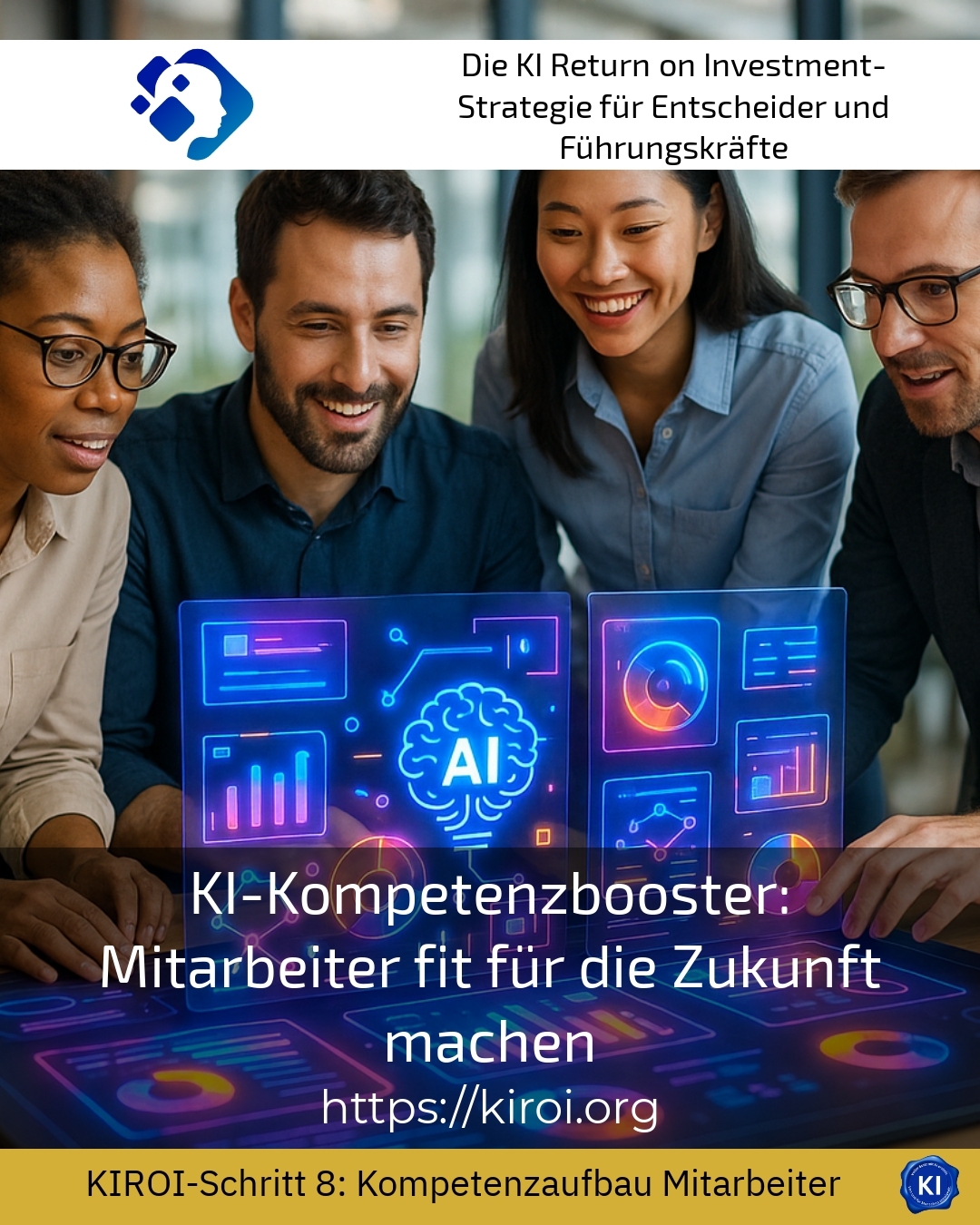
Imagine if your entire workforce could become genuine technology experts within a few months, confidently using complex digital tools. The AI Skills Booster: Getting staff ready for the future is no longer just a vision, but an urgent necessity in a rapidly changing world. Many companies face the challenge of preparing their teams for upcoming requirements. This is not just about technical knowledge, but about a completely new mindset. The following sections show you concrete ways in which this transformation can succeed.
Why the AI skills booster is essential today
The world of work is currently undergoing a fundamental transformation that is affecting all industries and occupational groups. Technological developments are progressing so rapidly that traditional further training concepts are no longer sufficient. Companies that do not actively support their employees risk falling behind the competition. At the same time, many workers report uncertainty when dealing with new digital systems. This uncertainty can lead to frustration and declining productivity.
A logistics company from Northern Germany was faced with precisely this problem. The warehouse staff were suddenly expected to work with automated inventory systems. Initially, there was widespread skepticism amongst the workforce. Following a structured implementation phase, however, most employees reported positive experiences. Another example is provided by a medium-sized engineering company whose service technicians were expected to use intelligent diagnostic tools. Initial rejection transformed into genuine enthusiasm through targeted guidance. A retail company with several branches was also able to significantly increase acceptance of new point-of-sale systems through systematic training.
The role of transruption coaching in skills development
Change processes in companies require more than just technical training. People need emotional support and guidance in uncertain times. This is precisely where transruptions coaching comes in, supporting teams and individuals through transformation projects [1]. This form of support takes into account both professional and personal aspects of change. Clients frequently report a significant reduction in their anxiety about new technologies.
A manufacturing company in the automotive supply industry used this support when introducing intelligent quality inspection. The assembly line workers felt taken seriously thanks to the coaching. In the food production sector, a similar approach helped with the implementation of automated hygiene controls. This supportive method also proved successful in the pharmaceutical industry, where the highest precision is required. Experience shows that people accept change better when they are not left alone during the process.
Best practice with a AIROI customer
An international company in the chemical industry faced the challenge of preparing over 500 employees across various production sites for new digital processes. The existing workforce had accumulated decades of experience with traditional working methods. The management recognised early on that purely technical training would not be sufficient. Working with the AIROI framework, the company developed a holistic approach to skills development. First, so-called ‘change agents’ were identified in each department and given intensive training. These internal ambassadors then acted as multipliers within their teams. At the same time, all managers received specialised coaching to support their staff. The roll-out took place gradually over a period of eight months. Regular feedback sessions enabled the approach to be continuously adapted. At the end of the process, internal surveys showed a satisfaction rate of over 85 per cent. It was particularly noteworthy that older staff members also successfully used the new systems. The company was able to reduce its error rate in production by around 30 per cent. At the same time, staff retention increased measurably because people felt valued.
Practical strategies for the AI skills booster in everyday business life
The successful development of digital skills requires a structured and long-term approach. Short-term training often proves ineffective because what has been learned is not sustainably anchored. Instead, experts recommend a continuous learning process with regular phases of practice [2]. In doing so, companies should take into account the varying learning speeds of their employees. Some people require more time and support than others.
In the construction industry, this approach is particularly evident in the introduction of Building Information Modeling. Architects and site managers have to learn to master completely new software tools. A successful construction company from Bavaria therefore integrated learning time firmly into the daily work routine. An energy supplier also used similar methods when digitising its grid management. In the medical technology sector, a manufacturer of diagnostic devices introduced accompanying study groups. These examples illustrate that comparable challenges exist across all industries.
Equipping employees for the future through personalised learning paths
Not every employee brings the same prerequisites, and these differences deserve respect. Individualised learning paths take existing knowledge into account as well as personal learning preferences. Some people learn better through practical experimentation than through theoretical instructions. Others prefer structured courses with clear milestones and measurements of success. Combining different learning formats significantly increases the likelihood of success.
A telecommunications company developed a modular system that adapts to individual needs, allowing employees to decide for themselves the pace at which they wanted to progress. In the banking sector, a financial services provider used playful elements to increase motivation [3]. A large insurance company also relied on gamification approaches when introducing new analysis tools. These methods particularly appeal to younger employees, but older generations benefit from them as well. Experience shows that enjoyment of learning is a crucial success factor.
Leaders as the key to a successful AI skills booster
The attitude of managers significantly influences how teams react to change. If superiors themselves exude uncertainty, this transfers to the entire department. Therefore, effective skills development often begins at the upper hierarchical levels of a company. Managers must learn to navigate their teams through phases of uncertainty and build trust. Open communication plays a central role throughout the entire change process.
A retail group initially trained all store managers intensively before involving the wider workforce. This approach created certainty and trust at all levels of the company. In the hotel industry, a similar approach proved successful when digitalising guest management. An airport operator also relied on prior management development when introducing automated check-in systems. As a result, the staff at the check-in desks felt supported by their superiors. These examples underline the importance of cross-hierarchical skills development.
Best practice with a AIROI customer
A long-established family-run business in the textile sector, with three production sites, wanted to modernise its manufacturing processes. The management recognised that technological change would not succeed without a cultural shift. As part of a AIROI project, all 25 managers first took part in a three-month programme. The focus was not only on technical understanding but also on emotional intelligence. The managers learnt how to recognise resistance and deal with it constructively. They practised conducting difficult conversations and taking concerns seriously without hindering progress. They were then trained and empowered to act as internal coaches for their own teams. This investment in the management team paid off significantly within a few months. The sickness absence rate, which had risen sharply at the start of the project, returned to normal. Staff turnover also fell noticeably, which seems particularly valuable in times of a skills shortage. The company reported a noticeably improved culture of communication across all levels of the organisation. Ultimately, the introduction of the new production systems went more smoothly than had originally been expected.
Understanding and constructively using resistance
Resistance to change is a natural human reaction that deserves respect. Behind rejection often lie legitimate worries and fears that want to be heard. Companies that ignore or suppress resistance risk long-term motivation problems within the workforce. Instead, dealing constructively with criticism can provide valuable impetus for improvements. Frequently, sceptical employees point out real weaknesses in planned changes.
In the aerospace industry, a supplier introduced regular feedback sessions during digitalisation. The criticism expressed led to concrete adjustments in the company's project plan. A company from the packaging industry even set up an anonymous suggestion box for concerns [4]. A logistics service provider also used critical voices as an early warning system for potential operational problems. This open attitude built trust and noticeably increased acceptance of the changes. Experience shows that resistance can be transformed if it is given space.
Sustainable embedding of new skills in everyday work
Learning new skills is only the first step on a longer journey. The crucial factor is that these skills can be permanently anchored in daily work. Without continuous application and practice, even well-taught knowledge quickly fades again. Companies should therefore create structures that enable and encourage regular practice. This also includes tolerance of errors and the opportunity to learn from mishaps.
A steel producer set up so-called learning tandems, in which experienced and new users work together. These partnerships promoted knowledge transfer while significantly strengthening team cohesion. In the printing industry, a company established weekly short training sessions lasting 15 minutes each. A household appliance manufacturer also relied on regular refresher modules for all employees. These continuous impulses prevented what was learned from being forgotten over time. The examples show that sustainability must be actively shaped in companies.
My AIROI Analysis
Developing future-proof skills within organisations is more like a marathon than a sprint. Anyone wishing to successfully prepare their workforce for the challenges ahead needs patience and staying power. Technical training alone is not enough to bring about real change in day-to-day working life. People need emotional support, clear guidance and the feeling that they are valued in times of change. The AIROI framework provides a structured framework that takes all these aspects into account and integrates them.
From my experience with numerous transformation projects, I draw several key practical insights. Firstly, many companies systematically and regularly underestimate the time required for genuine skills development. Secondly, the role of managers is often involved too late in the process during changes. Thirdly, companies frequently lack a long-term perspective that extends beyond the pure implementation phase. The AI Skills Booster: Getting staff ready for the future requires a holistic approach that puts people at its centre.
I find the insight that resistance is not an obstacle, but a valuable source of information, to be particularly important. Companies that take critical voices seriously design better change processes for everyone involved. In addition, it repeatedly becomes apparent that investments in skills development pay off manifold over time. They not only increase productivity, but also employee satisfaction and loyalty to the company. In an era of skills shortages, this is a competitive advantage for organisations that should not be underestimated.
Further links from the text above:
[1] transruptions coaching in transformation projects
[2] Best practices for workforce reskilling
[3] The role of gamification in employee training
[4] Harvard Business Review on change management
For more information and if you have any questions, please contact Contact us or read more blog posts on the topic Artificial intelligence here.








 Deutsch
  English (UK)