
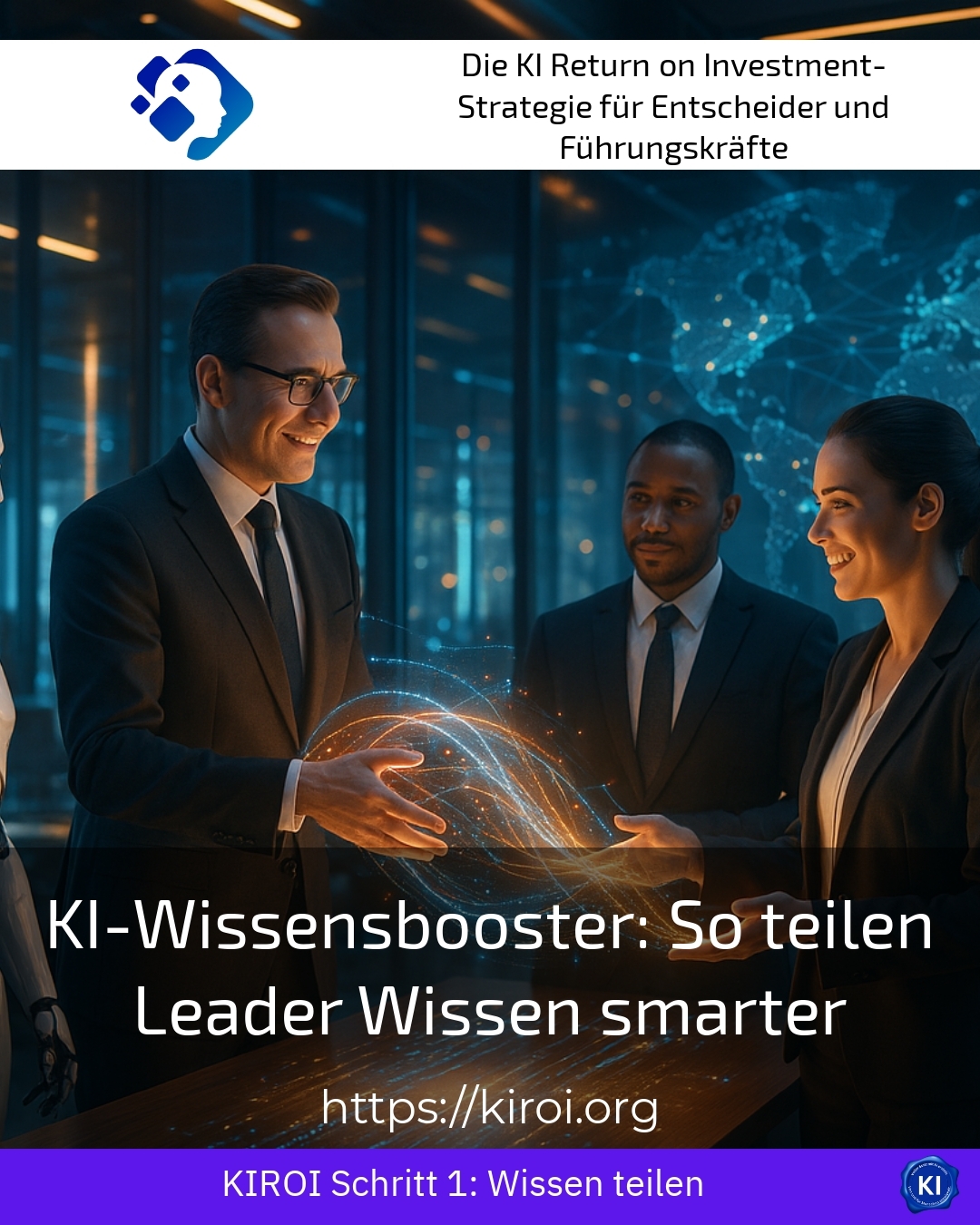
Have you ever wondered why some leaders can effortlessly spread their expertise throughout the entire organisation, while others fail against invisible barriers despite having brilliant expertise? The answer does not lie in a lack of competence or motivation, but rather in the way knowledge is prepared, structured and passed on. The AI Knowledge Booster is currently revolutionising the methods by which decision-makers share their expertise. In the process, entirely new possibilities are emerging for effective knowledge multiplication. At a time when information overload and time pressure are increasing in equal measure, modern leaders require intelligent tools. These tools support them in turning complex knowledge into digestible bites.
The transformation of knowledge transfer through intelligent systems
For decades, the traditional transfer of knowledge in companies followed the same patterns. Meetings, training sessions and extensive documentation formed the backbone of organisational learning. However, these traditional methods are increasingly reaching their limits. Leaders in the automotive industry frequently report the challenge of rapidly disseminating specialist technical knowledge about electromobility. In the healthcare sector, managers struggle to communicate new treatment guidelines efficiently. This problem is also evident in the financial sector when it comes to conveying regulatory changes.
Intelligent assistance systems can provide valuable support here. They analyse existing knowledge bases and identify gaps in information distribution. An example from the pharmaceutical industry illustrates this impressively. There, managers use automated summaries of clinical studies for their teams. The insurance sector relies on personalised learning paths for employees in various departments. In retail, dynamic training content is created that adapts to seasonal product changes.
Best practice with a AIROI customer A medium-sized engineering company faced a unique challenge in knowledge transfer. The most experienced engineers were set to retire within three years, and their extensive expertise threatened to leave the company. transruptions coaching supported the management team in establishing a structured knowledge transfer. First, critical knowledge areas were identified and prioritised. Subsequently, the team, together with the senior experts, developed interactive knowledge modules. These modules contained not only technical documentation, but also personal accounts of experience and problem-solving strategies. The intelligent system automatically structured the content according to complexity and relevance for various target groups within the company. Younger engineers were now able to access the experiential knowledge in a targeted manner and received context-based recommendations for further learning materials. After six months, the managers reported significantly improved knowledge retention and an increased sense of security in complex projects.
The AI knowledge booster in practical application
The practical implementation of intelligent knowledge systems requires a thoughtful approach. Leaders who want to share knowledge more smartly often begin with an inventory of their existing resources. In the logistics sector, for example, this means capturing process knowledge on optimal route planning. Energy suppliers document empirical values on grid stability and incident management. In the education sector, headteachers collect proven pedagogical concepts from various specialist areas.
The processing of this gathered knowledge represents the next crucial step. Modern systems can condense long technical texts into concise core messages. They automatically generate summaries tailored to different levels of comprehension. A team leader in the construction industry receives different information than a project manager or an apprentice. This differentiation is carried out intelligently, taking into account the respective level of knowledge and the specific work requirements.
The telecommunications industry provides a clear example of this adaptability. Technical documentation on new network technologies is translated into various formats there. Customer advisors receive comprehensible explanations for end-users, while technicians get detailed specifications. Executives, in turn, see strategic summaries with market implications. This multi-layered approach enables efficient knowledge distribution without redundancies.
Smarter sharing of knowledge through personalised learning paths
The personalisation of learning content is among the most effective approaches in modern knowledge transfer. Every employee brings different prior knowledge and learning preferences. Intelligent systems recognise these individual differences and adapt their recommendations accordingly. In the hotel industry, this is particularly evident in the training of service staff. Experienced employees automatically skip basic modules and focus on advanced topics.
The food industry benefits from this approach to communicating hygiene standards. New regulations are no longer taught in time-consuming face-to-face training sessions. Instead, employees receive precisely the information that is relevant to their work area. Production workers receive practical instructions, while quality managers obtain comprehensive background information. This targeted distribution saves time and simultaneously increases receptiveness.
In the media sector, editorial management uses intelligent systems to disseminate journalistic standards. New employees go through personalised onboarding programmes based on their previous experience. Experienced journalists receive updates on legal changes or new research methods. Knowledge transfer takes place continuously and integrates seamlessly into the working day.
Challenges and opportunities with the AI knowledge booster
The introduction of intelligent knowledge systems also brings challenges that leaders should consider. Data protection and confidentiality play a central role, especially in sensitive industries. Law firms must ensure that client-related knowledge remains protected. Research institutions pay attention to the protection of unpublished study results. In the banking sector, strict regulations apply to the handling of customer data.
Acceptance among employees represents another important dimension. Many people initially feel sceptical about automated systems. These concerns are understandable and should be taken seriously. Transparent communication about how the technology works and its limitations can help in this regard. In the aviation industry, managers have had positive experiences with phased rollouts. They began with simple use cases and gradually expanded the system.
Best practice with a AIROI customer An international management consultancy was looking for ways to make better use of its consultants' collective knowledge and make it available across national borders. transruptions coaching accompanied the leadership team over several months on this demanding transformation project. The biggest challenge was to convert implicit experiential knowledge into explicit knowledge content. For years, the consultants had successfully developed strategies, but rarely documented them systematically. Together, a process was established that integrated the capture of project insights into the normal workflow. Instead of extensive final reports, short reflections after major milestones were now sufficient. The intelligent system aggregated these contributions and identified overarching patterns and success factors. New consultants were now able to access this treasure trove of experience and received context-based recommendations for their current projects. The consultancy's partners reported a significantly reduced onboarding time and a higher quality of work results for complex tasks.
The role of the leader as a knowledge multiplier
Despite all technological support, the human component remains indispensable. Leaders act as bridge-builders between technology and the workforce. They provide impetus for the use of new tools and model open knowledge sharing. In the chemical industry, managers demonstrate through their own contributions that knowledge sharing is not a one-way street. In the public sector, department heads create spaces for collegiate exchange.
The moderation of knowledge processes is among the most important tasks of modern managers. They decide which topics are prioritised and how resources are allocated. In the sports industry, club managers coordinate the exchange of knowledge between the coaching staff and the medical department. Cultural institutions use similar approaches for the exchange between curatorial and administrative areas. This networking of different specialist departments creates synergies that would remain untapped without deliberate management.
Dealing with resistance requires tact and patience from managers. Not all employees spontaneously welcome new methods of knowledge transfer. In the trade sector, experienced master craftsmen sometimes view technological innovations with reservation. Here, successful pilot projects in individual departments can serve as role models. The real estate sector reports positive effects from involving sceptical employees in the design phase.
Sustainable embedding of intelligent knowledge processes
The long-term integration of intelligent knowledge systems requires a cultural shift in many organisations. Knowledge is traditionally often viewed as a power resource and guarded accordingly. For some, an open approach to expertise represents a paradigm shift. In the advertising industry, agencies have had positive experiences with incentive systems for active knowledge contributions. The shipping sector is establishing mentoring programmes that connect experienced captains with newcomers [1].
The continuous maintenance and updating of knowledge bases deserves special attention. Outdated information can do more damage than missing information. In software development, incorrect documentation leads to time-consuming troubleshooting. The fashion industry experiences the fast-moving nature of product knowledge particularly intensely. Automated systems can assist here by flagging outdated content and prompting updates [2].
Measuring success presents many organisations with methodological challenges. How can the value of better knowledge sharing be quantified? In the manufacturing industry, key figures such as error rates or onboarding times serve as indicators. The care sector measures the satisfaction of employees and residents alike. The events industry observes the quality of events as an indirect measure of success.
My AIROI Analysis
The intensive examination of the transformation of knowledge processes in organisations leads to several key insights that are important for leaders across all industries. The combination of human expertise with intelligent support systems opens up possibilities that seemed unthinkable just a few years ago and can fundamentally change the nature of collaboration. It repeatedly becomes clear that technological tools only unfold their full benefit when they are embedded in a well-conceived overall strategy and accepted by the people within the organisation.
Accompanying numerous companies through transformation projects has shown that success depends significantly on the attitude of the management level. Leaders who actively share knowledge themselves and open up to new methods create an environment in which employees are also willing to leave their comfort zone. The technical possibilities of AI Knowledge Boosterapproaches merely form the foundation upon which a vibrant knowledge culture can emerge, characterised by mutual trust and a genuine interest in learning together.
For the future, it is becoming apparent that organisations that invest in intelligent knowledge processes now will be able to build a sustainable competitive advantage. The ability to quickly identify, process and selectively distribute relevant knowledge is becoming a core competency for successful companies. Transruptions coaching helps to shape this development strategically and take into account the specific needs of each organisation. Previous experience shows that patient and respectful accompaniment makes the difference between superficial implementation and profound transformation.
Further links from the text above:
[1] McKinsey: Why Knowledge Management Matters
[2] Harvard Business Review: Insights on Knowledge Management
For more information and if you have any questions, please contact Contact us or read more blog posts on the topic Artificial intelligence here.










 Deutsch
  English (UK)