
Will you still have a job in a few years if nearly half of your daily tasks can be taken over by algorithms?
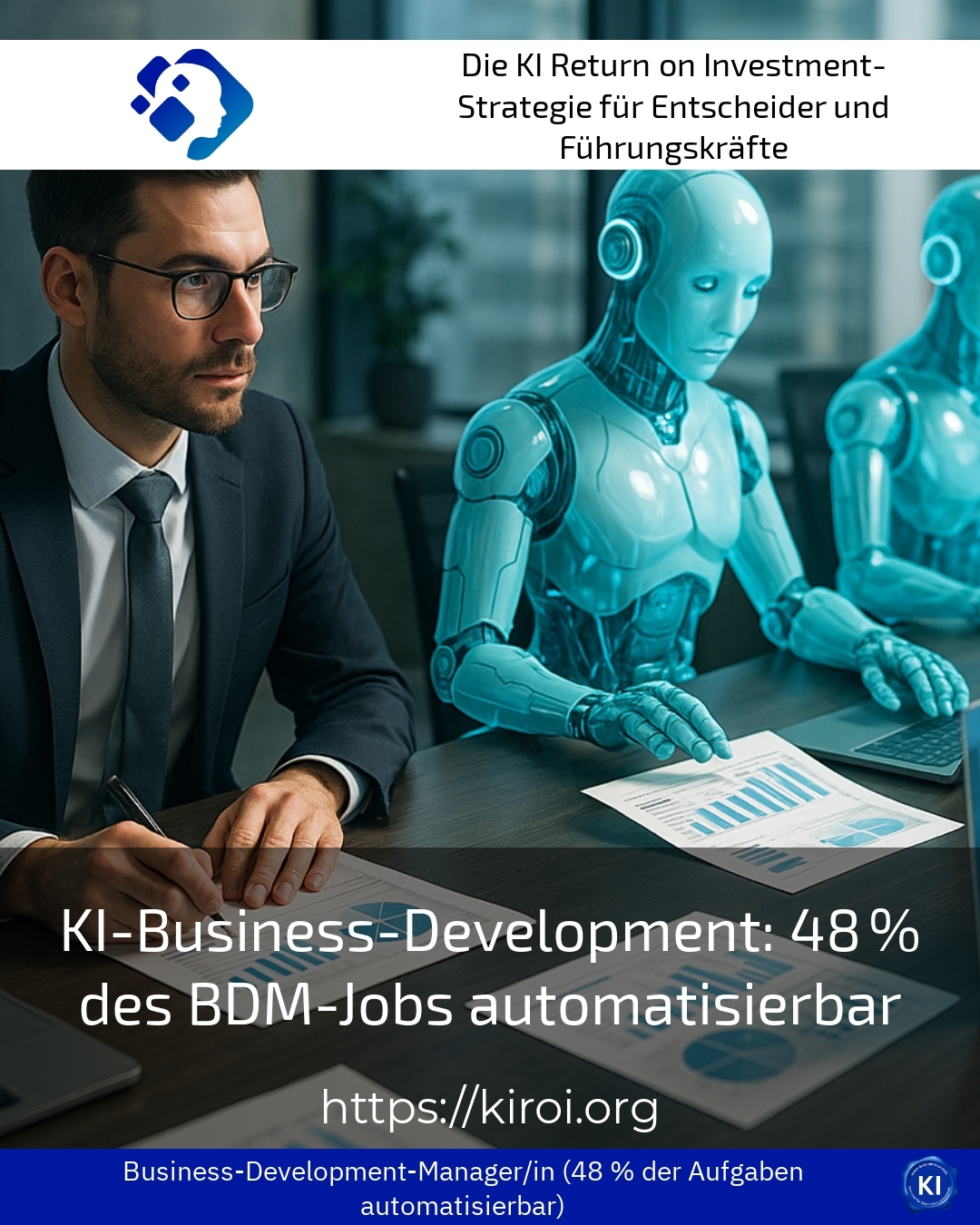
This question is currently occupying countless professionals in strategic positions, because the rapid development of intelligent systems is fundamentally changing working structures in almost all economic sectors. Anyone today in the AI Business Development is active or is building and maintaining business relationships, is faced with a remarkable finding: current analyses show that approximately 48 percent of typical activities in this professional field could be substituted by technological solutions. This figure raises fundamental questions that go far beyond mere efficiency gains and directly affect the professional existence of many qualified people.
The information in this article is based, among other things, on data from the renowned Job Futuromat of the Institute for Employment Research [1]. If you work in this dynamic field yourself and want to future-proof your position, the AIROI seminars offer valuable insights and practical strategies. You can find the current dates on Sanjay Sauldie's website [2].
The transformation of business development through intelligent systems
The change is not happening gradually, but with remarkable speed. Traditional methods of customer acquisition and partner development are increasingly giving way to data-driven approaches. Algorithms now analyse market potentials faster and more precisely than human analysts ever could. The identification of promising business contacts is now frequently carried out automatically by intelligent systems that can trawl through and evaluate huge amounts of data in a fraction of a second.
An engineering company recently implemented an automated lead qualification system. The software evaluates publicly available company data and creates precise profiles of potential customers. As a result, the sales department receives pre-selected contacts with a high probability of closing. Another example shows a software house that uses chatbots for the initial approach of international partners. These virtual assistants conduct conversations around the clock and gather relevant information. In addition, a medium-sized logistics service provider uses predictive analytics to identify market trends at an early stage. The system identifies emerging demand in certain regions before competitors become aware of it.
Best practice with a AIROI customer An international trading company was faced with the challenge of making its expansion strategy into new markets more efficient. The methods used previously for market analysis required considerable human resources, yet often yielded incomplete results. As part of a AIROI support programme, a structured approach was developed that combines human expertise with technological support. The team first identified which tasks could actually be automated and which required human judgement. This was followed by the gradual integration of various tools for data analysis and establishing contacts. Staff were not replaced in the process, but instead gained new skills in using the systems. After six months, the company was able to triple its reach in its search for partners, whilst the quality of the identified business opportunities increased significantly. Specialists often report that they can now focus on value-adding activities because routine tasks are no longer necessary.
which activities are particularly affected
Automation does not affect all areas of responsibility equally. Repetitive tasks such as generating reports or maintaining databases are particularly easy to delegate to machines. The coordination of appointments with business partners is also frequently taken over by intelligent assistants nowadays. The analysis of competitor activities is increasingly carried out by systems that continuously search the internet for relevant information. We are observing this development across industries with increasing intensity.
For example, a financial services provider uses automated systems to monitor regulatory changes in various countries, ensuring that business developers are always kept informed about new market conditions. A pharmaceutical company relies on intelligent document analysis when evaluating potential collaboration partners; the software fully automatically assesses publications, patents, and financial metrics. Additionally, a technology company implemented a system for the automated creation of presentations. Based on just a few inputs, the software generates tailored materials for different target audiences.
Developing AI business development as a future skill
The crucial question is not whether technological changes are coming, but how skilled professionals prepare for them. The development of new competencies is at the centre of all considerations. Anyone who understands how intelligent systems work and where their limitations lie gains a considerable competitive advantage. The combination of human creativity and machine efficiency creates entirely new opportunities for strategic business development.
In the automotive supply industry, an experienced team is currently supporting the establishment of partnerships for electromobility. They are using intelligent systems to identify suitable technology providers worldwide. A media company is developing new business models for digital content with algorithmic support. The analysis of user behaviour provides valuable insights into future market opportunities. In addition, an energy supplier is experimenting with automated negotiation assistants. These prepare complex contract discussions and provide relevant market data in real time.
Best practice with a AIROI customer A medium-sized management consultancy recognised early on the need to fundamentally overhaul its customer acquisition methods. Traditional approaches involving networking events and cold calling were yielding increasingly unsatisfactory results. As part of the AIROI support, a comprehensive analysis of the existing processes was initially carried out. This revealed that the consultants spent a significant portion of their working time on administrative tasks. The strategy subsequently implemented combined various technological tools with a modified work organisation. The specialists received training in the use of analysis systems and learned to critically interpret their results. The ability to ask the systems the right questions proved particularly valuable. Following the transformation, employees frequently reported a significantly increased job satisfaction. They were able to focus more on strategic discussions and the development of creative solutions. Customer acquisition improved significantly because the outreach was more precise and individual.
The human component remains indispensable
Despite all technological advancements, the human factor retains its central importance. Trust still arises primarily through personal encounters and authentic conversations. Complex negotiations require emotional intelligence that no algorithm can replicate. The ability to read between the lines and understand cultural nuances remains an exclusively human domain.
An example from the real estate industry clearly illustrates this. There, the attempt to completely automate investor discussions failed. Decision-makers continued to prefer personal interaction for important transactions. A luxury goods manufacturer had similar experiences when searching for distribution partners in Asia. Cultural nuances required a sensitive human approach. A biotechnology company also found that research collaborations only came about through intensive personal relationships. While technological support helped in identifying potential partners, the actual cooperation was based on human trust.
Strategies for personal development in AI business development
Successful adaptation to changing conditions requires a structured approach to skills development. First, an honest inventory of one's own abilities and activities is recommended. Which tasks could theoretically be automated? Where lies the unique added value of one's personal work? These questions form the starting point for future-oriented career planning.
An experienced business developer in the chemicals sector systematically aligned his profile with sustainability partnerships. This specialist knowledge can hardly be replaced by algorithms. A female colleague in the telecommunications sector specialised in cross-cultural negotiation management. Her expertise in talks between European and Asian companies remains in high demand. A third example shows a specialist from the food industry. He developed into an expert for ethical supply chains and now advises companies on selecting responsible partners.
The role of further education and continuous learning
Lifelong learning is shifting from an option to an absolute necessity. The speed of technological change requires the permanent adaptation of one's own skills. This is not about becoming a technology expert oneself. Rather, what counts is an understanding of the possibilities and limitations of the available tools.
An insurance company established an internal digital skills development programme. Employees learn there how to make effective use of technological tools. An industrial group is cooperating with universities for specialised further training offerings in the field of AI Business Development. Participants acquire practical skills in handling modern analysis tools. In addition, a foreign trade association organises regular workshops on digital methods. These events enable the exchange of experience between practitioners from various industries.
Best practice with a AIROI customer A long-established family-run mechanical engineering firm found itself faced with the challenge of modernising its international business relationships. Whilst the existing methods were still working, the younger generation of management recognised the potential of new approaches. As part of the AIROI process, the existing organisational structure was first analysed and the employees’ existing skills assessed. The team then developed a bespoke transformation plan that preserved the company’s strengths. Long-standing customer relationships and in-depth industry knowledge formed the basis for this. Technological tools complemented these strengths without replacing them. Staff learnt to use analytical systems for market monitoring. At the same time, they retained full control over strategic decisions and customer relationships. The result was a significant increase in efficiency when identifying new business opportunities. The corporate culture remained intact throughout, which was crucial to long-term success.
My AIROI Analysis
The realisation that almost half of typical business development tasks can be automated should neither cause panic nor be ignored. Rather, it offers valuable guidance for personal and organisational development. The professionals who actively engage with these changes today will be tomorrow's most sought-after experts in their industry. Technology does not replace humans; rather, it significantly enhances their capabilities.
Successfully navigating this transformation requires the courage to change and a willingness for continuous learning. The AIROI methodology supports this process by providing structured guidance in a complex situation. Businesses and individuals alike benefit from a systematic approach to skills development. Examples from various industries show that change can be shaped. Those who set the right course today secure their professional relevance for the coming years. The combination of technological understanding and human strengths creates unique competitive advantages. This is not a question of whether change is coming, but rather how we shape it. The future belongs to those who view technology as a tool and purposefully develop their unique human capabilities further. Strategic business development remains a deeply human endeavour that is enriched by intelligent systems, but can never be completely replaced.
Further links from the text above:
[1] Job-Futuromat of the Institute for Employment Research
[2] AIROI seminars and live events with Sanjay Sauldie
For more information and if you have any questions, please contact Contact us or read more blog posts on the topic Artificial intelligence here.








 Deutsch
  English (UK)