
Have you ever wondered why some teams seem to effortlessly generate innovations, while others, despite highly skilled employees, stagnate and never reach their full potential?
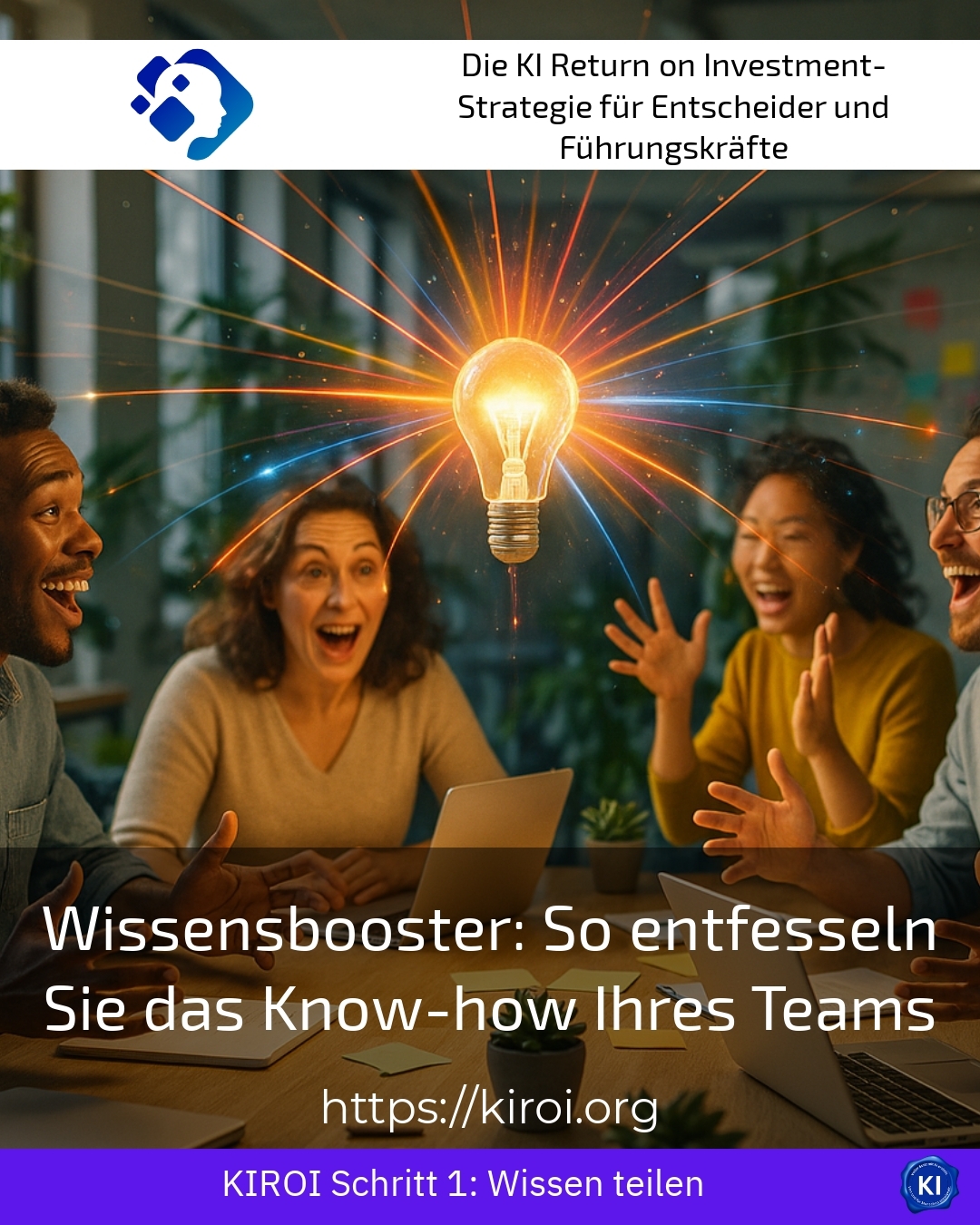
The answer often lies not in a lack of competence; it lies rather in the way organizations handle the knowledge they have at their disposal. A targeted approach Knowledge booster It can bring about true miracles here. It unleashes collective expertise and transforms latent knowledge into tangible results. In a time when information grows exponentially, the strategic use of internal resources becomes the decisive competitive advantage. Companies that understand how to activate the collective expertise of their workforce create sustainable value creation. They build resilient structures and position themselves as attractive employers.
Why untapped potential holds organizations back
Many leaders systematically underestimate the hidden assets in their teams. Studies show that on average, only about 40 percent of the existing expertise is actively used [1]. The rest lies dormant in the minds of employees. It waits to be awakened. This waste not only costs money. It also leads to frustration among those whose expertise remains unappraised.
A medium-sized manufacturing company in the automotive supply industry faced exactly this problem. The development department worked in isolation from the production department. Valuable practical experience did not feed into new product designs. Similarly, a financial services provider whose customer advisors excelled individually. However, they did not share their successful strategies with each other. A hospital was also struggling with this phenomenon. Nursing staff with decades of experience were retiring. Their tacit knowledge disappeared with them irretrievably.
Transruptive coaching helps organizations identify and resolve these specific obstacles. It is not about promising quick solutions. Rather, the method supports teams in developing their own paths. These paths are tailored to the specific corporate culture and are therefore sustainably effective.
Best practice with a AIROI customer
An internationally operating mechanical engineering company noticed increasing friction losses between its locations in Europe and Asia. The German engineers had deep theoretical knowledge. Their Asian colleagues, however, brought pragmatic production expertise. However, both sides hardly communicated with each other. Within the framework of a transruptive coaching project, the company developed a multi-stage mentoring program. Experienced employees from both regions were brought together to share knowledge. They exchanged ideas on a weekly basis in structured formats. This involved more than just technical details. Cultural differences in problem solving were also discussed. After eight months, the participants reported significantly improved collaboration. The development times for new products were noticeably shortened. Particularly valuable was the insight that both sides could learn from each other. No one was merely a giver or merely a receiver. This reciprocity created genuine connection across continents.
The knowledge booster as a strategic instrument for sustainable development
A thoughtful Knowledge booster It is much more than a collection of training measures. It encompasses a holistic system for activating and networking existing competencies. Technological solutions play a role as well as human forms of interaction. The art lies in the intelligent combination of both elements.
For example, an insurance company implemented an internal knowledge platform. However, it initially encountered resistance. Employees perceived the tool as an additional burden. Only the introduction of playful elements and regular face-to-face meetings brought about the breakthrough. A logistics company took a different approach. It established so-called learning circles in warehouse management. Experienced professionals showed newcomers proven techniques. These were documented in video and made accessible to everyone. A software company also benefited from systematic knowledge activation. Development teams conducted regular code reviews. Senior developers not only made corrections. They also explained the underlying principles in detail.
How the Knowledge Booster leads teams to take responsibility for their own learning
An essential feature of successful knowledge strategies is self-organization. Teams that independently decide what knowledge they need learn more effectively. They develop intrinsic motivation and take responsibility for their own development. Transruptive coaching provides valuable impulses here. It helps leaders create spaces for autonomous learning.
An advertising agency experimented with so-called Learning Fridays. On every second Friday, the creative team devoted themselves to self-selected training topics. Some delved into new design software. Others explored the psychological foundations of advertising effectiveness. The results were then shared in short presentations. A pharmaceutical company established similar formats in the research department. Scientists presented current professional articles to each other. They discussed their relevance to ongoing projects. A craft business also successfully used the principle of self-organization. Apprentices independently developed training materials for apprentices. They ultimately knew best which obstacles the career entry entails.
Best practice with a AIROI customer
A medium-sized family business in the food industry was looking for ways to manage the generational change. The founding generation possessed invaluable experience. However, this experience was nowhere documented. The younger generation brought digital expertise with them. However, they could do little with it as long as the core business remained misunderstood. In transruptive coaching, the idea of a knowledge safari was born. Young employees accompanied experienced colleagues through their workdays. They posed targeted questions and recorded their observations in structured protocols. From these records, mixed teams subsequently developed digital manuals. The process lasted several months and required significant effort from all involved. The result, however, exceeded all expectations. Not only did the explicit professional knowledge remain secure. The corporate culture and informal rules of conduct were also incorporated into the documentation. The older generation felt valued and appreciated. The younger generation gained respect for established traditions.
Cultural prerequisites for the knowledge booster
Technical infrastructure alone is not enough for successful knowledge transfer. The organizational culture must promote openness and trust. Employees share their expertise only when they feel secure. They must be able to trust that their contribution is recognized. At the same time, admitting knowledge gaps must not be seen as a weakness.
A consulting firm struggled for a long time with knowledge hoarding. The partners treated their expertise as personal capital. Only the introduction of new remuneration models changed the behavior. Now contributions to knowledge dissemination are also rewarded. A technology company experienced similar challenges in the development department. Engineers feared being replaced by knowledge sharing. Targeted communication from the management level gradually reduced these fears. A hospital also had to overcome cultural barriers. The strict hierarchy between medical staff and nursing staff hampered the professional exchange. Interprofessional case discussions at eye level created new opportunities here.
Psychological safety as the foundation of the knowledge booster
The term psychological safety describes a team climate without fear of embarrassment [2]. In such environments, people dare to ask questions. They admit mistakes and propose unconventional ideas. This atmosphere is indispensable for lively knowledge exchange.
An architecture firm promoted psychological safety through regular brainstorming sessions. At these meetings, team members reported on projects that had not gone as planned. The focus was on learning effects. It was not about assigning blame. An accounting firm implemented anonymous question forums. Junior employees could ask questions there. Experienced colleagues answered without knowing who had asked. An energy provider also relied on building trust. Executives shared their learning stories in town hall meetings. This showed that no one needs to know everything.
Practical formats for activating team knowledge
The variety of possible formats for knowledge activation is vast. Each organization must determine which approaches fit their own culture. Transruptions coaching supports this exploration. It helps to test and adapt different methods.
A retail company introduced so-called lunch-and-learn sessions. During the lunch break, colleagues presented short lectures on their special fields. Participation was voluntary and was very popular. A law firm established case study workshops. Complex legal issues were worked through together. Experienced partners moderated the process and shared their expertise. A travel company also used innovative formats. Employees who returned from destination visits created virtual tours. They made their acquired knowledge accessible to everyone.
Best practice with a AIROI customer
A company in the chemical industry faced the challenge of transferring expert knowledge from research to production. The laboratory scientists spoke a different language than the production workers. Misunderstandings regularly led to quality problems and delays. In transruptive coaching, the company developed the concept of knowledge ambassadors. Selected individuals from both areas received special communication training. They learned to translate complex issues in an understandable way and to appreciate both perspectives. These knowledge ambassadors became bridge builders between the departments. They moderated regular exchange meetings and resolved conflicts early on. Within a year, cross-departmental collaboration improved measurably. The error rate in production significantly decreased. At the same time, the research department received valuable feedback from practice. New products could be developed more quickly to market maturity. The company now plans to expand the ambassador concept to other interfaces.
My AIROI Analysis
The intensive focus on the topic of knowledge activation in teams reveals a central insight. Organizations rarely fail due to a lack of competence; rather, they fail due to the inability to mobilize and network existing knowledge. Knowledge booster It is not a single tool; it is a holistic approach that combines technical, cultural, and process dimensions.
What stands out most to me is the importance of psychological safety. Without an atmosphere of trust, even the best knowledge management systems are ineffective. People share their knowledge only generously when they feel valued and protected. Leaders bear a special responsibility in this regard. They must take the lead and show vulnerability themselves.
The practical examples also show that there is no one-size-fits-all solution. Each organization must find its own path. Transruptional coaching provides valuable guidance in this regard. It provides impulses without prescribing ready-made recipes. It supports teams in developing and implementing their own solutions.
Finally, the factor of time must not be underestimated. Sustainable changes in the knowledge culture require patience and perseverance. Rapid successes are rarely lasting. However, organizations that think long-term and continuously invest in their knowledge infrastructure are rewarded. They build resilient structures and secure their future viability in a rapidly changing business world.
Further links from the text above:
[1] McKinsey – The Social Economy: Unlocking Value and Productivity Through Social Technologies
[2] Harvard Business Review – High-Performing Teams Need Psychological Safety
For more information and if you have any questions, please contact Contact us or read more blog posts on the topic Artificial intelligence here.










 Deutsch
 English (UK)