
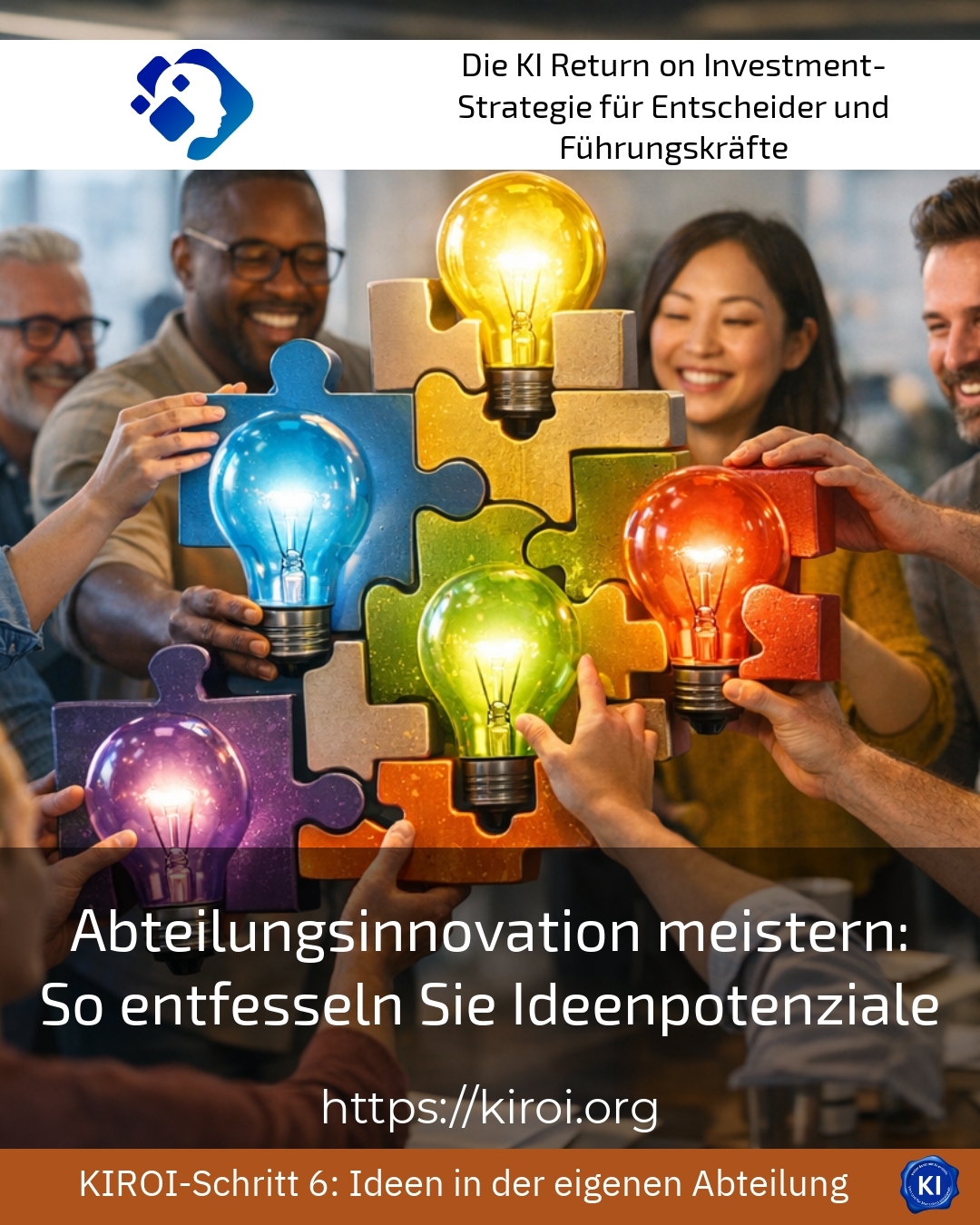
How do companies systematically unleash the hidden creative potential within their teams and thereby achieve sustainable competitive advantages? This question concerns executives and decision-makers across industries, because the answer to it often determines the difference between stagnating business and dynamic growth. Mastering departmental innovation: This is how you unleash the potential of ideas This poses a central challenge that goes far beyond traditional brainstorming sessions. In a time when disruptive changes can obliterate entire business models overnight, organizations need structured approaches to ensure that creativity is not left to chance. Time and again, it is revealed that the most valuable ideas often come from unexpected sources, and employees at all levels develop surprising solutions when given the appropriate framework.
The hidden sources of creative energy in organisations
Many companies dramatically underestimate the creative potential of their own employees. They invest large sums in external consultants and innovation agencies. At the same time, internal ideators often remain unheard. For example, a medium-sized manufacturing company realized only after years that a service technician had already developed solutions for recurring customer problems. These ideas lay dormant in his notebook without anyone asking about them. Another example comes from an automotive supplier whose production workers independently tested improvements to manufacturing processes. No one had asked them about them afterwards, but they acted out of intrinsic motivation. A medium-sized packaging manufacturer also benefited from the untapped knowledge of its logistics department. There, employees had long since recognized how supply chains could be optimized [1].
The real problem rarely lies in a lack of ideas. Rather, there are a lack of structured channels for their collection and evaluation. Companies that systematically establish feedback loops often report a veritable flood of ideas. However, these must be professionally moderated. Otherwise, overwork instead of progress threatens to result. The art lies in creating spaces for freedom while providing guidance at the same time. Transruptive coaching can provide valuable impulses as a support for projects related to cultural change processes.
Master department innovation through systematic idea promotion
Systematic promotion of innovation culture requires more than isolated workshops. It requires a holistic approach that addresses structures, processes, and mindsets alike. For example, an electronics manufacturer implemented weekly experimentation slots for all departments. During this time, employees were allowed to work on their own projects. The results significantly exceeded all expectations. A pharmaceutical supplier established an interdisciplinary innovation circle that was staffed across all hierarchical levels. This created entirely new perspectives on familiar problems. A textile company also relied on regular innovation days where production and sales worked together to improve [2].
Best practice with a AIROI customer
A medium-sized company in the manufacturing sector faced the challenge of significantly increasing its rate of innovation and involving all departments in the process. In the context of intensive coaching support by Transruptions, we jointly developed a multi-stage program that initially identified existing barriers and then specifically addressed them. It became apparent that many employees had creative ideas but had never expressed them for various reasons. Some feared negative reactions from their superiors, while others simply did not know whom to turn to. We initially established anonymous idea channels to reduce barriers and make initial successes visible. After about three months, confidence grew noticeably, and more and more employees came forward openly. The leaders learned to respond constructively to suggestions and also seriously consider unconventional approaches. Within a year, the number of submitted improvement proposals tripled. Several of them led to measurable cost savings and process optimizations that sustainably strengthened the company and significantly increased employee satisfaction.
Cultural prerequisites for sustainable creative development
An innovation-friendly corporate culture does not emerge overnight. It requires continuous work on several key factors simultaneously. Leaders must communicate and demonstrate that mistakes are opportunities for learning. For example, a tool manufacturer introduced monthly “fuck-up” sessions. There, employees shared failed projects and the lessons learned from them. The atmosphere changed noticeably as a result. A food producer established innovation awards for all levels of the hierarchy. This also recognized ideas from the production side and not just suggestions from management. A chemical company adopted job rotation between departments. This created unexpected cross-connections and fresh perspectives [3].
Psychological safety forms the foundation of any sustainable innovation culture. Employees must feel that their contributions are valued. They need the certainty that mistakes will not be punished. Only then will they dare to bring unconventional proposals forward. Clients often report that even small changes in the communication behavior of the leaders have a big impact. A careful listening and genuine interest in ideas can work wonders.
Mastering the creation of structures for systematic departmental innovation
In addition to the cultural dimension, organizations also need structural frameworks for innovation. A metal processing company set up a physical innovation space. Regular cross-departmental creative sessions took place there. The spatial separation from daily operations noticeably fostered free thinking. A plastic manufacturer implemented a digital idea management system. Each employee could submit and evaluate suggestions there. Transparency significantly increased engagement. A building materials manufacturer also benefited from clearly defined innovation processes. From the initial idea to implementation, there were comprehensible steps and responsibilities.
The balance between structure and freedom proves crucial. Too much formalization stifles creativity at its roots. Too little structure, on the other hand, leads to good ideas being lost. Successful companies find a middle ground that provides guidance while allowing for room for maneuver. Transruptive coaching supports the development of customized solutions to this challenge.
Leaders as Facilitators of Creative Processes
The role of leaders is fundamentally changing. They are becoming facilitators rather than decision-makers. A plant builder specifically trained its middle management level in coaching methods. This permanently changed the conversation culture. A glass manufacturer established a mentoring program in which experienced innovators accompanied younger colleagues. The knowledge transfer was thereby significantly accelerated. Also, a furniture manufacturer invested in leadership development with a clear focus on fostering innovation. The results were evident in a significantly higher employee participation in improvement projects [4].
Leaders need to learn to relinquish control and to give trust. This is initially difficult for many. They are accustomed to providing answers rather than asking questions. The transition to a questioning, supportive leadership style requires practice and reflection. External facilitators can provide valuable insights and moderate development processes.
Best practice with a AIROI customer
A traditional family business in the metal industry wanted to fundamentally transform its leadership culture and foster more innovative approaches. The management team realized that the previous top-down culture was more likely to inhibit creativity than to encourage it. Together, we developed a comprehensive development program for all the company’s leadership. In several workshops, we worked on concrete behavioral changes and new communication patterns. The participants practiced asking open questions and actively listening without immediately judging. We established regular reflection sessions where leaders exchanged experiences and learned from each other. The concept of experimental budgets, in which each department received its own innovation projects, was particularly effective. This created a new dynamic because employees suddenly had real opportunities to innovate. After about six months, the teams reported a noticeably more open atmosphere and greater self-initiative. The number of internally developed process improvements increased significantly, and the employee survey showed improved values in all relevant categories.
Recognising and constructively overcoming obstacles
Numerous obstacles lie in the path of an organization that is conducive to innovation. A paper processing company initially encountered internal resistance from long-time employees. They perceived changes as criticism of their previous work. Only intensive communication and integration turned the tide. An electric motor manufacturer struggled with silo thinking between departments. The departments worked more against each other than together. Targeted cross-team projects gradually resolved these encrustations. Also, a printing company experienced initial skepticism towards new innovation formats. The employees considered them to be an additional workload without any real benefit [5].
Dealing with resistance requires patience and empathy. Behind rejection often lie fears or unmet needs. These must be taken seriously and addressed. At the same time, resistance must not lead to changes being completely avoided. The art lies in involving those who have concerns without completely slowing down the pace.
Master the departmental innovation through networking and exchange
Innovation rarely thrives in isolation. It benefits from networking and the exchange of different perspectives. A foundry company initiated regular innovation breakfasts, to which external partners were also invited. The fresh impulses from the outside significantly enriched internal discussions. A packaging machinery manufacturer cooperated with universities and start-ups. These partnerships brought new knowledge and unconventional thinking to the company. A textile machinery manufacturer also benefited from industry networks where best practices were exchanged.
Opening up to the outside world is difficult for some companies. They fear the outflow of know-how or the loss of competitive advantages. But experience shows that the benefits from external impulses usually outweigh the risks significantly. What is crucial is a conscious approach to sensitive information while remaining open to new ideas.
My AIROI Analysis
The systematic promotion of innovation potential within departments and teams represents one of the most important leadership tasks of our time. My analysis of numerous mentoring projects shows that success depends on several factors. First, there must be an honest commitment from the company leadership that goes beyond mere declarations. The willingness to provide resources and create spaces for freedom must be communicated authentically. At the same time, cultural change requires patience and a long-term perspective, because established patterns do not disappear overnight.
Based on my experience, I recommend an iterative approach with quick initial successes. Small experiments show what works and build trust. In parallel, structural foundations should be laid to ensure sustainability. The combination of bottom-up initiatives and top-down support proves particularly effective. Leaders need to redefine their role and become facilitators rather than controllers.
Transruptions coaching can be valuable in supporting this process as external support. It provides a protected framework for reflection and development. At the same time, it brings in experiences from other contexts without imposing them. The responsibility for change remains always with the company itself. Only in this way does real ownership and sustainable cultural change emerge.
Further links from the text above:
[1] McKinsey: The Eight Essentials of Innovation
[2] Harvard Business Review: Insights on Innovation
[3] Forbes: Innovation and Technology
[4] Gartner: Innovation Research and Insights
[5] BCG: Innovation Strategy and Delivery
For more information and if you have any questions, please contact Contact us or read more blog posts on the topic Artificial intelligence here.









 Deutsch
 English (UK)