
How is it possible that teams that have previously hardly worked with digital tools suddenly manage to develop the most innovative solutions?
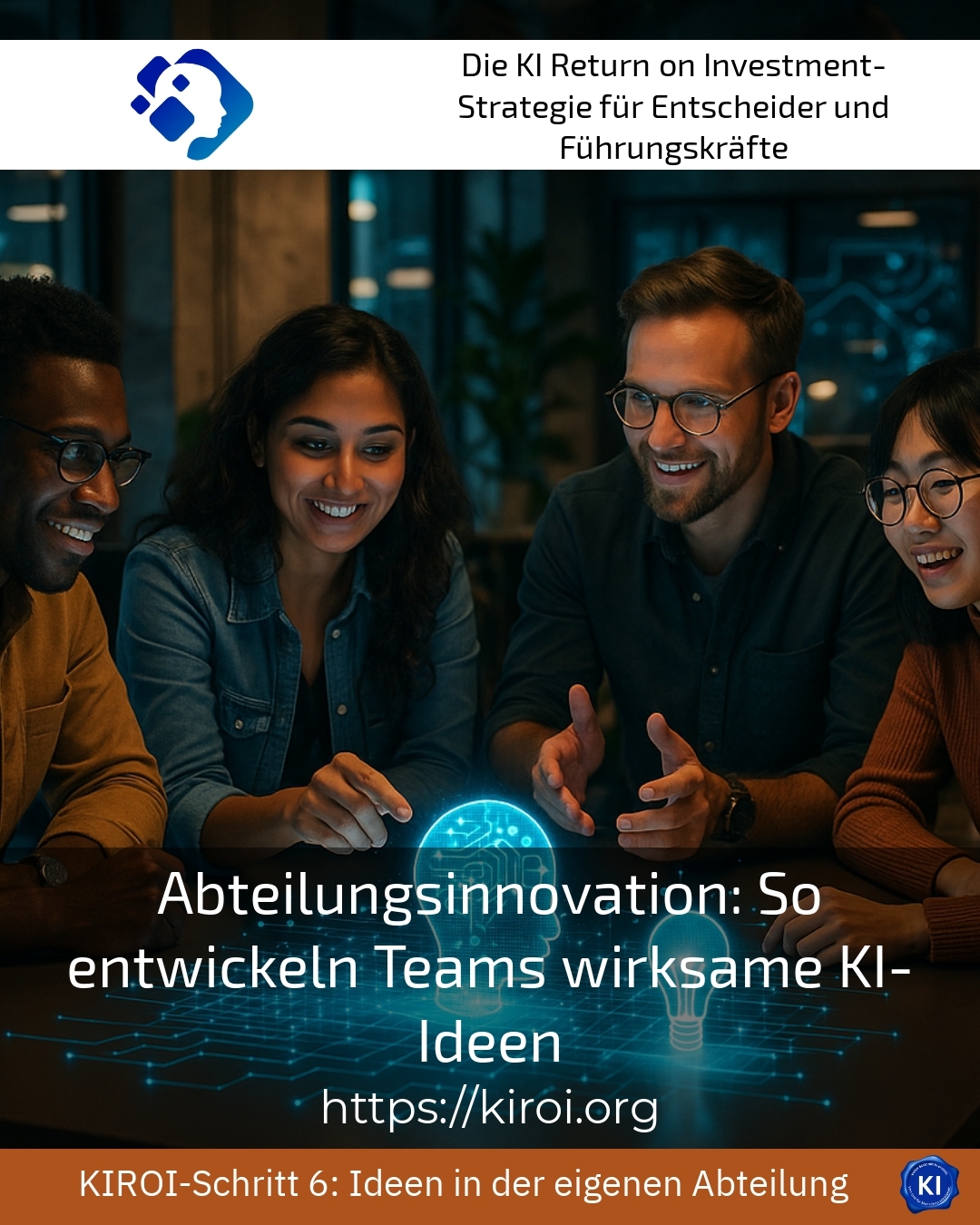
This question currently concerns numerous executives in a wide variety of organizations, because the answer to it hides enormous potential for sustainable competitive advantages. Departmental Innovation It is increasingly coming to the focus of strategic considerations because it marks the crucial difference between stagnating day-to-day business and real progress. Many executives report that their employees initially react skeptically to new technological possibilities. However, this initial reluctance often turns into enthusiasm as early successes become visible. Transruptive coaching helps teams approach such transformation processes in a structured manner. This results in effective concepts that actually work in everyday work life and enable measurable improvements.
Why department innovation is the key to sustainable success
The times when innovations originated exclusively in specialized research departments are long gone. Today it is increasingly evident that precisely the departments with direct customer contact or operational responsibility can provide particularly valuable impulses. For example, a production team immediately recognizes which process steps can be optimized through intelligent automation. At the same time, service employees know exactly which customer inquiries can be repeated and answered in a standardized manner.
In the area of logistics, companies often report significant efficiency gains through intra-departmental idea development. Warehouse employees, for example, developed proposals for intelligent inventory forecasting because they were faced with bottlenecks and overstocking issues on a daily basis. Financial departments, which identify repetitive booking processes and highlight automation potential, are also making similar experiences. Human resources departments are also increasingly discovering application possibilities, such as in the pre-selection of application documents or the answering of standardized employee inquiries.
Transruptions coaching helps systematically unlock such potential and translate it into actionable project plans. The coaching focuses on connecting existing expertise with technological capabilities. This leads to solutions that do not come from outside but grow from within the team itself.
Best practice with a AIROI customer
A medium-sized business faced the challenge of making its customer support more efficient without losing the personal touch that had distinguished the company for decades. The management decided to actively involve the service team in the ideation process, rather than having ready-made solutions implemented by external consultants. During several workshops, the employees initially identified the most frequent requests and categorized them according to complexity and processing time. It was revealed that around sixty percent of all incoming requests concerned standardized information, such as delivery times, product availability, or return conditions. The team then jointly developed a concept for an intelligent assistant that pre-qualifies these requests and, if necessary, forwards them to human colleagues. The practical knowledge of the service staff proved particularly valuable, as they knew exactly which formulations customers typically used and which inquiries occurred regularly. The implementation took place in stages, with the team providing continuous feedback and suggesting adjustments. After six months, the average processing time had been reduced by forty percent, while customer satisfaction even slightly increased because complex requests now received more time and attention.
Establishing methods for systematic department innovation
The journey from a vague idea to a workable concept requires structured approaches that promote creativity while ensuring feasibility. Many teams fail not because of a lack of ideas, but because they lack the methods to evaluate and prioritize their proposals. Therefore, it is beneficial to first define a clear framework within which ideas can be developed and evaluated.
In the insurance industry, for example, claims processing teams use structured creativity methods to identify improvement potential in claims processing. They first analyze their daily workflows and identify those steps that appear particularly time-consuming or prone to errors. Then they evaluate which of these tasks could benefit from intelligent support.
Similarly, purchasing departments approach this task when exploring opportunities for automating supplier comparisons or bid evaluation. The employees bring their expertise in quality criteria and negotiation strategies, while technical experts highlight the implementation possibilities. This combination regularly leads to solutions that neither pure technicians nor pure experts could have developed alone.
Marketing teams, in turn, experiment with intelligent tools for text generation or image processing and document their experiences for other departments. They test various use cases, from creating social media posts to personalizing customer communication, and share their findings in cross-departmental formats.
Creativity techniques for effective departmental innovation
Certain creativity techniques have proven particularly effective in generating and developing technological innovation ideas. The so-called reverse method invites teams to first consider how to make a process maximally inefficient, then to formulate the opposite ideas. This playful approach breaks down mental blocks and often leads to surprising insights.
In quality assurance, teams use this method to identify sources of error and design intelligent testing systems. For example, they ask how to ensure that every error is overlooked and develop ideas for automated control mechanisms. Manufacturing departments use similar techniques to design maintenance forecasts or production optimizations.
Another proven method is analogy building, where teams transfer successful solutions from other industries to their own context. For example, customer support teams can be inspired by chatbot implementations in retail and adapt the basic principles to their specific requirements. Research departments, in turn, transfer pattern recognition approaches from medical technology to industrial applications.
Best practice with a AIROI customer
The controlling department of a manufacturing company sought ways to speed up its monthly reporting processes while increasing the depth of analysis. Traditionally, controllers spent most of their time compiling and preparing data, leaving little capacity for actual analysis and interpretation. In a structured innovation workshop, accompanied by transruptive coaching, the team initially developed a comprehensive inventory of all recurring activities. The employees identified several areas with high potential for automation, including consolidating data from various front-end systems, creating standardized deviation analyses, and generating commentary texts for routine deviations. Particularly innovative was the proposal to train an intelligent system that analyzed historical comments and submitted formulation suggestions based on similar patterns of deviations. The controllers maintained full control and decision-making authority throughout, but gained significant time for strategic analyses and recommendations for action. After implementation, the team reported a time savings of about thirty percent while simultaneously increasing the quality of management reports, because more capacity was now available for in-depth content development.
Overcoming obstacles and constructively using resistance
Every change process encounters resistance, and the introduction of intelligent technologies is no exception. In practice, employees often express concerns regarding their future role or the quality of automated results. These concerns deserve serious attention because they often point to important aspects that should be considered during design.
In the legal field, for example, lawyers often approach new technologies with professional skepticism, which is quite justified given the high demands on precision and confidentiality. Successful teams use this critical attitude constructively by defining strict quality criteria and establishing testing mechanisms. This results in solutions that meet even the highest professional standards.
Healthcare institutions are experiencing similar experiences, where data protection and ethical considerations play a central role. Nursing teams are developing ideas for administrative relief, while strictly adhering to the preservation of patient dignity and trust relationships. Technical documentation teams in industry, in turn, emphasize the need for traceability and auditability.
Transruptive coaching provides valuable impetus in such situations by helping to structure concerns and translate them into constructive demands. The coaching focuses on understanding resistance not as a means to combat it but as a quality assurance mechanism to be used productively. Clients often report that the initial critics later become the most dedicated supporters because their objections were taken seriously.
Communication as a success factor for departmental innovation
The way innovation projects are communicated influences their success significantly. Transparency about goals, procedures, and expected outcomes creates trust and encourages the active participation of all team members. At the same time, leaders should set realistic expectations and not give the impression that technology can solve all problems [1].
In the banking industry, regular information formats have proven effective, where teams share their progress and insights. Credit departments, for example, report on their experiences with intelligent scoring tools, while compliance teams provide insights into automated testing routines. This cross-departmental communication fosters knowledge transfer and inspires other departments.
Telecommunications companies leverage internal platforms to collect and share success stories and learnings from various departments. Network technology teams document their experiences with predictive maintenance, while sales departments report on personalized customer interactions. This knowledge base is continuously expanded and serves as a source of inspiration for new initiatives.
Energy providers establish innovation ambassadors in various departments who act as multipliers and contact points. These employees receive special training and regularly network with each other to exchange experiences and learn from each other [2].
From the idea to the pilot project: shaping the implementation
The transition from the conceptual phase to practical testing poses special challenges for many teams. It is necessary to define an appropriate scope for initial tests, establish success criteria, and secure resources for implementation. An iterative approach, which enables rapid learning cycles and allows for adjustments, proves to be effective in this context.
Pharmaceutical companies often choose pilot projects that are well-defined sub-processes where errors have no serious consequences. Lab teams first test intelligent analysis tools using historical data before integrating them into ongoing processes. Regulatory departments test automated documentation tools on internal documents before using them for regulatory submissions.
In retail, pilot projects often start in individual stores or product categories to create manageable test environments. Merchandise teams initially implement intelligent ordering suggestions for selected assortments and collect experience over several weeks. Visual merchandising departments test automated floor plans in pilot markets and compare the results with traditionally designed stores.
Transruptions coaching accompanies projects around piloting and helps define suitable test scenarios. The advice supports creating realistic timelines and defining milestones against which progress can be evaluated. Clients often report that this structured guidance is crucial to project success [3].
Best practice with a AIROI customer
A service company in the facility management sector wanted to speed up its quote generation process while improving the quality of its calculations. Until now, each individual customer quote required extensive manual research into property sizes, cleaning intervals, staffing requirements, and regional wage costs. The sales department developed a concept for an intelligent support system together with the calculation department that was to be trained on historical quote data. In the pilot phase, the team focused on a specific service category, namely the maintenance cleaning of office buildings, in order to keep the complexity manageable. The employees initially entered historical quotes into a structured database and supplemented them with information about the actual project progress. After a few weeks, the trained system was able to generate initial proposals that served as a starting point for the individual fine-tuning. The planners retained full decision-making authority and adapted the proposals to customer-specific requirements. The pilot phase showed a time saving of approximately fifty percent in the preparation of offers, while the success rate in placing orders even slightly increased because the calculations were now more consistent and more easily understandable.
Sustainability and continuous development are guaranteed
A successful pilot project does not mark the end, but the beginning of continuous development. Teams must establish structures that preserve what has been learned and enable further improvements. This requires clear responsibilities, regular reviews, and a willingness to make adjustments.
Automotive suppliers establish innovation rounds where departments regularly share their experiences with intelligent tools and discuss new ideas. Design teams report on automated design suggestions, while quality departments provide insights into image-based testing systems. These institutionalized exchange opportunities promote organizational learning.
Media companies create dedicated roles to coordinate innovation activities across departmental boundaries. Editorial teams, production, and marketing work together on new formats and share their insights in monthly meetings. This structured networking prevents silo thinking and promotes holistic solutions.
Educational institutions systematically document their innovation experiences and make them accessible to newcomers. Teachers who use intelligent tools for lesson preparation or feedback generation create guides for interested colleagues. Administrative teams share their findings about automated processes in internal knowledge databases.
My AIROI Analysis
The systematic development of technological innovation ideas within existing departmental structures proves to be one of the most effective levers for sustainable competitive advantages in a rapidly changing business world. The examples and methods presented in this article illustrate that success depends less on the available technology than on the ability to connect existing expertise with new opportunities. Teams that thoroughly understand their work processes can precisely identify where intelligent support provides the greatest benefit and where human expertise remains indispensable.
What seems particularly remarkable to me is the observation that initial resistance often leads to better solutions when it is constructively addressed. Employees who ask critical questions and point out potential problems make a valuable contribution to quality assurance. Leaders should not view these voices as a barrier, but as an important resource for developing robust concepts. The described best practices vividly demonstrate how skepticism can turn into engagement when concerns are taken seriously.
The role of structured support through coaching and counseling should not be underestimated. External impulses help to break through established patterns of thinking and open up the perspective on unconventional solutions. At the same time, a methodological approach ensures that innovative energy is not wasted but is transformed into concrete results. The combination of internal expertise and external methodology has proven to be particularly fruitful in achieving lasting change.
Further links from the text above:
[1] Harvard Business Review – Artificial Intelligence Insights
[2] McKinsey – AI Transformation Insights
[3] Gartner – AI Research and Analysis
For more information and if you have any questions, please contact Contact us or read more blog posts on the topic Artificial intelligence here.











 Deutsch
 English (UK)