
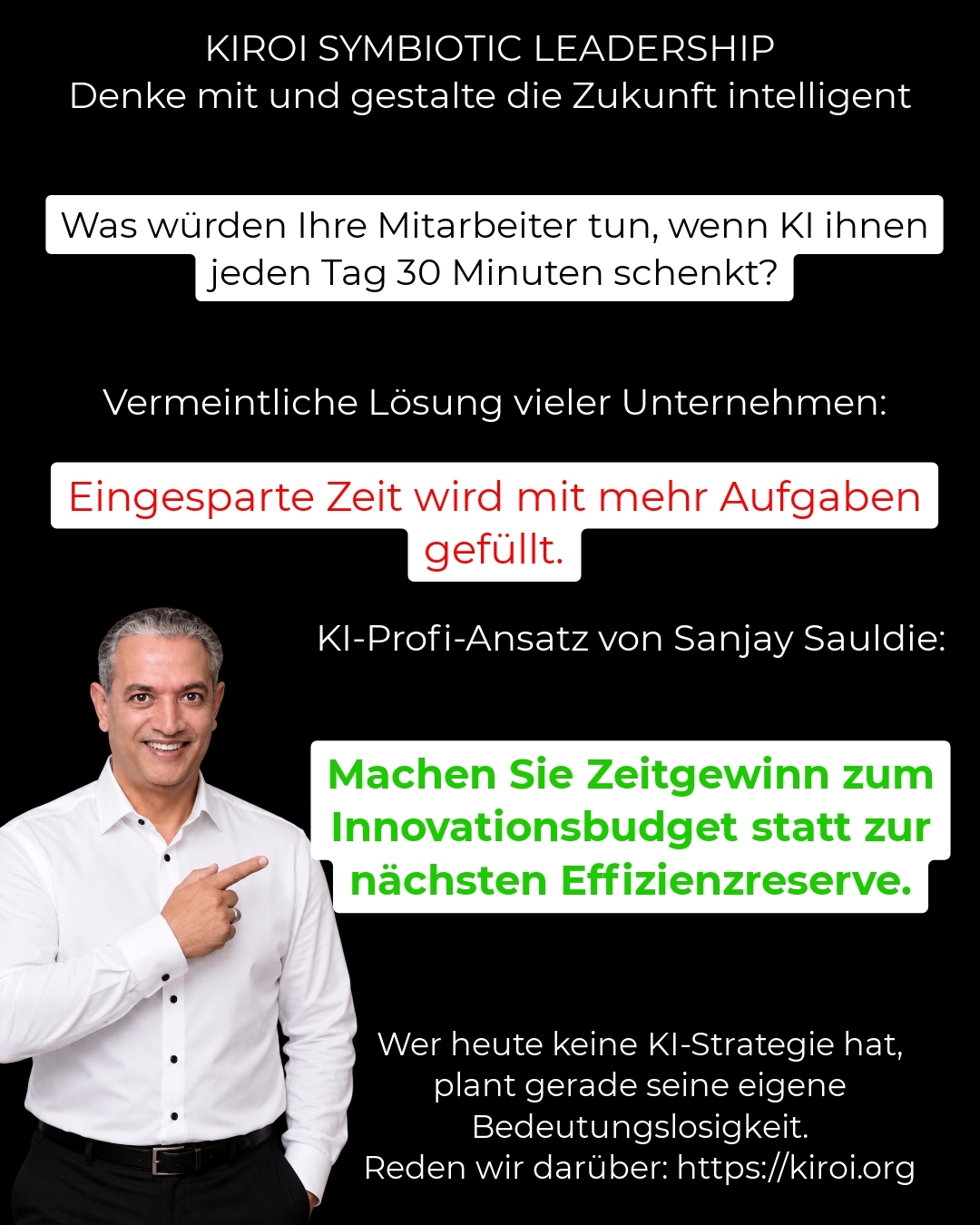
What actually happens with the 30 minutes that your employees could gain daily through intelligent automation?
Countless executives in various organizations are currently asking themselves this question, and the answer to it decisively determines the future viability of entire companies. While technological solutions are now capable of significantly accelerating repetitive tasks and taking on routine tasks almost entirely, the strategic implications of this development often remain unaddressed. The role of AI in corporate management Unfortunately, in many organizations, it still remains limited to pure efficiency enhancement, even though the true potential of this technology goes far beyond that. The time gained in reality represents a treasure whose value most companies simply underestimate or even actively destroy by applying old mindsets to new opportunities [1].
The paradox of gained time in modern organizations
A fascinating phenomenon is currently evident in countless businesses of various sizes. Employees report significant time savings through automated processes. At the same time, however, they do not feel relieved but rather are even more under pressure. This apparent contradiction can be explained by examining traditional management approaches. The management level automatically interprets any increase in efficiency as a reserve capacity for additional operational tasks. A clerk who can complete his correspondence more quickly thanks to intelligent templates is promptly assigned additional administrative duties. A team leader who is able to complete an additional project earlier thanks to automated reporting is now supposed to take on an additional project as well.
This mindset stems from an industrial paradigm that measures productivity solely in quantitative categories. More output per unit of time is considered desirable, regardless of what kind of output this actually is. However, in knowledge-based organizations, this pattern leads to counterproductive results. Employees are not more productive in the true sense of the word, but merely more occupied. However, creative thinking processes, strategic reflection, and innovative impulses require precisely those unallocated time windows that are systematically eliminated by additional tasks [2].
Concrete effects in various work areas
Consider, for example, an internal communication department. In the past, employees spent considerable time manually creating presentations and documents. Today, intelligent systems take on much of this formatting work. Instead of using this time for conceptual considerations, colleagues are now encouraged to simply produce more documents. The quality of the content is in no way improved as a result. Similarly, in areas such as data analysis, where automated analyses could theoretically provide room for profound interpretation, in practice only more reports are requested, which hardly anyone reads thoroughly or even uses as a guide for action.
The role of AI in corporate management as a strategic resource
A fundamental realignment requires first a changed understanding of what technology-based time savings actually means. It is not an efficiency reserve in the traditional sense. Rather, it is an innovation budget in the form of human attention and creativity. This perspective fundamentally changes all subsequent decisions. Leaders who have internalized this connection no longer ask about which additional tasks their teams can now take on. Instead, they explore together with their employees what improvements, innovations, or experiments have so far been left out due to a lack of time.
The AIROI-approach offers a structured framework that helps organizations consciously convert gained time into innovation capacity. This methodological approach prevents valuable resources from disappearing in a vicious cycle of ever-increasing operational activities. The guidance provided by experienced coaches helps break through established patterns and establish new ways of allocating resources. This is not about theoretical concepts but about practical implementation in day-to-day operations [3].
Best practice with a AIROI customer
A medium-sized organization with several hundred employees faced an interesting challenge when the implementation of automated workflows freed an average of 35 minutes per person per day. The management level’s initial reaction followed the familiar pattern and involved using this time for additional administrative tasks, which met with significant resistance from the employees. As part of the AIROI coaching process, the company developed a completely different approach and introduced so-called innovation periods, in which employees could work on improvement ideas independently. The results surprised even the most optimistic people, because within six months more than forty concrete improvement proposals had emerged, fifteen of which were immediately implemented. These proposals ranged from optimized internal processes to new service concepts and creative solutions for long-standing problems. Employee satisfaction increased measurably because people felt they could really make a difference, instead of simply doing more of the same. The organization reports a noticeably improved atmosphere of collaboration and increased identification with the company’s goals.
Practical implementation examples for various functional areas
In the area of personnel development, time windows gained can be used, for example, for in-depth employee discussions. Instead of handling these conversations at ten-minute intervals, more detailed formats enable genuine relationship building and better development planning. Similarly, project teams benefit when they receive regular time for retrospectives and joint learning. The quality of collaboration improves sustainably once reflection is no longer seen as a luxury. Positive effects are also evident in customer service when employees have time to truly understand the causes of problems rather than processing requests as quickly as possible.
The transformative power of time savings through AI in corporate management
Organizations that dare to view the time gained as an innovation budget are experiencing a remarkable transformation of their entire work culture. Employees no longer perceive technology as a threat but as an opportunity for new freedoms. This changed perception has far-reaching consequences for the acceptance of further digitalization measures. People who have had positive experiences with technology-based relief also welcome future changes with greater openness. A positive cycle is created that promotes innovation and a willingness to change equally.
Transruptive coaching accompanies organizations precisely at this critical point of realignment. It is about fundamentally questioning existing assumptions about productivity and efficiency. Many leaders report that it was only through this guidance that they became aware of how much they themselves were trapped in old mindsets. The realization that more tasks do not automatically mean more value creation often feels liberating and opens up entirely new strategic options [4].
Structural prerequisites for successful transformation
The transition to an innovation-oriented use of time gains requires clear organizational frameworks. First, a common understanding must be created at the leadership level that time gained is not automatically available for operational tasks. This agreement should be documented in writing and communicated regularly. Subsequently, employees need concrete guidance on how they can use the freed up time in a meaningful way. Some require structured formats such as innovation workshops or learning circles. Others flourish when they are allowed to experiment independently. Flexible approaches have proven particularly effective in practice because they cater to different personality types.
Another important factor relates to measuring and recognizing results. When innovation time is introduced, the resulting ideas and improvements should be made visible. This increases motivation and provides arguments for continuing the approach. Regular presentations, internal communication about successful projects, and explicit appreciation from management are essential for success.
Best practice with a AIROI customer
A service company with an international focus had initially made the classic mistake of filling the time gained through automation with additional operational tasks. The result was a significantly increased turnover among the most qualified employees, who increasingly perceived themselves as replaceable labor rather than as valued professionals. In the context of an intensive consultation process, a fundamentally new approach was developed that divided the gained time into three different categories. One third was available for personal development, with the employees themselves being able to choose the topics and formats. Another third was reserved for cross-departmental innovation projects, in which interdisciplinary teams worked on self-selected improvement initiatives. The final third remained flexible for unforeseen requirements or particularly labor-intensive phases. This structure proved to be extremely effective and led to a noticeable improvement in employer attractiveness. In conversations, qualified applicants explicitly cited this work schedule model as an important factor in their decision. Fluctuations decreased by more than thirty percent within a year, while the company’s innovation rate simultaneously increased significantly.
Obstacles and how to overcome them
The transition from an efficiency-driven to an innovation-oriented use of time gains is by no means trivial. Various obstacles can complicate the process or even lead to failure. One of the most common problems lies at the middle management level, where performance is often measured primarily in operational metrics. These managers often find themselves in conflict between short-term performance expectations and long-term innovation goals. Without appropriate support and adapted targets, they often revert to old patterns.
Another obstacle concerns the employees themselves. After years or decades in a system that equated employment with performance, many people find it difficult to actually use the time freed up for creative or strategic activities. They feel uncomfortable when they do not constantly appear busy. Reducing this discomfort requires time, patience, and continuous encouragement from supervisors. Here too, external support from experienced coaches can provide valuable impulses and accelerate the change process [5].
Long-term perspectives and strategic implications for AI in corporate management
Organizations that start today to treat earned time as an innovation budget will gain a significant competitive advantage for the years to come. The ability to continuously improve and adapt is becoming increasingly important in a world of increasing speed of change. Companies that primarily use their human resources for operational routine tasks will not be able to compete in the long term. The strategic use of technologically acquired time windows will become a crucial differentiating feature.
At the same time, employee expectations are also changing. Skilled professionals are increasingly looking for employers that offer meaningful activities and development opportunities. The prospect of having more time for creative and strategic work thanks to technological support is becoming attractive. Companies that instead immediately compensate any efficiency gains with new tasks will find it harder to attract and retain talent.
My AIROI Analysis
Observations from numerous accompanying projects reveal a clear pattern. Organizations are at a crossroads when technological solutions begin to generate tangible time savings. The intuitive reflex to immediately fill this time with additional operational tasks proves to be strategically shortsighted and squanders enormous potential. The AIROI-methodology offers an alternative path that consciously converts the time gained into innovation capacity, thereby creating sustainable competitive advantages.
What is particularly noteworthy is the observation that organizations that take this path often benefit from a kind of positive domino effect. Improved job satisfaction leads to lower turnover. Lower turnover reduces onboarding costs and preserves valuable knowledge gained through experience. Innovation projects generate concrete improvements that in turn enable new efficiency gains. A virtuous cycle is created that reinforces itself and continuously advances the organization forward.
Experience shows that the biggest challenge lies not in the technical implementation but in cultural change. Leaders must learn to define and measure success differently. Employees must develop trust that more flexible work arrangements are indeed desirable. These changes do not happen overnight; they require continuous attention and guidance. However, the investment in these changes is often worth it, as the experiences from successful transformation projects impressively demonstrate. The question is not whether organizations should take this path, but how quickly they begin to implement it.
Further links from the text above:
[1] Harvard Business Review – Artificial Intelligence
[2] McKinsey – The State of AI
[3] AIROI-Strategy – Risawave
[4] Gartner – Artificial Intelligence Insights
[5] MIT Sloan – Artificial Intelligence Research
Are you a leader and would you like to learn how you can genuinely introduce AI into your company in a valuable and sustainable way, away from the hype? Take part Contact us or read more blog posts on the topic Artificial intelligence here.







 Deutsch
 English (UK)