
Have you ever wondered why some leaders seem to effortlessly pass complex insights on to their teams, while others, despite enormous expertise, fail to embed their expertise in a lasting way?
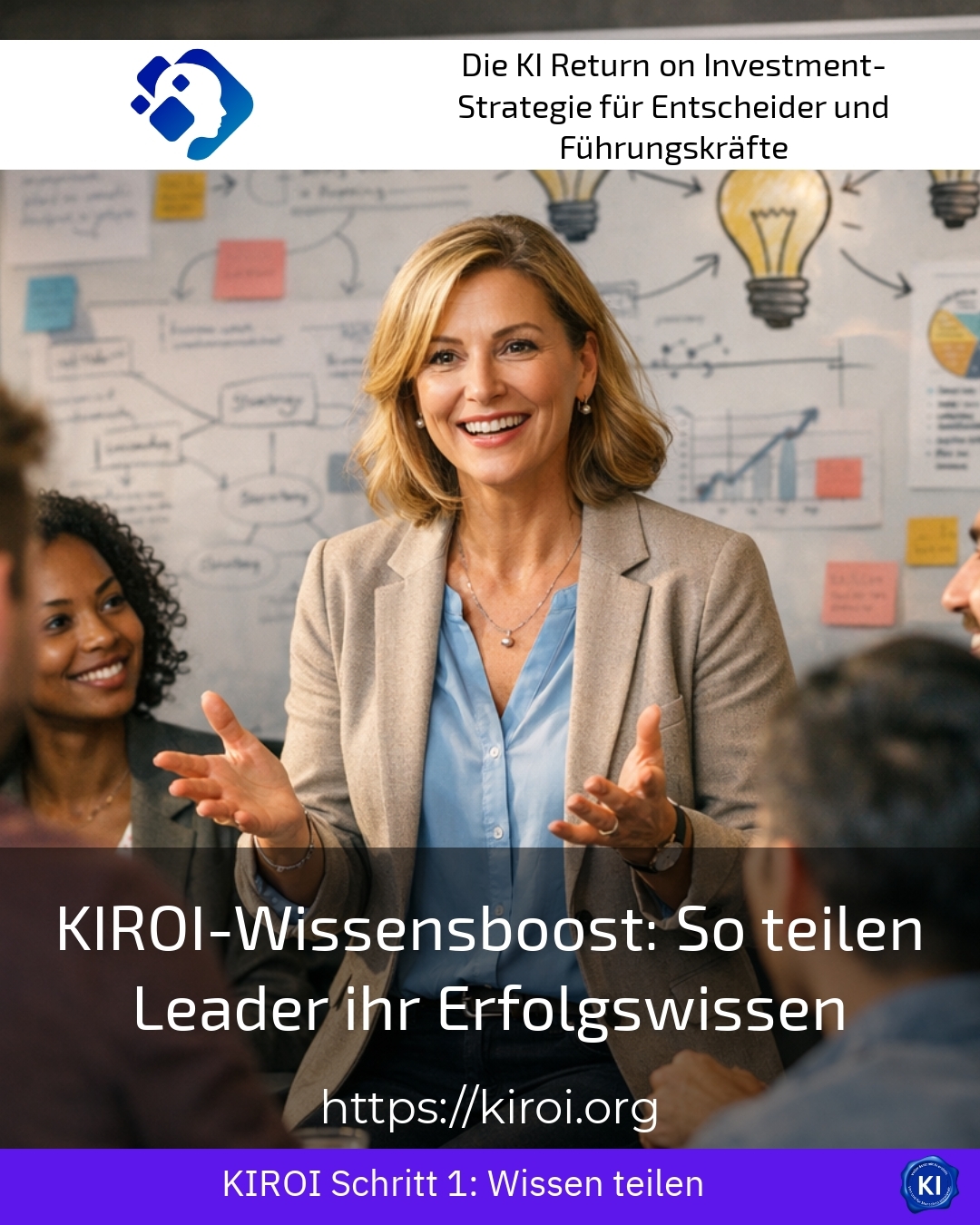
The AIROI Knowledge Boost: How Leaders Share Their Success Knowledge It revolutionizes the way companies multiply and strategically utilize internal know-how. In a world where knowledge has become the most valuable resource, the ability to systematically disseminate it determines the success or stagnation of entire organizations. Leaders face a paradoxical challenge: They possess years of accumulated experience, yet rarely find the appropriate structures to effectively share it. This is where a well-thought-out coaching concept comes into play: it provides the necessary impetus and guidance during transformation projects.
The importance of structured knowledge dissemination in modern leadership
Successful leaders are not only distinguished by their professional competence, but above all by their ability to empower and develop other people. This insight may sound self-evident at first, but its practical implementation often proves significantly more complex than many decision-makers initially assume. AIROI Knowledge Boost: How Leaders Share Their Success Knowledge offers a systematic framework that precisely fills this gap and helps leadership figures transform their implicit knowledge into explicit, transferable formats.
Clients often report that despite years of experience, they have difficulty in organizing their findings in a way that employees can immediately apply them. They struggle with the challenge of simplifying complex relationships without losing essential nuances. Moreover, they often lack the time to develop structured knowledge formats that go beyond sporadic meetings. A professional support program can provide valuable insights and open up new perspectives in this regard.
Best practice with a AIROI customer
An internationally operating technology company faced the challenge of systematically passing on the experience of its senior management to the next generation. Previous attempts to transfer this knowledge through traditional training had shown only moderate success, because the theoretical content was too disconnected from the lived practice. In the context of a transruptive coaching process, we jointly developed a multi-stage mentoring program that brought experienced executives with emerging talent together in structured tandems. The special feature was the systematic documentation of decision-making processes and solution strategies in a proprietary knowledge database. After only six months, the participants reported a significantly improved understanding of strategic connections and felt better prepared for future leadership tasks. The senior leaders, in turn, benefited from reflecting on their own working methods and thereby also developed new perspectives on established processes.
Making implicit knowledge visible
An essential aspect of successful knowledge transfer is making unconscious competencies conscious and translating them into communicable formats. Many experienced leaders make decisions intuitively without explicitly articulating the underlying considerations. However, this intuition is based on years of accumulated experience that can be thoroughly systematized [1]. A structured coaching process helps to highlight these hidden repositories of knowledge and make them accessible to others.
Take the example of a sales manager who seemingly effortlessly builds and maintains customer relationships. When asked how she does it, she might respond with general platitudes like „I just listen well“ or „That comes with experience.“ But behind these superficial statements lie concrete behaviors, conversational techniques, and relationship strategies that are certainly teachable. The systematic analysis of these success patterns enables the generation of transferable knowledge that benefits other team members.
AIROI-Boost of knowledge: This is how leaders share their success knowledge in practice
The practical implementation of sustainable knowledge dissemination requires more than good intentions and occasional training sessions. Rather, it requires a well-thought-out system that links different learning formats and communication channels together. Such a system takes into account different learning styles, integrates both synchronous and asynchronous knowledge dissemination, and creates incentives for active participation. Furthermore, it must be flexible enough to adapt to changing circumstances [2].
In the field of financial services, for example, leading institutions have recognized that regulatory knowledge must not only be anchored in compliance departments but must be understood and applied by all customer-facing employees. Successful executives in this sector therefore develop practical case studies that link abstract regulations with concrete customer situations. They utilize regular case discussions where real-world challenges are discussed and joint solutions are developed. Furthermore, they establish feedback loops that ensure that gained insights are continuously fed back into the knowledge base.
In healthcare, the importance of structured knowledge sharing is particularly evident in the collaboration between different professional disciplines. Experienced medical professionals who make complex diagnostic and treatment decisions can share their experience through systematic case conferences with younger colleagues. This involves not only medical expertise but also communication strategies with patients and their families, as well as interdisciplinary collaboration.
Best practice with a AIROI customer
A medium-sized manufacturing company with multiple locations struggled with the problem that proven procedures and optimization ideas were often only known locally and were not systematically shared between the plants. The management recognized that enormous potential lay here and decided to support this with our transruptive coaching program. Together we developed a digital knowledge portal that not only included process documentation but also video tutorials from experienced machine operators and interactive problem-solving databases. The introduction of monthly „Best Practice Calls“ where executives from different locations presented and discussed their most successful initiatives was particularly valuable. The participants reported an increased sense of belonging to the overall organization and a significantly improved innovation culture, because good ideas could now be identified and scaled more quickly. Within a year, measurable efficiency improvements were achieved that were directly attributable to the improved knowledge exchange.
Use digital tools for knowledge transfer
Digitalization opens entirely new possibilities for the systematic dissemination of knowledge that would have been unthinkable just a few years ago. Modern collaboration platforms enable executives to prepare their knowledge in various formats and make it available asynchronously [3]. Video tutorials can vividly explain complex processes, interactive wikis allow the collaborative development of knowledge bases, and intelligent search functions help employees quickly find relevant information.
In software development, for example, the practice of „code reviews“ has established itself as an effective tool for knowledge sharing. Experienced developers comment on the code of their colleagues, not only providing suggestions for possible improvements, but also sharing their knowledge of best practices and architectural decisions. This form of situational learning is particularly effective because it starts directly from concrete work results and provides immediate feedback.
In the field of corporate consulting, leading firms utilize sophisticated knowledge management systems that bring together the collective knowledge of all consultants and make it searchable. Project experiences are systematically documented, lessons learned are captured in structured formats, and expert profiles are maintained that enable the rapid identification of specialists for specific issues. Successful partners in these organizations are not only distinguished by their own expertise but also by their willingness and ability to share that expertise with others.
Cultural prerequisites for successful knowledge transfer
Even the best methods and tools remain ineffective if the underlying corporate culture does not promote or even hinder knowledge exchange. In many organizations, the perception still prevails that knowledge means power and must therefore be guarded rather than generously shared. This mentality leads to silo thinking and prevents the collective potential of the organization from being fully exploited. A cultural shift towards a learning organization therefore requires conscious efforts at various levels [4].
Leaders play a key role in this cultural change because their own behavior sets standards and sends signals. When supervisors openly discuss their mistakes and share the lessons learned from them, this also encourages employees to adopt a similar openness. When the sharing of knowledge is taken into account in performance evaluations and rewarded, it creates a clear incentive for appropriate behavior. And when time and resources are explicitly allocated for knowledge exchange activities, it signals that the organization takes this area seriously.
In the pharmaceutical industry, for example, where research and development processes are particularly knowledge-intensive, innovative companies have recognized that interdisciplinary collaboration and open knowledge exchange are crucial for innovation success. They deliberately create spaces and opportunities for informal exchange, foster multidisciplinary project teams, and reward employees who share their knowledge generously. These cultural measures complement the structural and technical aspects of knowledge dissemination and help make knowledge management a lived practice.
Best practice with a AIROI customer
An internationally operating law firm faced the challenge of systematically passing on the specialized expertise of its senior partners to younger lawyers without neglecting the demanding work involved in their mandates. As part of our transruptive coaching support, we developed an innovative „Knowledge Circles“ concept, in which experts for specific legal areas moderated regular virtual meetings. These meetings followed a structured format that linked current legal developments, complex mandate cases, and strategic considerations. Participants received preparatory materials before each meeting and were able to ask questions and contribute their own experiences during the sessions. The subsequent documentation of the discussed content was particularly valuable, in the form of a searchable knowledge database accessible to those who were unable to attend live. The feedback from the participating lawyers was overwhelmingly positive, and several clients expressed appreciation for the increased expertise of even younger team members.
The AIROI-Knowledge Boost as a Support for Sustainable Transformation
The sustainable establishment of a knowledge-based leadership culture is not a one-time project; it is a continuous development process that requires professional guidance. Executives who come to us with this issue often report on failed attempts to implement knowledge management initiatives using in-house resources. They may have introduced new software that no one uses, or established knowledge exchange formats that have fallen dormant after initial enthusiasm. These experiences illustrate that technical solutions alone are not sufficient and a holistic approach is required.
Professional coaching can provide valuable insights and help identify individual barriers and success factors. It involves understanding the specific corporate culture, analyzing existing resources and competencies, and developing customized solutions. It is important to involve all relevant stakeholders and consider their perspectives. Only in this way can it be ensured that the developed measures are accepted and actually implemented.
In retail, for example, where proximity to the customer is crucial, experienced store managers can pass on their knowledge of successful sales strategies, personnel management, and local market conditions to younger management teams. In the logistics industry, where efficiency and reliability are top priorities, proven process optimizations can be systematically documented and shared between locations. And in the creative industry, where innovation and fresh ideas are in demand, structured brainstorming formats and feedback processes can help unleash the creative potential of the entire team.
My AIROI Analysis
After intensive work on the topic of systematic knowledge dissemination by leaders, a clear picture emerges: Organizations that succeed in multiplying the experience knowledge of their leaders gain a sustainable competitive advantage that is difficult to replicate. This does not involve developing perfect systems or planning for all eventualities in advance, but rather establishing a learning mindset that enables continuous improvement.
The most successful approaches combine structured methods with cultural measures and use digital tools as enablers, not as an end in themselves. They take into account that people learn differently and require different formats. They create psychological safety that allows people to openly discuss mistakes and failures. And they embed knowledge dissemination into the regular work processes, rather than positioning it as an additional burden.
For leaders who wish to embark on this path, I recommend a pragmatic start with manageable pilot projects that enable rapid success and build momentum for larger initiatives. The guidance of experienced coaches can help avoid common pitfalls and benefit from the experiences of other organizations. Ultimately, the goal is to understand knowledge as a shared resource that, through sharing, becomes not less but more—a paradigm shift that has the potential to fundamentally transform organizations and equip them to meet the challenges of a knowledge-intensive economy.
Further links from the text above:
[1] Harvard Business Review – Knowledge Management
[2] McKinsey – People & Organisational Performance Insights
[3] Gartner - Definition of Knowledge Management
[4] MIT Sloan – Organizational Learning
For more information and if you have any questions, please contact Contact us or read more blog posts on the topic Artificial intelligence here.






 Deutsch
 English (UK)